


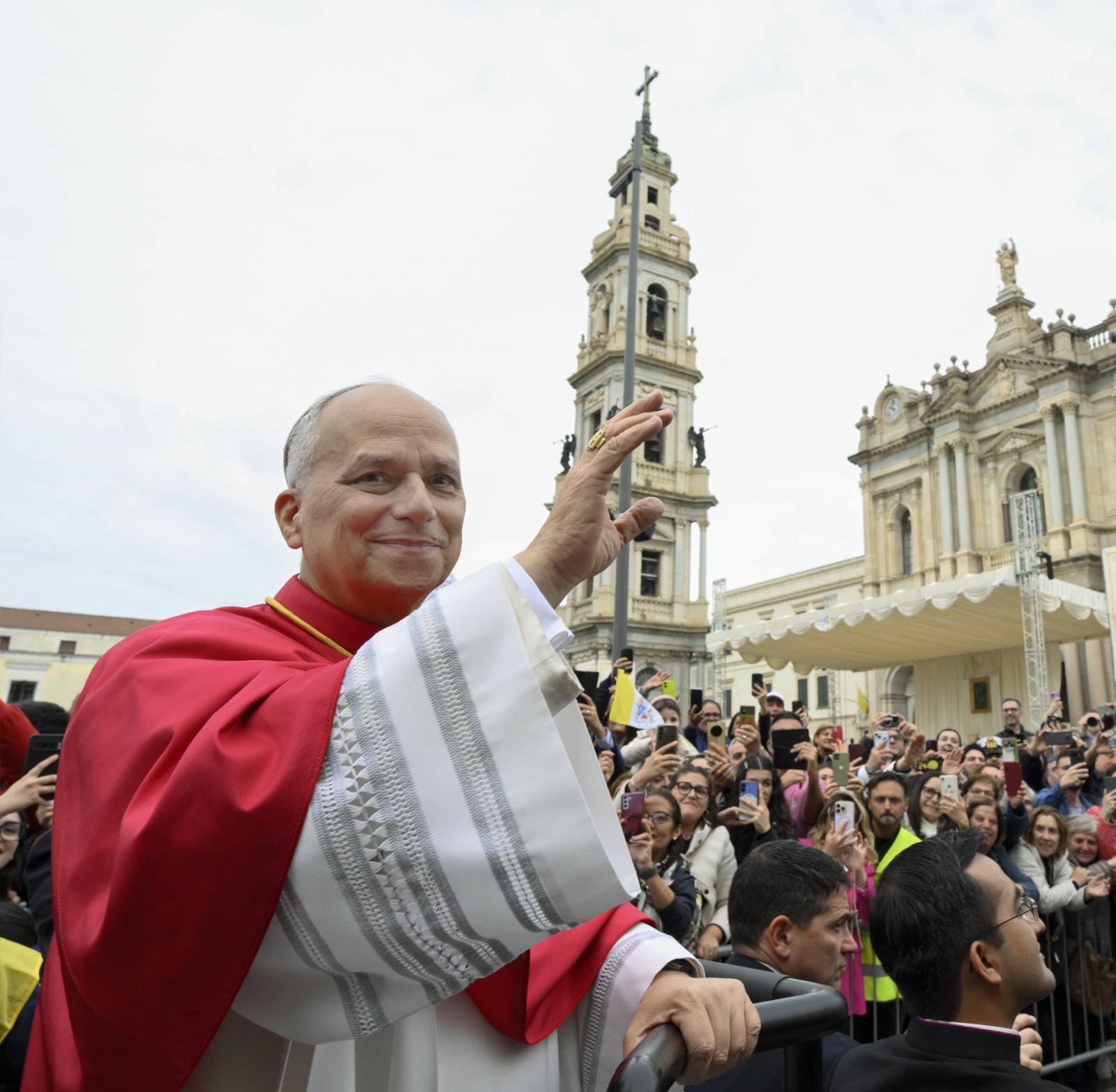
One of the most beautiful homilies of Pope Leo XIV’s pontificate to date was delivered May 8, 2026, the first anniversary of his election. Pope Leo marked the occasion by visiting the Shrine of Our Lady of the Rosary, also known as Our Lady of Pompeii, “to place my service under the protection of the Holy Virgin,” as he said in his homily.
For a pontificate that began last May by placing Christ so prominently at the center, a Marian shrine seemed to be a highly fitting place for Pope Leo to pause and reflect. And who better to reflect upon than Our Lady, Mother of God, Mother of Jesus, Mother of the Church?
Mary’s powerful and exemplary role at the Annunciation was the context for Pope Leo’s reflections at Mass that day. That Gospel scene, the backdrop for the Hail Mary, afforded an opportunity to reflect on this prayer so central to the everyday practice of the faith. Pope Leo’s reflections on the Hail Mary propose an opportunity for us to reflect upon it as a blueprint that allows the Incarnation to shape us and be renewed within each of us.
Observing that the angel’s greeting to Mary at the moment of the Incarnation beckons her to rejoice, the pope described how the light radiating from Mary’s womb illuminates the true meaning of history. The angel’s invitation remembered in each Hail Mary invites her to rejoice in this inward reality.
The Hail Mary’s message
“The Hail Mary is an invitation to joy: It tells Mary, and through her all of us, that upon the ruins of our humanity, tested by sin and therefore ever prone to oppression, abuse and war, the caress of God has come, the caress of mercy, which takes on a human face in Jesus,” he said.
In the context of today’s troubled world, an invitation to rejoice is the tonic we need. And if we consider the wondrous event that began in Mary’s womb, and blossoms anew in us each time we receive the Eucharist and spend time with the Lord in his real presence, we have deep, inward reasons to rejoice.
As Mary is “full of grace,” she consents willingly to God’s plan and brings forth Christ into the world. Our cooperation with God’s grace will enable us to allow it to bear fruit through our lives. The rosary is a vital component of Christian prayer because it helps us in this aim.
“This moment in history,” the pope proposed, “possesses a tenderness and a power that draw the heart and lift it to that contemplative height where the prayer of the holy rosary takes root.”
A historic echo of Mary
With its roots in salvation history, the pope encourages the rosary as an opportunity to allow the incarnation to become reality in our own lives.
“‘Hail Mary!’ The repetition of this prayer in the rosary is like an echo of Gabriel’s greeting, an echo that spans the centuries and guides the believer’s gaze to Jesus, seen through the eyes and heart of his Mother,” Pope Leo XIV said. “Jesus adored, contemplated, and assimilated in each of his mysteries, so that with St. Paul we may say: ‘It is no longer I who live, but Christ who lives in me'” (Gal 2:19).
Quoting St. Bartolo Longo, who built the shrine to which Pope Leo made pilgrimage that day, “The Eucharist is the living rosary, and all the mysteries are found in the Holy Sacrament in an active and vital form.”
“In the Eucharist, the mysteries of Christ’s life are all found, so to speak, concentrated in the memorial of his sacrifice and in his real presence,” Pope Leo said. “The rosary marks the rhythm of our life, continually bringing it back to Jesus and the Eucharist.”
In my Pauline religious family, our founder Blessed James Alberione encouraged a daily Eucharistic visit, and to include the rosary within that hour. It’s a fruitful practice, a means to allow the Incarnation to find new meaning in our lives. If that hasn’t been part of your prayer life, it seems now is a great time to start.
Michael R. Heinlein is author of “Glorifying Christ: The Life of Cardinal Francis E. George, O.M.I.” and a promised member of the Association of Pauline Cooperators.
