

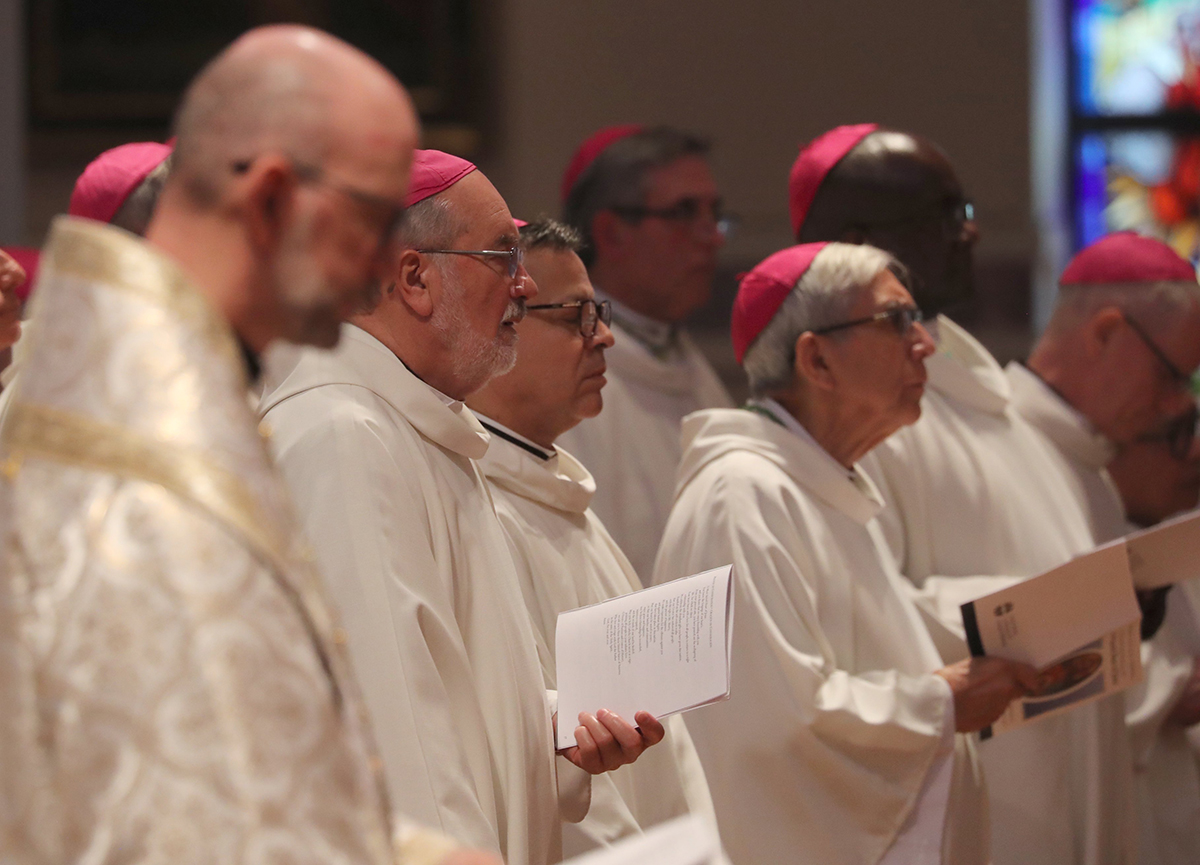
(OSV News) — At their spring assembly in Orlando, Florida, the U.S. bishops focused on strengthening the Church’s mission and addressing challenges while keeping the Sacred Heart of Jesus as the key to personal and public transformation in focus.
The June 10-12 assembly was animated in particular by its culminating event, the national consecration of the United States during a June 11 Mass at Orlando’s Basilica of the National Shrine of Mary, Queen of the Universe.
“To consecrate ourselves to the Sacred Heart is ultimately to accept Christ’s invitation to remain in his love and to allow that love to shape every aspect of our lives, public and private,” Archbishop William E. Lori of Baltimore, the homilist for the Mass, said. “It is a declaration that the future does not belong merely to political movements, economic forces, or human plans. The future belongs to God.”
The opening session of the U.S. bishops’ meeting June 10 had two addresses that reflected on the Church’s evangelizing mission and the Sacred Heart.
Proclaiming Christ’s truth ‘more confidently’
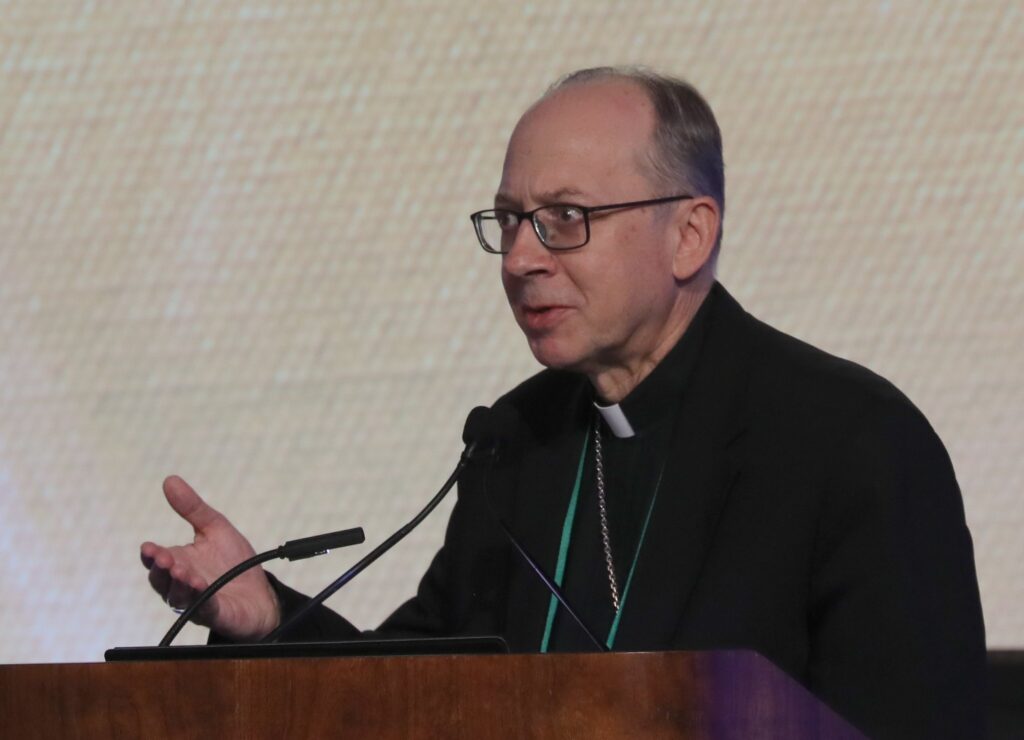
Archbishop Paul S. Coakley of Oklahoma City, in his first address to the bishops as USCCB president, spoke of how “the truth of Christ must be proclaimed all the more confidently” to restore hope that is under threat from wide-ranging attacks on human dignity and polarization “within our country, and even within our Church.”
In response, he called for preaching that “life is a gift from God,” the “cultivation of interpersonal relationships and conversations between those who may disagree,” and acting on the bishops’ mission directive “to reach out to the disaffiliated and the unaffiliated.” But above all, Archbishop Coakley reminded his brother bishops, “It is the love flowing from the Sacred Heart of Jesus that feeds our hope.”
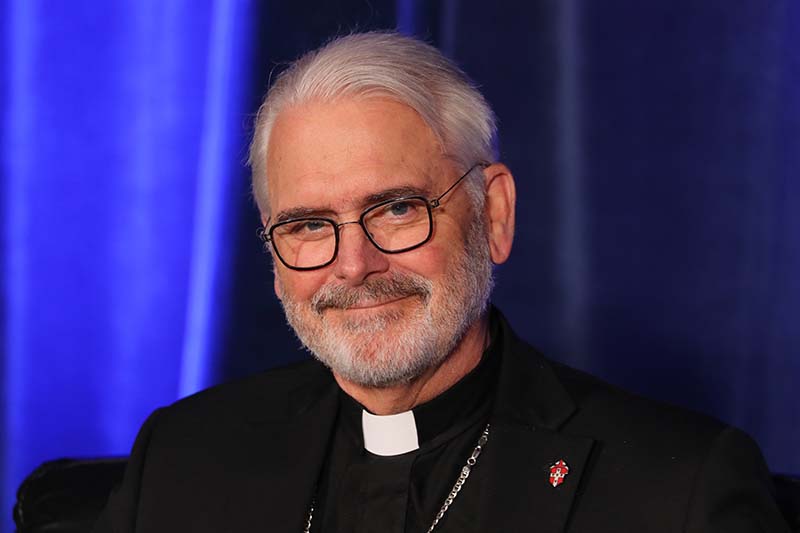
Archbishop Gabriele G. Caccia gave his inaugural address to the bishops as nuncio to the U.S. and also highlighted the consecration of the U.S. Church to the Sacred Heart of Jesus. He urged the bishops to fulfill their mission as missionary disciples by welcoming immigrants in their midst, and reminded the bishops his ministry is there to support them.
The start of the public session also included a message from the U.S. bishops to Pope Leo XIV thanking him for shining “the light of the Gospel and the tradition of the Church on the new opportunities and challenges posed by the rise” of artificial intelligence and “emerging technologies” through his new encyclical “Magnifica Humanitas.”
Other presentations that day also lifted up exemplars of the Church’s witness and opportunities to strengthen that witness.
Reawakening Catholic imagination in academic life
Mathematical biologist Santiago Schnell, provost of Dartmouth University, addressed the bishops on “Ex Corde Ecclesiae,” St. John Paul II’s 1990 apostolic constitution on Catholic universities, and invited them to explore how they can reawaken the Catholic imagination in academic life and nurture leaders who can become “voices for the Catholic Church.”
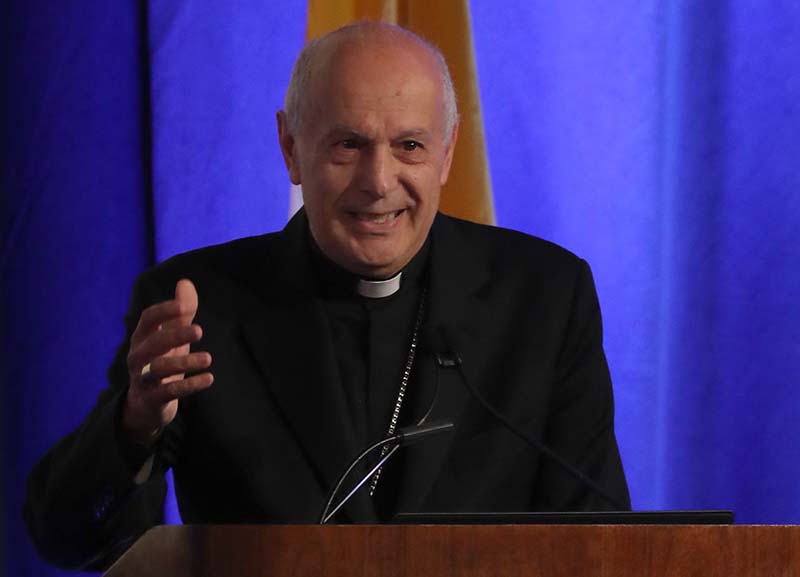
The bishops heard a report on World Youth Day 2027, which is to take place Aug. 3-8 in Seoul, with 10,000-15,000 pilgrims expected to travel to South Korea from the U.S. Seoul Auxiliary Bishop Paul Kyung Sang Lee, general coordinator for WYD 2027, shared with the bishops that the Catholic Church in Korea began with the laypeople, became strengthened by the blood of 10,000-plus martyrs, and served as a sanctuary for democracy and human rights.
The bishops also gave a unanimous consent June 10 to support the advancement of two American canonization causes: Duluth, Minnesota’s pioneer missionary priest Msgr. Joseph Buh, and upstate New York’s entrepreneur-turned-evangelist John Rick Miller.
Duluth Bishop Daniel J. Felton spoke of how Msgr. Buh is a model for how “missionary discipleship demands courage, sacrifice, perseverance and complete availability to God’s will.” Miami Archbishop Thomas G. Wenski spoke of Miller — who worked to re-evangelize Latin American countries and have them consecrated to the Sacred Heart — as having “lived the baptismal call to holiness in an exemplary way.”
Approval of 2 liturgical texts
On the second day of public sessions, the U.S. Catholic bishops approved portions of two texts with near unanimity: a new edition of the Lectionary for Mass, which provides the Scripture readings and psalm for each day’s liturgy; and the 2025 Roman Missal-Liturgy of the Hours Supplement.
The bishops also ultimately agreed to move ahead and approve updates to their landmark document on protection policies for minors. The revision commits the Church to “act on the presumption of the sincerity of those who bring forth a complaint of sexual abuse” while also maintaining “a corresponding presumption of innocence on the part of the accused until guilt is proven.”
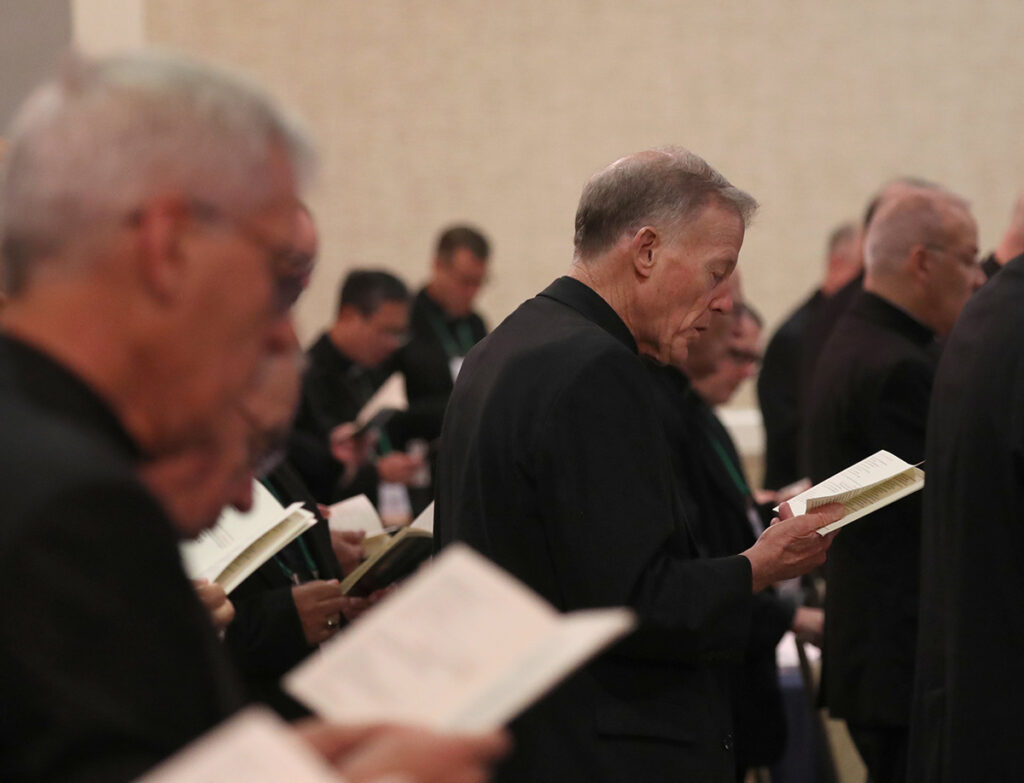
The bishops voted on the floor to add a further revision that would commit themselves to form future clergy in “trauma-informed” pastoral care.
Sara Larson, executive director of Awake, a community of abuse survivors, Catholic advocates and other allies, issued a statement following the vote commending the “important progress” the Catholic Church in the U.S. has made in two decades in protecting children, but emphasized it was important for the bishops to extend that protection to adults who “continue to experience devastating abuse in situations of vulnerability like confession, spiritual direction, pastoral support, religious life, and employment.”
The ‘ongoing work of reform and healing’
“Awake encourages Church leaders throughout the United States to continue building upon the progress already made by extending safeguarding efforts to adults, implementing trauma-informed practices, and engaging survivors as valued partners in the Church’s ongoing work of reform and healing,” she said.
While the scope of the charter’s revision did not address adults, and stayed within its mandate to focus exclusively on protecting minors, Deacon Bernie Nojadera, executive director of the USCCB’s Secretariat of Child and Youth Protection, told OSV News in an interview that they anticipate possible related developments in this area coming from the Vatican’s Pontifical Commission for the Protection of Minors.
“The U.S. Catholic Church stands ready once those documents do come forward,” he said.
But the revised charter saw animated debate — not so much around the proposed changes, but rather over the process of consultation. Following the June 10 presentation, Archbishop W. Shawn McKnight of Kansas City, Kansas, asked if it would be possible to suspend the vote on the revisions pending further consultation among presbyteral councils and diocesan review boards. He cited several factors and also argued further consultation was more in line with the synodal style of consultation envisioned for the Church.
Bishop Barry C. Knestout of Richmond, Virginia, chair of the USCCB’s Committee on the Protection of Children and Young People, acknowledged that the charter is “not a perfect document,” but he noted that consultation on the revision has been “occurring for about five years,” with “input received on multiple occasions from bishops.”
On June 11, ahead of the vote, Archbishop McKnight reiterated his call to postpone the vote, with Bishop Earl K. Fernandes of Columbus, Ohio, seconding the motion. But after balloting, the motion failed, and a two-thirds majority voted to approve the revised text.
Auxiliary Bishop Juan Miguel Betancourt of Hartford, Connecticut, then spoke on behalf of a USCCB task force on the ongoing implementation of synodality in the life of the Church. He provided the bishops June 11 with an update on recent consultations among the bishops, but also invited them to hear directly from Pope Leo himself.
Video of Pope Leo XIV addressing synodality
The bishop played a video of the pope addressing some of the U.S. concerns about synodality at a Jubilee 2025 gathering, where Pope Leo emphasized the importance of a patient and proper formation “on every level” about what it means to be a “Church which is synodal.” But Pope Leo also affirmed the Church in the U.S. already has many existing structures that “have great potential for being synodal” and encouraged them “to find ways of continuing to transform them into more inclusive kinds of experiences” for the laity, the clergy, and women and men religious, in order that all might feel “a co-responsible sense of belonging, and of leadership and accountability in the life of the Church.”
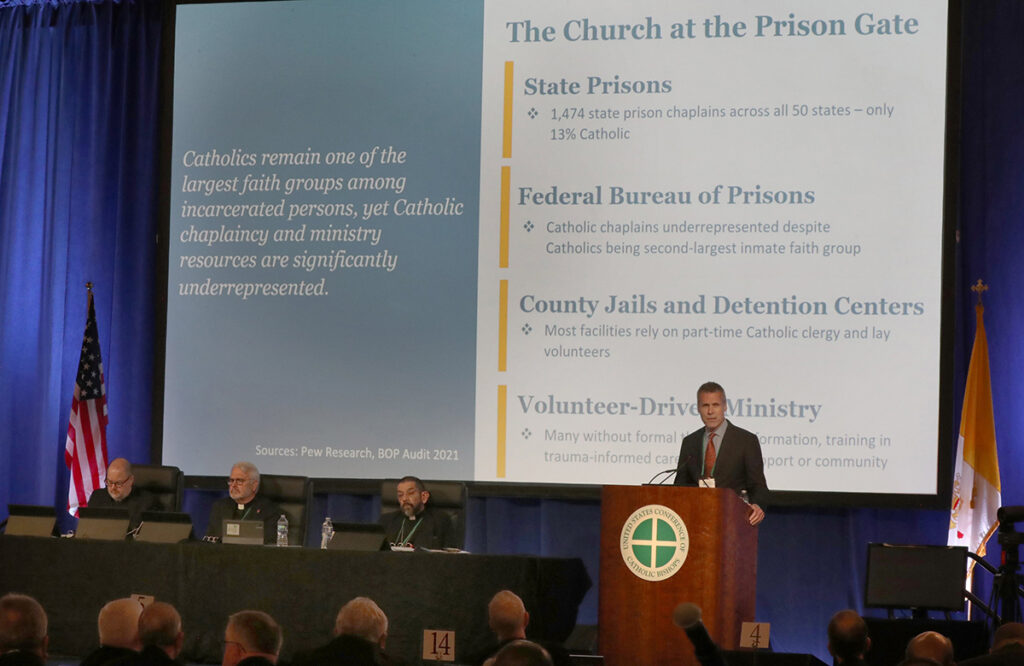
The bishops also heard a presentation on the Catholic Prison Ministry Coalition, where Bishop William A. Wack of the Diocese of Pensacola-Tallahassee, Florida, gave his own personal testimony of serving in prison ministry, and how a prisoner’s letter convinced him to “go regularly.”
“I invite you to visit, too. You know how important it is for the prisoners to have a visit from a priest, deacon, religious, but especially a bishop?” he said. “Like that prisoner wrote to me, the bishop is their shepherd. They are part of your flock.”
Preparations for 500th anniversary of Guadalupe apparitions
Bishop Oscar Cantú of San Jose, California, chairman of the bishops’ Subcommittee on Hispanic/Latino Affairs, addressed his fellow bishops June 11 about preparations for the 500th anniversary of Our Lady of Guadalupe’s appearance to St. Juan Diego Cuauhtlatoatzin in five years, and dioceses’ participation in the Intercontinental Guadalupan Novena.
Before the bishops headed out to consecrate the U.S. to the Sacred Heart, they heard reflections on the Sacred Heart of Jesus from three of their brother bishops.
The final day of the conference, June 12, was spent in executive session. The remaining bishops then returned home to their own dioceses to carry out the consecration to the Sacred Heart of Jesus from their own cathedrals.
Peter Jesserer Smith is the national news editor for OSV News. Contributing to this report were Julie Asher, Gina Christian, Michael Heinlein, Jean Gonzalez and Tony Gutiérrez.
