


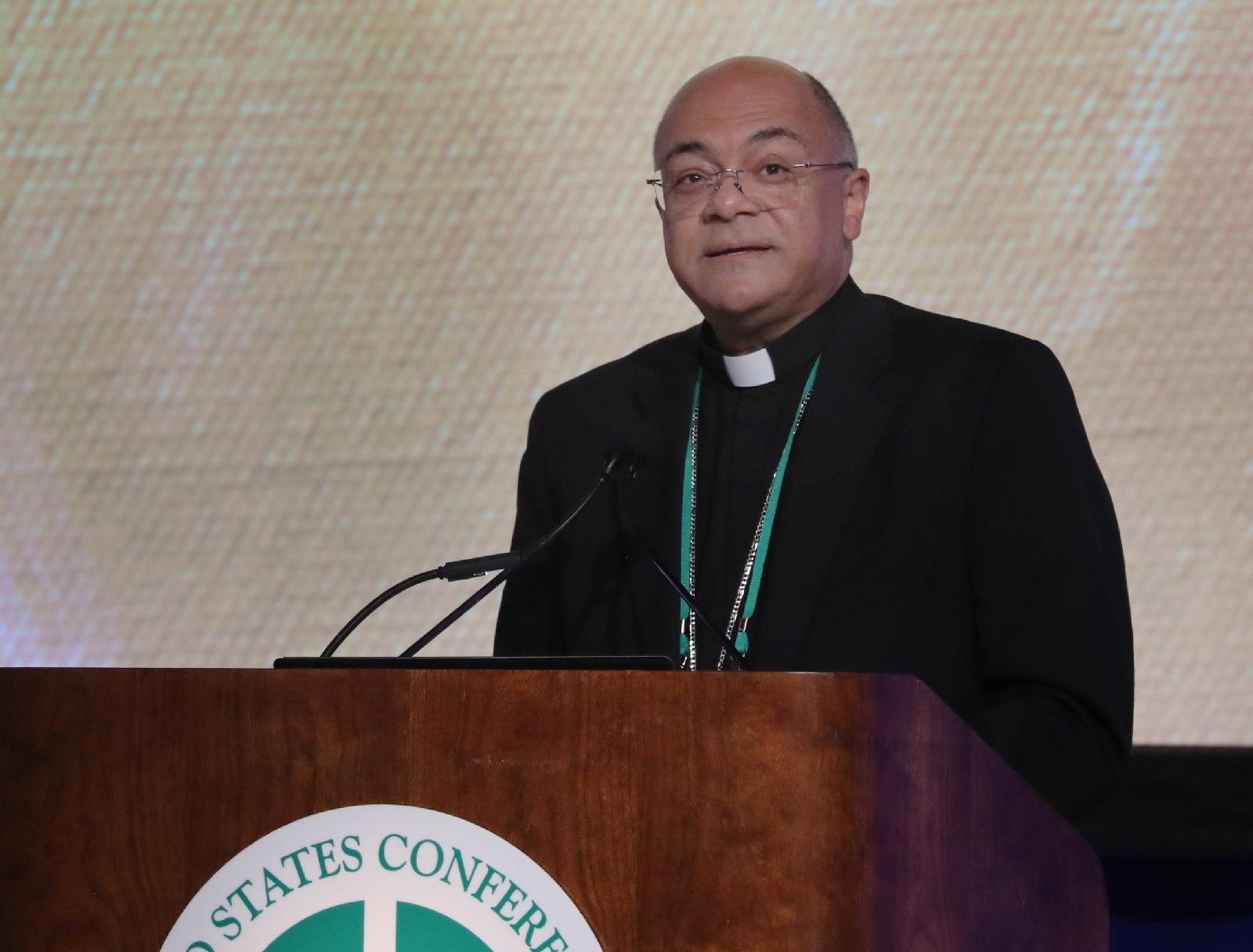
On June 11, the United States bishops undertook the long-anticipated consecration of the nation to the Sacred Heart of Jesus. Ahead of the Mass at which the consecration took place, three American archbishops offered to their brothers reflections on the Sacred Heart of Jesus.
The presentation by Louisville’s Archbishop Shelton J. Fabre, on how the Sacred Heart of Jesus builds communities, was a tour de force of what living with the love of the Sacred Heart should look like in the Church, for the good of society.
Modeling Christ’s love
Archbishop Fabre offered a stirring examen for his brother bishops, building upon Christ’s heartfelt plea to the Apostles on the night before he offered his life in love: “I give you a new commandment: love one another. As I have loved you, you also should love one another. This is how all will know that you are my disciples, if you have love for one another” (Jn 13:34–35).
Challenging his brothers to take these words to heart, Archbishop Fabre stressed the need for unity within their ranks, observing how “before the Apostles would preach, govern, sanctify, and hand on the life of the Church, they first had to learn to love one another as brothers.”
Urging further reflection on Christ’s commandment of love, Archbishop Fabre asked his brother bishops to confront the sometimes obvious, sometimes subtle divisions that can creep into their ranks. Why? Because, as he said, if bishops are to ask their priests and flock “to build communities rooted in charity, encounter, patience, and mutual love” then it is incumbent upon them to be exemplary models “regardless from which directions the political, partisan, or civic winds may blow.” He warned that the danger of not doing so risks making their communion “reduced to a temporal ideological model” rather than “the spirituality of communion and mission we visibly live and foster as genuine fraternity.”
“If we desire our parochial communities to become authentic parishes animated by communion, missionary discipleship, trust, and mutual charity, we must first model that Communion,” Archbishop Fabre urged. As he rightly pointed out, those entrusted to the bishops’ care “should always be able to look to us and discernibly see living icons of what it means to follow Jesus Christ.”
These words struck me as most timely and necessary. We live in a society plagued with deep divisions and polarizing ideologies, and the Church is not immune from mirroring these tendencies. Any divisions that exist among the bishops, which Archbishop Fabre articulated so well, “deeply harms the Church’s witness and calls us to feel the gravity of our unity’s fragility.”
Bishops, he argued to his brothers, are called to “ensure that our words and choices make visible our life-giving incorporation into Jesus Christ, a lived participation in Christ that binds us to each other with an unfeigned love.”
Unity in a polarized world
In warning against the temptations to categorize people, which our polarized and fractured world so often encourages, Archbishop Fabre stressed encountering others in the manner of the Sacred Heart of Jesus. “If we are to always be continually striving to love one another authentically as brothers, we must resist the temptation to reduce one another to labels or conventions.”
To a conference that has had its share of embroilments, Archbishop Fabre observes: “The people entrusted to our care do not simply need efficient leadership or compelling strategies. They long to encounter the Sacred Heart of Jesus in us, their shepherds.”
And to a conference at times divided over prudential matters, Archbishop Fabre encourages: “The Christian faithful seek to see bishops who continually and genuinely love one another, speak of one another with reverence, bear one another’s burdens patiently, and remain united even amid difficulty. Such a witness is an exemplar of the evangelical beatitudes and possesses a formidable evangelical power.”
Simply put, in order for the recent consecration of the U.S. to the Sacred Heart of Jesus to bear fruit, our hearts must be transformed — and Archbishop Fabre’s impassioned appeal got to the heart of the matter. The archbishop laid out a vision for the U.S. episcopacy that can equip them to be shepherds with the heart of Christ.
The challenge he posed to his brother bishops was simple: To love as Christ loves, and to model this love for the world.
Michael R. Heinlein is author of “Glorifying Christ: The Life of Cardinal Francis E. George, O.M.I.” and a promised member of the Association of Pauline Cooperators.
