

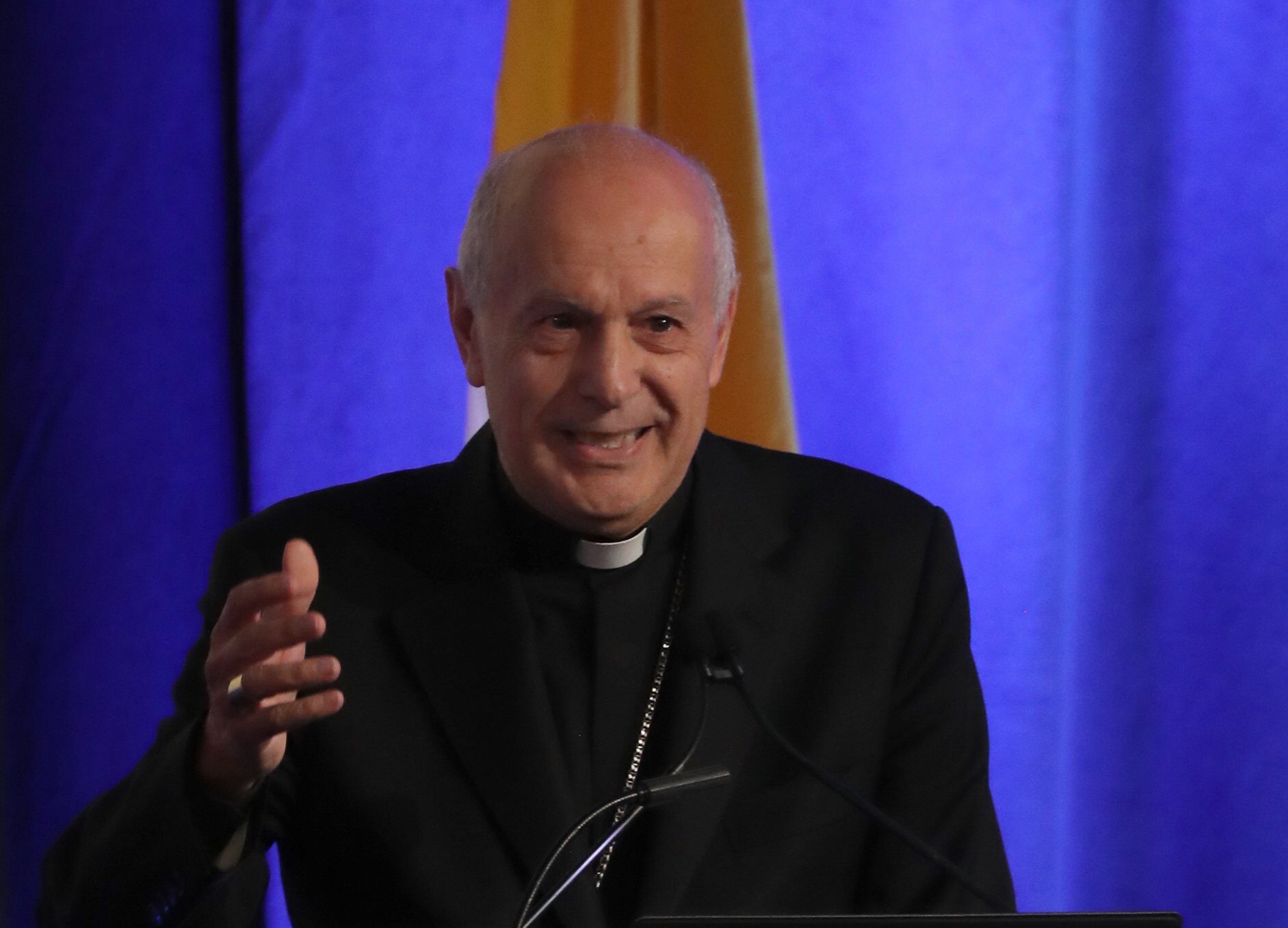
ORLANDO, Fla. (OSV News) — The new apostolic nuncio to the United States told the U.S. bishops June 10 their “generosity and collaboration” will assist him in carrying out his new mission “at the service of communion and peace.”
Those words were offered by Archbishop Gabriele G. Caccia June 10 in his inaugural address as the new nuncio to the U.S. bishops at their spring plenary at the Omni Resort at ChampionsGate near Orlando.
He gave thanks to his “brother bishops” for their fraternal welcome and turned to the new president of the U.S. Conference of Catholic Bishops — Archbishop Paul S. Coakley of Oklahoma City — and said “so we begin together.”
The two prelates both addressed the assembly for the first time in their current positions; the nuncio was named in March, after having previously served as the Holy See’s permanent observer to the United Nations, and the new USCCB president was elected last November.and the new USCCB president was elected last November.
Consecration of U.S. to Sacred Heart
In his address, Archbishop Caccia highlighted the consecration of the U.S. Church to the Sacred Heart of Jesus, urged the bishops to fulfill their mission as missionary disciples by welcoming immigrants in their midst, and reminded his brother bishops he is there for them, especially in moments when their responsibilities as episcopal shepherds leads them to feel isolated.
“My service here is one of listening, trust, and shared discernment within the Church that we are all serving together,” Archbishop Caccia said.
Grateful for the U.S. bishop’s fraternal welcome, the archbishop remarked how “beautiful is the image of unity of brother bishops gathered,” sharing the same sprit and fulfilling the same mission. He added if he were to encapsulate his feelings in a few words, it would be “great esteem for the Church in America,” which he said has “given so much to the universal church, even giving us our pope.”
But he added that esteem does mean “wounds that remain in the life of the Church” should be ignored.
Leo’s election ‘a gift of the Holy Spirit’
“I see the election of Pope Leo as a gift of the Holy Spirit, encouraging the Church in this country, on one hand to foster what is best in her tradition and on the other to continue facing with determination those wounds in her recent history that have caused much suffering especially through the cases of abuse,” he told the U.S. bishops.
“As the (Second Vatican) Council reminds us, the Church is at once holy and always in need of being purified. Let us pray and work together for her renewal, so that her witness may be credible, her communities safe and her mission ever more faithful to the Gospel.”
Leaders of the Church are called to witness to one another the “peace of the risen Christ,” borrowing the words of Pope Leo XIV, as a peace that is “unarmed and disarming, humble and persevering,” and a peace of God’s unconditional love.
As “builders of peace,” Archbishop Caccia said the formal consecration of the U.S. Church to the Sacred Heart of Jesus, which will occur at the Basilica of the National Shrine of Mary, Queen of the Universe June 11, would serve as a “spiritual center” of the assembly.
‘Life can fund unity again’ in ‘healed heart’
“When the heart is lost, the person becomes fragmented. When the heart is healed, life can find unity again,” the archbishop said. “From the heart of Christ, the Church learns the truth of the human heart: its dignity, its wounds, its desire for God, and its need for communion.”
Archbishop Caccia said the U.S. Church certainly understands the missionary spirit, as its young history benefited from the missionaries who arrived on U.S. shores from other lands.
But he said the Church sends missionaries and awakens missionary disciples not just to go to foreign lands, but to welcome immigrants seeking hope in the United States. He said bishops should meet immigrants “with the charity of Christ, to recognize their dignity, and to help them find a place in the life of the community is also part of a missionary Church.”
Before his closing remarks, the archbishop gifted each U.S. bishop a pocket-sized booklet containing the two dogmatic constitutions of the Second Vatican Council: “Lumen Gentium,” on (on the Church) and “Dei Verbum” (on Divine Revelation). He said the constitutions “remind us who the Church is, and how the Church listens to the Word of God.”
“They bring us back to the sources of our communion and mission,” he told the bishops. “This continuity is important. We are not beginning again from zero. We receive a living tradition; and above all, we receive the love of Christ, poured out from his heart for the life of the world.”
Jean Gonzalez, editor with Florida Catholic Media, is helping cover the bishops’ spring plenary for OSV News.
Updated on June 10, 2026, at 5:16 p.m. ET
