

Before the Declaration of Independence was boldly signed in 1776, before pilgrims feasted at what became popularly regarded as the “First Thanksgiving” in 1621, there was St. Augustine, Florida.
The coastal Florida city was founded in 1565 by Spanish Catholic explorer Pedro Menéndez de Avilés, is celebrated as the longest continually inhabited European-founded city in the U.S., and is home to the United States’ oldest continuously operating parish, the Cathedral Basilica of St. Augustine.
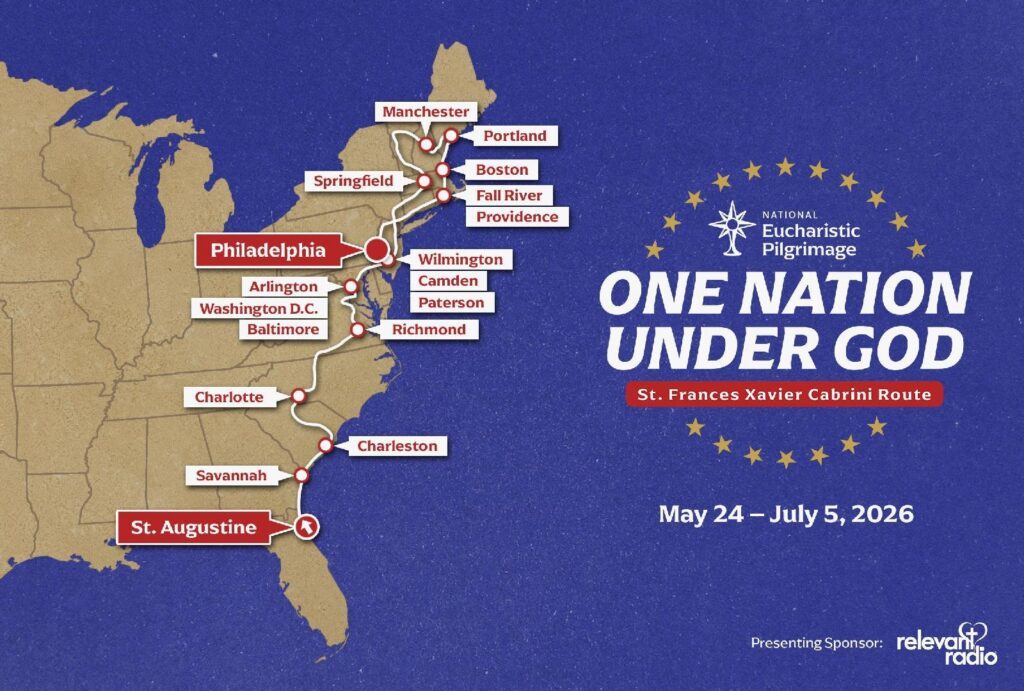
It is also the May 24 starting point for the 2026 National Eucharistic Pilgrimage, themed “One Nation Under God” in honor of America’s 250th year.
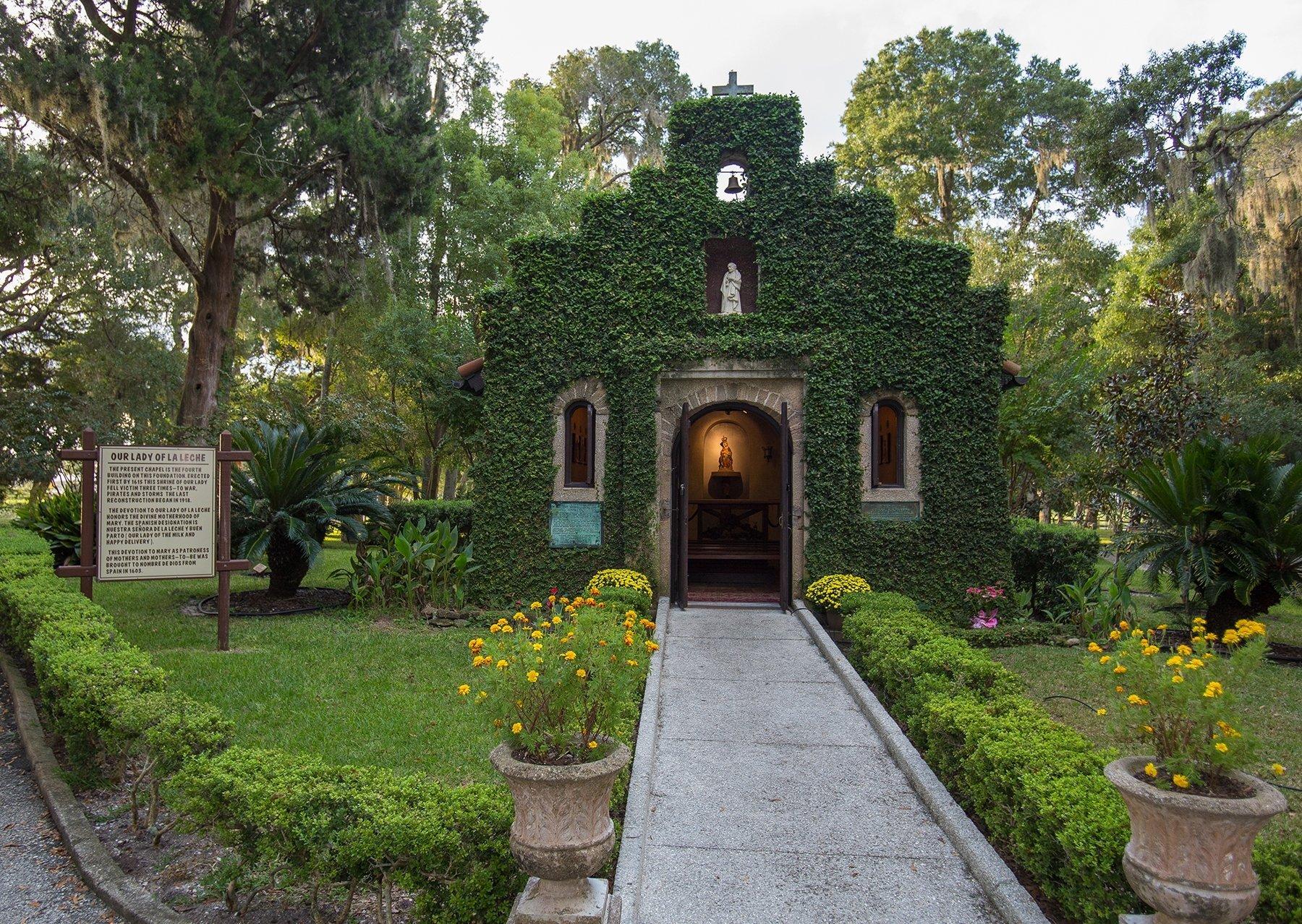
The pilgrimage begins on the historic grounds of America’s oldest Marian shrine: the National Shrine of Our Lady of La Leche at Mission Nombre de Dios, which Bishop Erik T. Pohlmeier of St. Augustine has described as “the oldest site of continuous Catholic presence in the United States.”
With its founding, St. Augustine became the site of an early Mass in what is now the United States, celebrated in 1565 to commemorate the landing of a Spanish explorer, his crew and Catholic clergy.
“As we focus this year on the Declaration of Independence and the 250th anniversary of that, St. Augustine helps us begin not with politics, but with worship,” said Jason Shanks, National Eucharistic Congress president. “And I think that’s critically important.”
Oldest US Marian shrine
Both the shrine and the mission, its caretakers say, “stand as living witnesses” not just to the founding of St. Augustine, but also to the practice of the Mass in the United States. The site roots its history in the landing of Spanish Admiral Pedro Menéndez de Avilés. In 1565, his crew sighted land on Aug. 28, the feast of St. Augustine, and Menéndez came ashore Sept. 8. The admiral claimed the land for Spain, “establishing the settlement that would become the first permanent European settlement in what is now the continental United States,” according to the shrine’s website.
Soon after landfall, the expedition’s chaplain, Father Francisco López de Mendoza Grajales, celebrated a Mass of thanksgiving.
The shrine and mission grounds, known as “The Sacred Acre,” still yield discoveries, said the shrine’s rector, Father Timothy Lindenfelser.
“We’re constantly doing archaeological excavations. Most recently, we found the foundations of the Franciscan church that was on the property. That was found with burials of Indigenous people around it, and then the kitchen that was connected to it,” he said. “Every time we do a renovation or do archaeological digs, we’re always finding new things.”
Continued Catholic presence
The mission and shrine’s website describes Father Francisco’s Mass as the “first Catholic Mass of Thanksgiving in what is now the United States, establishing the first parish and planting the roots of the Catholic faith in the New World.”
However, “we do not claim to be the first Catholic Mass in what is today the United States,” said Father Lindenfelser. “The first that’s documented would have been in Pensacola in 1559. The Spanish established a settlement there, so we know there were priests and Mass was celebrated. But the settlement didn’t last.”
Kathleen Bagg, the Diocese of St. Augustine’s communications director, elaborated, telling OSV News, “What makes St. Augustine historically significant is that the Sept. 8, 1565, Mass of Thanksgiving was connected to the founding of the first permanent European settlement in what is now the continental United States, and to a Catholic community whose presence has continued into the present day.”
“The phrase ‘first Catholic Mass of Thanksgiving in what is now the United States’ is intended as a historical distinction connected to the founding of St. Augustine, rather than a claim that no earlier Masses had ever been celebrated elsewhere in territories that later became part of the United States,” she said.
Determining first Mass in future US ‘tricky’
If the wording seems intentionally careful, it is because there is some historical wrestling over the location of the first Mass celebrated in what would become the United States of America.
“There are a whole series of Spanish expeditions into Florida and elsewhere in the Southeast, long before Pensacola was established in 1559,” said J. Michael Francis, a history professor and chair of Florida studies at the University of South Florida.
He noted expeditions led by Juan Ponce de León — the first of which made landfall in 1513, probably south of Cape Canaveral — as well as subsequent expeditions, and the settlement of San Miguel de Guadalupe.
“It hasn’t been located archaeologically,” Francis told OSV News, “but it was likely somewhere in present-day South Carolina in 1526. That settlement lasted for less than one year — but assuredly there were many Masses said at San Miguel. Then you have the 1539 Hernando de Soto expedition, and there were likely dozens — if not hundreds — of Masses said between 1539 and 1543 during the course of that expedition.
“So,” he emphasized, “this is where it gets really tricky.”
Accounts vary
The 1565 Mass at St. Augustine, held on the feast of the Nativity of Mary, “is often attributed to an account written by the priest” — Father Francisco López de Mendoza Grajales — “who allegedly said that Mass. But he never says that in his account. What he says is that on Sept. 8, 1565 — when Menéndez, the founder of St. Augustine, comes ashore — they greet him singing the ‘Te Deum laudamus,'” a hymn of rejoicing.
Father López, Francis continued, “said Menéndez — and all of the others with him — approached him on their knees, and they kissed the cross. … But he never specifically says, ‘I said Mass.’ He says there were ‘other ceremonies.’ There’s another account — that has been attributed to Pedro Menéndez de Avilés’ brother-in-law — in which he says that on that day, Menéndez ordered that a solemn Mass be said.
“So what often happens with these kind of stories is that different sources get conflated,” Francis stressed.
‘A great place of evangelization’
Bagg pointed out what she described as another “important historical nuance.”
“While St. Augustine remained continuously inhabited as a city, Catholic parish life was interrupted during the British period (1763–1784), when Spanish clergy departed and public Catholic worship ceased until the arrival of the Minorcans and Father Pedro Camps in 1777,” she told OSV News. “Even with that interruption in sacramental life, the broader Catholic presence associated with the founding of St. Augustine and Mission Nombre de Dios remains foundational in American Catholic history.”
Ultimately, the St. Augustine site remains a place of witness. When the tourist trolleys stop at the National Shrine of Our Lady of La Leche at Mission Nombre de Dios, Father Lindenfelser says visitors often find themselves deeply affected.
“Many people have come back to the faith,” he said. “Some people have for the very first time heard the message of the Gospel, just because they were sitting there — and one of the chaplains or one of the staff, we come up and talk to them,” Father Lindenfelser said.
“So, it’s still today a great place of evangelization,” he added, “by just being present to those who come.”
Kimberley Heatherington is a correspondent for OSV News. She writes from Virginia.
