

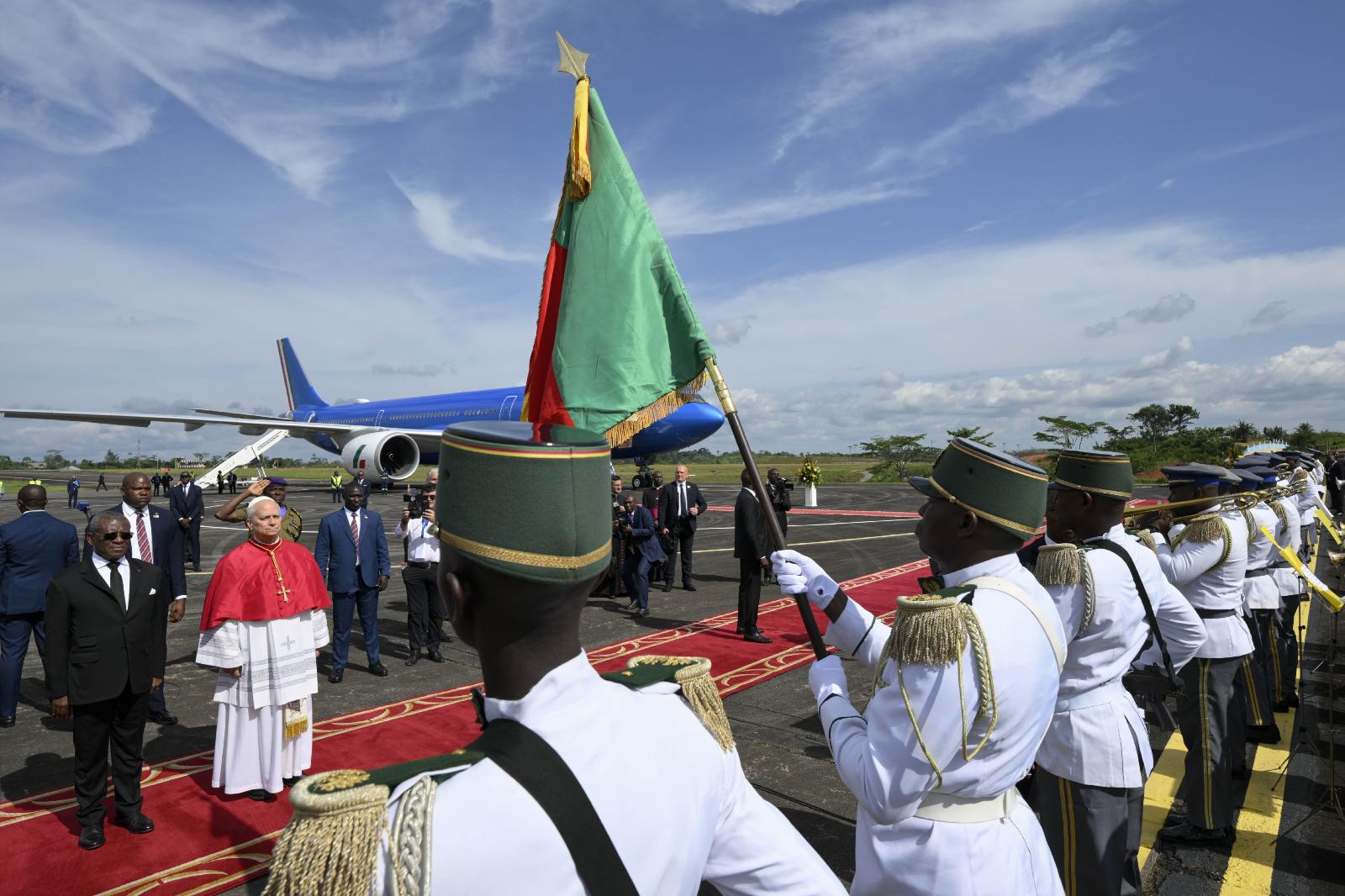
YAOUNDÉ, Cameroon (OSV News) — Pope Leo XIV arrived in Cameroon on April 15, delivering a forceful appeal for peace to a nation scarred by years of separatist violence, telling the country’s leaders that “there is such a hunger and thirst for justice” as thousands lined the streets of the capital to welcome him.
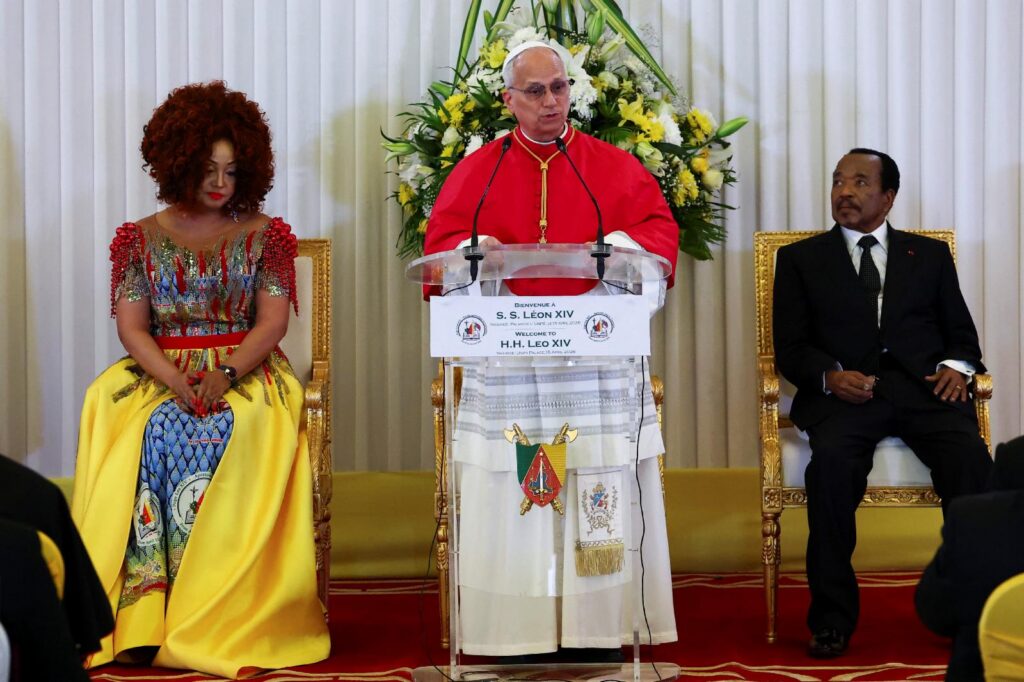
Speaking to civil authorities at the Presidential Palace in Yaoundé, the pope said he came “as a shepherd and as a servant of dialogue, fraternity and peace,” acknowledging the “profound suffering” caused by fighting that has gripped the country’s English-speaking northwest and southwest regions since 2017.
“Lives have been lost, families displaced, children deprived of schooling and young people no longer see a future,” the pope said, as President Paul Biya, the 93-year-old authoritarian who has ruled Cameroon for more than four decades, sat beside him.
“Behind the numbers are the faces, stories and shattered hopes of real people,” Pope Leo said.
The visit comes amid a conflict between Anglophone separatist militias and government forces that has killed more than 6,500 people and displaced more than 500,000 since armed hostilities began in 2017.
According to the United Nations, about 1.8 million of the Anglophone regions’ 4 million residents require humanitarian assistance, while approximately 250,000 children have been affected by school closures.
Just days before the papal visit, the separatist alliance in Cameroon’s English-speaking regions declared a three-day ceasefire, saying it would observe a “safe travel passage” to allow civilians and visitors to move freely during the pope’s stay.
Peace is ‘everyone’s responsibility, beginning with civil authorities’
The pope and Biya held a private one-on-one meeting before the public address. Prior to the visit, a prominent Cameroonian Jesuit priest, Father Ludovic Lado, had publicly urged the pope not to come, warning the visit could be seen as an endorsement of a government he said had engaged in “massive fraud” to extend Biya’s rule following a disputed October 2025 presidential election. Father Lado said dozens of civilians were killed in post-election violence.
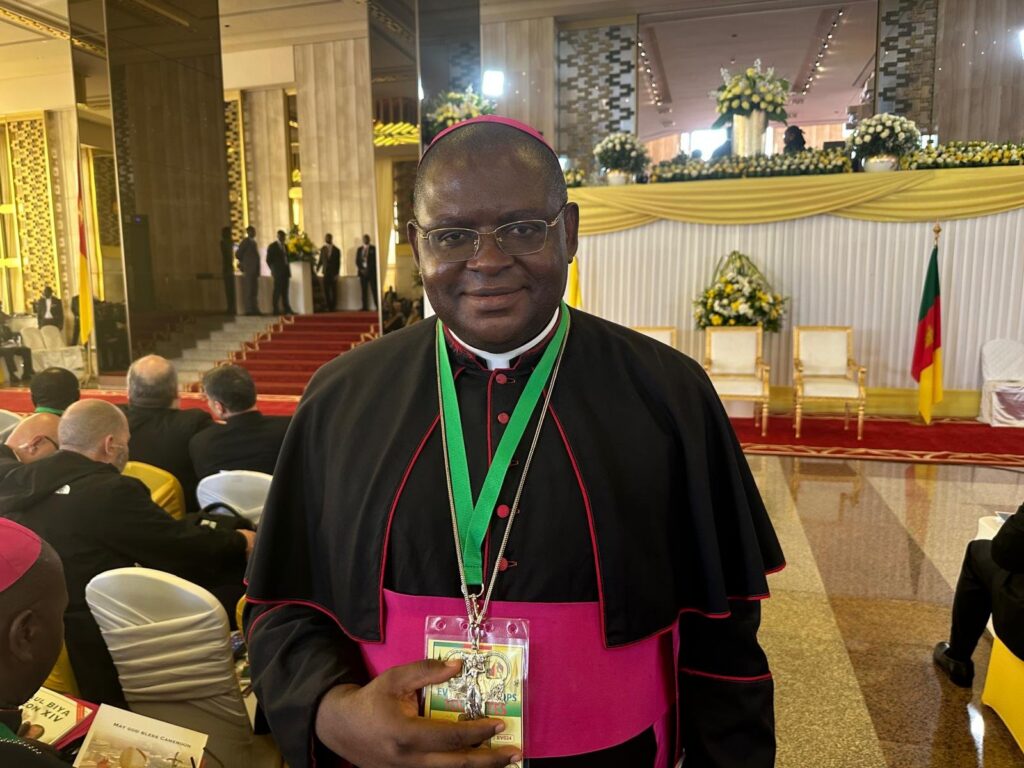
Speaking with OSV News in the Presidential Palace, Bishop Michael Miabesue Bibi of Buea, one of the regions affected by the separatist conflict, explained that there has been “a lot of controversy” in Cameroon after the election.
The bishop emphasized that he has no doubt that Pope Leo was well informed ahead of the trip about the reality of the political situation within Cameroon. In response to the controversy over the pope meeting with Biya, the bishop said, “I think that there is no human being that is too bad that the Holy Father cannot visit,” adding that he hopes that the Holy Father’s visit will be “a moment of conversion” for the country.
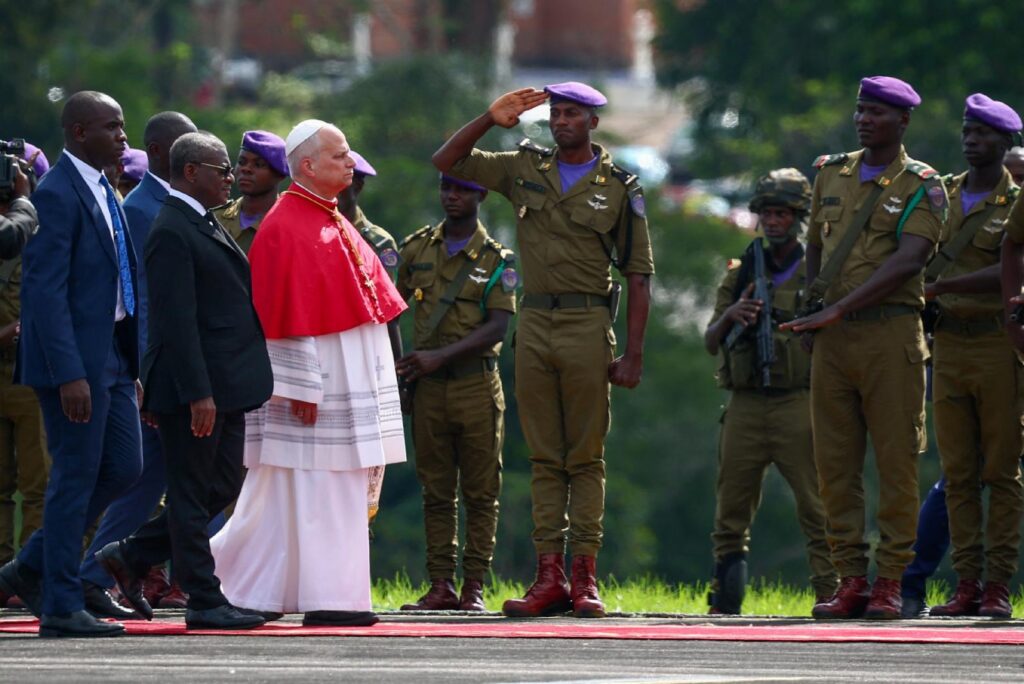
In his speech, Pope Leo underlined to Cameroon’s politicians that peace “is everyone’s responsibility, beginning with civil authorities,” and that “the management of public resources and respect for the rule of law are essential to restoring trust.”
He invoked St. Augustine, quoting “The City of God,” which says those who govern should “rule not from a love of power, but from a sense of the duty they owe to others.”
Cameroon faces multiple simultaneous crises. Beyond the Anglophone conflict, Boko Haram militants carry out attacks in the far north from across the Nigerian border. The country also remains politically tense following the contested election that kept Biya, the world’s oldest sitting head of state, in power.
Biya addressed those gathered in the Presidential Palace before the pope’s speech, the elderly president speaking with a frail, raspy voice. Biya has been in power for so long that he was serving as head of state in 1985 when Pope John Paul II visited Cameroon for the first time.
Pope Leo arrived in the Cameroonian capital of Yaoundé after a five-hour flight from Algiers, Algeria, the first stop on a tour of four African nations that will also include Angola and Equatorial Guinea.
Local Catholics leaders express hope
Cameroon has the nickname of “Africa in miniature” for its geographic and cultural diversity. The country is home to more than 8 million Catholics and more than 200 languages in addition to its two official ones, French and English.
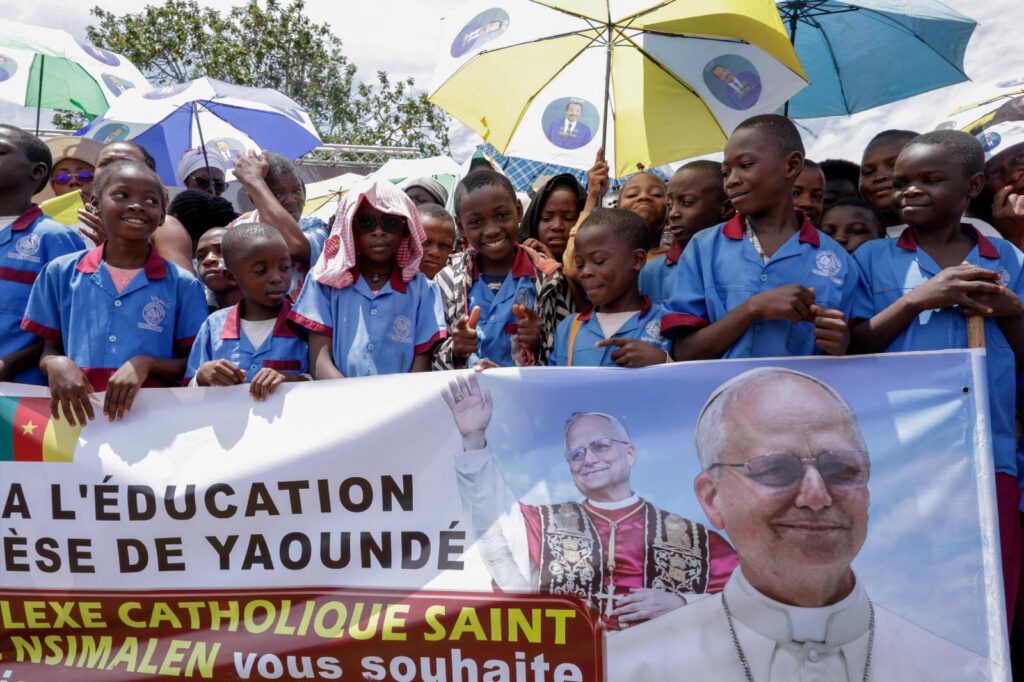
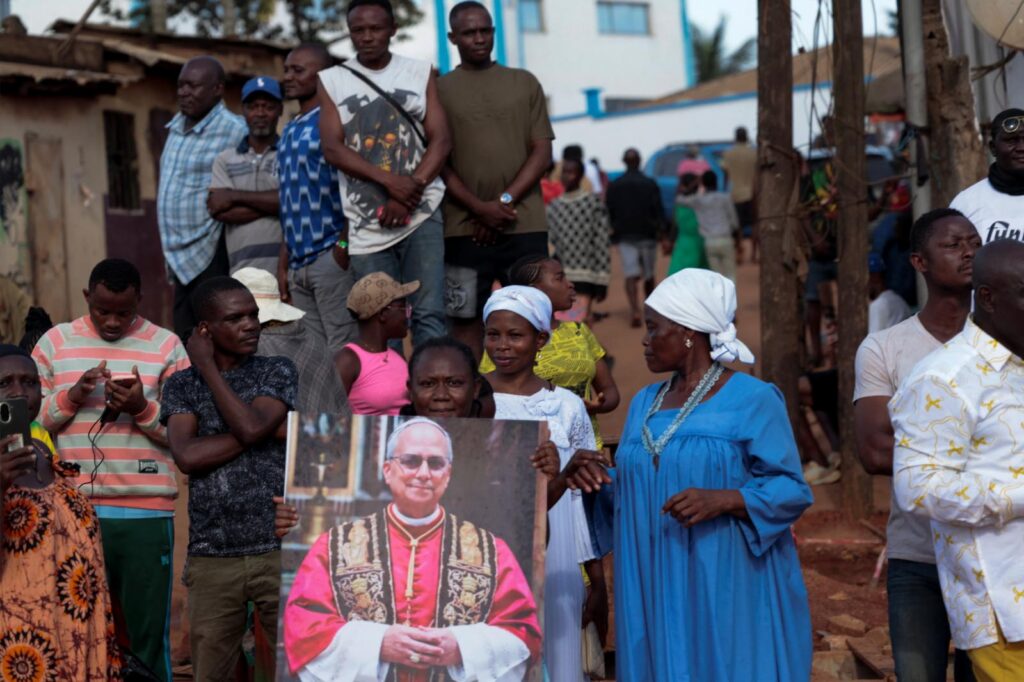
Crowds lined the streets for miles as the papal motorcade passed, with schoolchildren waving Vatican flags and women wearing dresses made from colorful custom fabric printed with the pope’s image.
Local Catholic leaders expressed hope that the visit could be transformative.
Archbishop Andrew Nkea of Bamenda, president of the country’s bishops’ conference, told OSV News ahead of the visit that he believes the pope’s presence could bring about “tangible miracles” for peace.
He noted that diaspora communities, politicians and even separatist fighters had voiced a shared desire for the pope’s message, saying in a unified voice: “Welcome Holy Father. Help us to arrive at peace.”
“This is already a big miracle,” the archbishop said.
On Thursday, April 16, the pope is scheduled to travel to Bamenda — the epicenter of the separatist conflict — where he will preside over a peace meeting at St. Joseph’s Cathedral and celebrate an open-air Mass at Bamenda International Airport.
Five months ago, Bishop John Berinyuy Tatah, an auxiliary bishop of Bamenda, was among those kidnapped by separatists in the region, held for two weeks before being released. At the time, Berinyuy Tatah was a priest; Pope Leo XIV named him a bishop in February.
Later in his four-day visit, the pope will travel to Douala, Cameroon’s largest city, for a stadium Mass expected to draw massive crowds, before returning to Yaoundé to meet with students and faculty at the Catholic University of Central Africa. He departs for Angola on April 18.
Father Gabriel Abega Owona, a Cameroonian priest from the Diocese of Sangmélima, told OSV News on the day of the pope’s arrival, “For me, the pope’s presence in Cameroon is not just a diplomatic event, but a caress from the Successor of Peter to a land that suffers and hopes.”
“His visit tells Cameroonians: ‘You are not forgotten.’ It is a call to national reconciliation and a reminder to political leaders of responsibility and justice,” he said.
Courtney Mares is Vatican editor for OSV News. Follow her on X @catholicourtney.
