


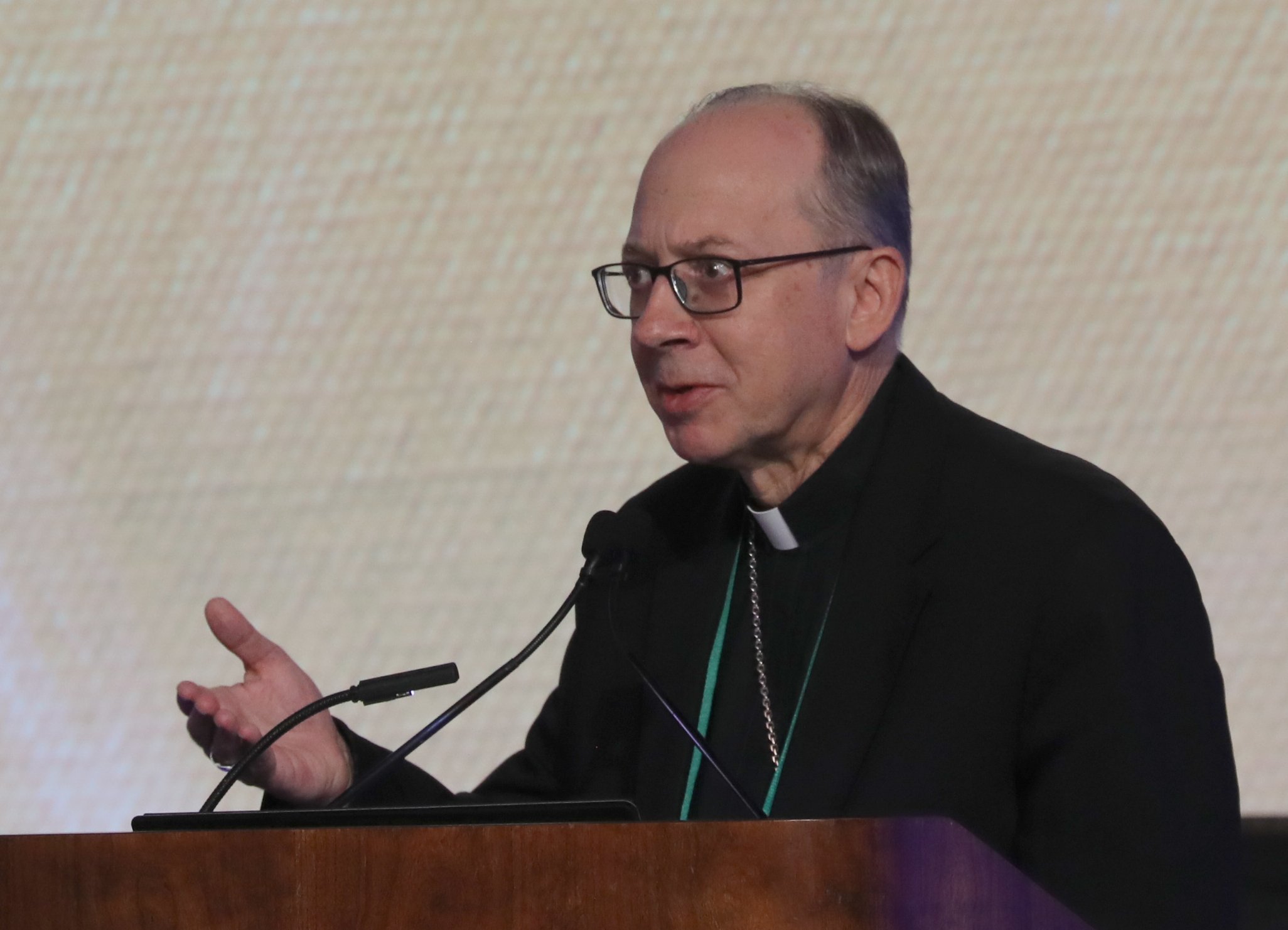
ORLANDO, Fla. (OSV News) — The U.S. Catholic bishops approved several updates to their landmark document on protection policies for children and minors, seeking to define key terms while balancing care for victim-survivors with accused clergy’s right to a presumption of innocence until proven otherwise.
The revisions, preliminarily introduced June 10 during the U.S. Conference of Catholic Bishops’ spring plenary assembly in Orlando, passed by a two-thirds vote June 11 after a period of debate.
The changes will keep the “Charter for the Protection of Children and Young People” focused “exclusively” on clergy abuse of minors, with a new document being developed to address abuse involving vulnerable adults, said Bishop Barry C. Knestout of Richmond, Virginia, chairman of the USCCB’s Committee on the Protection of Children and Young People, in his introductory remarks June 10.
Presentation on recommendations
Joining Bishop Knestout on the dais during the presentation that day were Archbishop Ronald A. Hicks of New York, chair of the USCCB’s Committee on Clergy, Consecrated Life and Vocations; and Bishop Thomas J. Paprocki of Springfield, Illinois, chair of the USCCB’s Committee on Canonical Affairs and Church Governance. Both committees have also weighed in on charter updates, as have the USCCB’s general counsel and its consultative National Review Board.
The charter — instituted by the USCCB in 2002 as a number of clerical abuse scandals emerged — lays out a comprehensive set of procedures for addressing allegations of sexual abuse of minors by Catholic clergy. Commonly called the Dallas Charter, the document also includes guidelines for reconciliation, healing, accountability and prevention of abuse.
A year after the charter’s most recent revision in 2018, Pope Francis issued the motu proprio “Vos Estis Lux Mundi” (“You are the light of the world”), outlining global legal procedures for how the church should deal with clergy sexual abuse, including procedures for investigating bishops. The updated 2023 version included the specific term “vulnerable adults,” and extended investigations to leaders of Vatican-recognized international Catholic lay associations and movements.
‘Forthcoming documents’ expected from Vatican
Bishop Knestout said in his presentation that “forthcoming documents” are expected from the Vatican, “specifically the Universal Guidelines Framework being prepared by the Pontifical Commission for the Protection of Minors, and canonical legislation on spiritual abuse.”
Both of those “may impact” the charter, he said.
Bishop Knestout noted that “none of the proposed modifications” to the charter would require changes to the U.S. bishops’ 2005 essential norms, which are the particular application of the Church’s canon law on the issue to the Church in the U.S.
He said the revised text includes a glossary of terms “in response to repeated requests from dioceses on having more consistent definitions.”
Right of accused person to ‘presumption of innocence’
In addition, said Bishop Knestout, proposed revisions — drawing on canon law — integrate “the right of an accused (person) to the presumption of innocence.”
Additional modifications include “the clear allowance for electronic letters of suitability,” and “an added reference to the protection of information under the seal of the Sacrament of Penance,” he said.
He also noted that among the general provisions under “Vos Estis” is “the identification of mandatory Church reporters to complement mandatory reporting to civil authorities.
Following the June 10 presentation, Archbishop Shawn McKnight of Kansas City, Kansas — citing several factors — asked if it would be possible to suspend the vote on the revisions pending further consultation among presbyteral councils and diocesan review boards. The latter are consultative bodies required under the charter, with members assisting bishops in their assessment of abuse allegations.
Concerns over impact of revisions
In particular, ArchbiIshop McKnight pointed to concerns over the revisions “will impact known victims, as well as unknown” and priests.
In response, Bishop Knestout — acknowledging that the charter is “not a perfect document” — noted that consultation on the revision has been “occuring for about five years,” with “input received on multiple occasions from bishops.”
Archbishop McKnight, while affirming “there has been extensive consultation over many years,” said that “a lot has happened” since 2022, the last year that, as he was aware, consultations had taken place.
“There are a lot of new bishops that have been appointed since that time,” he observed, while calling for a “more synodal” approach, with “better feedback and buy-in” regarding “how we’re addressing these issues.”
Archbishop McKnight underscored the need “make it very clear and not create more ambiguity” with respect to the charter.
On June 11, ahead of the vote, Archbishop McKnight reiterated his call to postpone the vote, with Bishop Earl K. Fernandes of Columbus, Ohio, seconding the motion. Bishop Fernandes said he also wanted to consult his presbyteral council, explaining, “When they aren’t sufficiently consulted, there’s been strong pushback.”
After balloting, the motion failed, and a two-thirds majority voted to approve the revised text.
Gina Christian is a multimedia reporter for OSV News. Follow her on X @GinaJesseReina.
Second to last paragraph corrected to include a clarification on June 12, 2026, at 10:03 a.m. ET
