


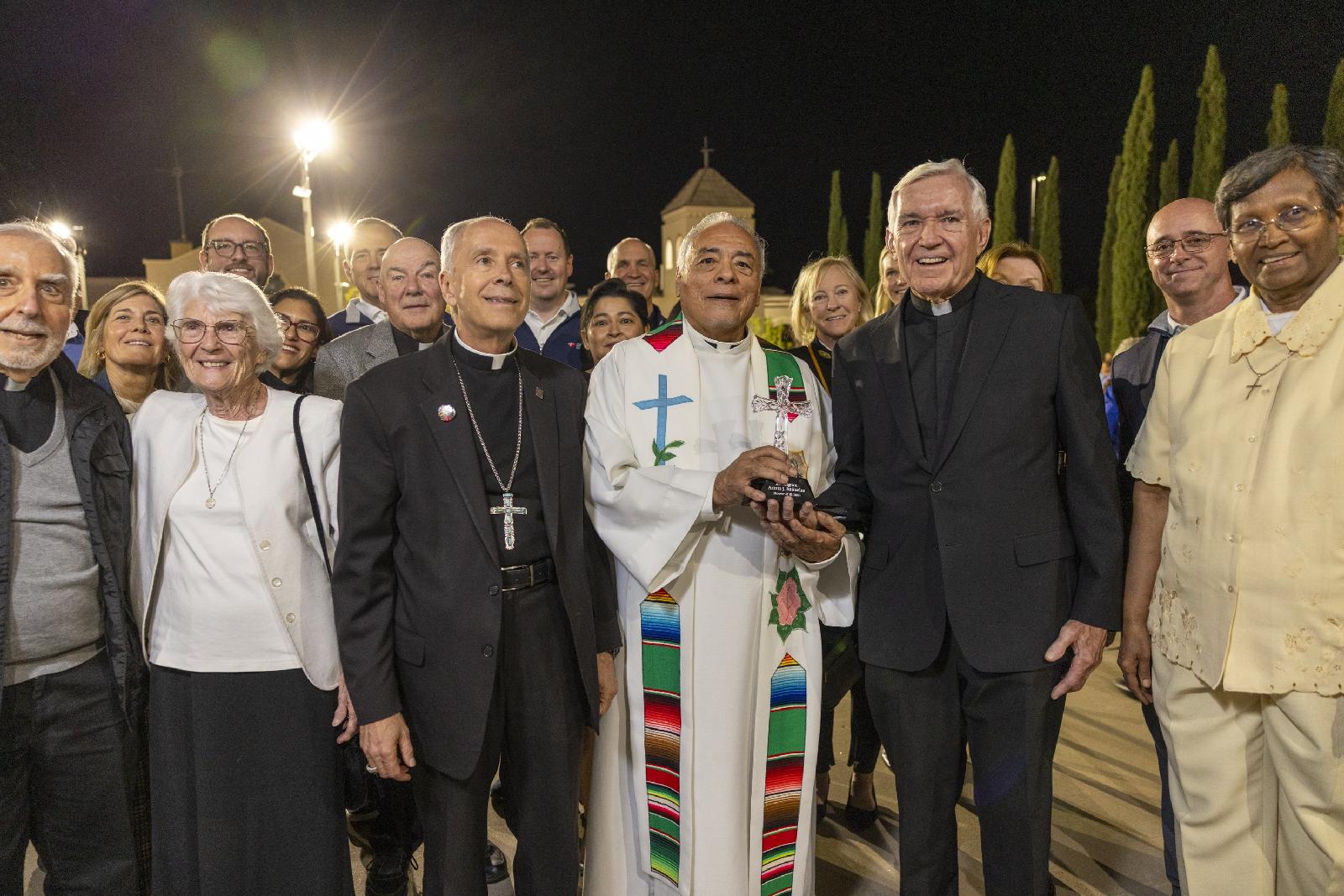
(OSV News) — A Texas institute born beneath the “sacred tilma” bearing the image of Our Lady of Guadalupe decades ago has formed 80,000 lay Catholic leaders. Its priest-founder was honored for that legacy at a Mass in early November where he received the Catholic Extension Society’s 2026-2027 Lumen Christi Award.
Chicago-based Catholic Extension gave Msgr. Arturo Bañuelas of the Diocese of El Paso, Texas, founding director of the Tepeyac Institute, its highest honor, which is awarded “to those who radiate and reveal the light of Christ in the communities they serve.”
Msgr. Bañuelas was chosen from eight finalists for the award announced in August. The finalists were selected from 46 nominees.
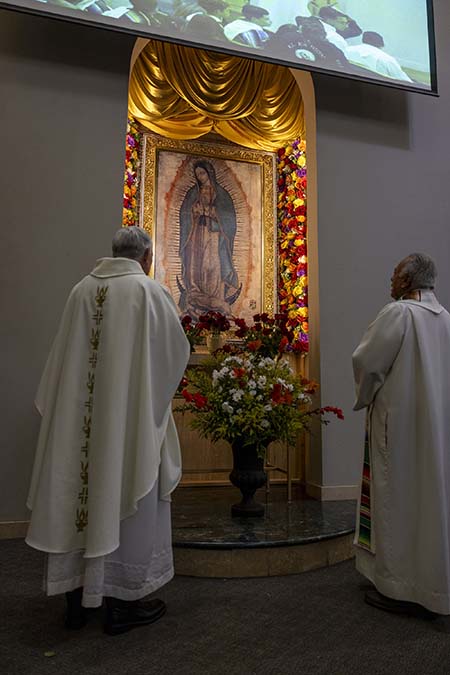
Following a discernment retreat in 1988 at the Basilica of Our Lady of Guadalupe in Mexico City, where, he has said, he received inspiration from the Blessed Mother, Msgr. Bañuelas returned to the Diocese of El Paso and established the Tepeyac Institute.
The basilica houses the tilma, or cloak, of St. Juan Diego Cuauhtlatoatzin, which has Our Lady’s image miraculously imprinted on it. The Texas institute is named for Tepeyac Hill, the site of Mary’s apparitions to St. Juan Diego in 1531.
Vatican II called whole Church to take active role
At the time of the institute’s beginnings, the priest said, many in the church too often understood the role of laypeople as “mainly” being “father’s helpers,” but the Second Vatican Council “called the whole Church to remember (that) you’re not spectators in the Church.”
Through baptism, the laity are called “to share in Christ’s mission,” he said. “Each (of us) is called to bring our unique gifts” in service of God.
Msgr. Bañuelas made the comments in accepting the Lumen Christi Award at St. Mark Church in El Paso during a special Mass he concelebrated Nov. 3 with Father Jack Wall, president of Catholic Extension Society, and Bishop Mark J. Seitz of El Paso.
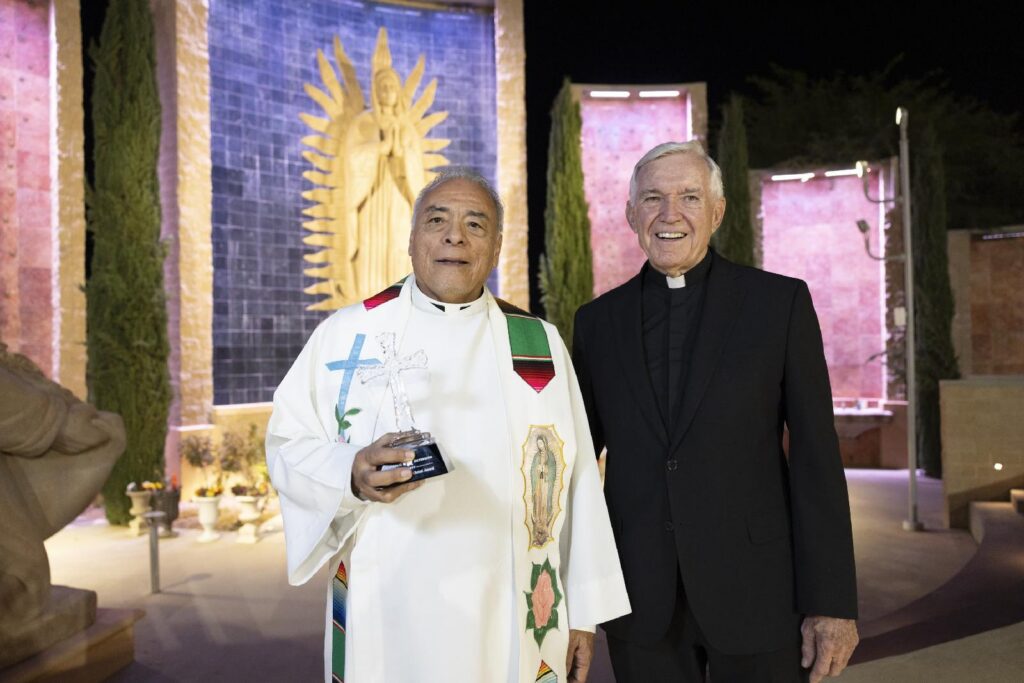
Msgr. Bañuelas was pastor at St. Mark from 2015 until retiring in 2022. Before that he was at St. Pius X Parish 1988 to 2014. He continues to assist with Mass at roughly 10 parishes throughout the Diocese of El Paso and continues teaching through the Tepeyac Institute.
In presenting the award to Msgr. Bañuelas, Father Wall said the priest and the Tepeyac Institute have “incarnated” the church’s vision that “each one of us” is a missionary disciple and “called to become this light of Christ.”
Lumen Christi Award comes with $100,000
The Lumen Christi Award comes with $100,000, an amount split to support Msgr. Bañuelas’ ongoing ministry and the Diocese of El Paso. Award finalists received $15,000 each.
Msgr. Bañuelas accepted the award “with joy” on behalf of the institute and “the many men and women “who have studied, served, prayed, organized, accompanied and quietly kept the flame alive.” He also paid tribute to his late co-worker and friend, Dominican Sister Esther Ortega, who helped him establish the center.
The light of Christ “does not belong to anyone of us,” he said. “It is the flame entrusted to us to carry to hospital rooms and nursing homes, into prisons and food banks, into classrooms and parish halls, into the homes of families who are struggling, and to the places where human dignity is threatened or forgotten.”
Msgr. Bañuelas remarked that Joe Boland, Extension’s vice president of mission, reminded him of “a beautiful circle of grace”: Catholic Extension helped build the church at Santa Rosa de Lima Parish in Pecos, Texas, where he was baptized, and supported seminarians when he was in the seminary, and for many years has been “our faithful partner in the mission of Tepeyac.”
“He says I have been an Extensionista all my life,” the priest added.
Catholic Extension helps Church in underserved regions
The Diocese of El Paso is among the many dioceses where the Catholic Extension Society works to help build up Catholic faith communities in underserved regions of the U.S., including offshore U.S. territories. That has been its mission since its founding in 1905.
In his remarks, Msgr. Bañuelas addressed U.S. immigration policy, U.S.-Mexico border issues and the plight of immigrants facing deportation.
“Our border region carries both extraordinary beauty and deep pain,” the priest said. “Migrants are detained only miles from where we gather tonight in the nation’s largest detention center, which needs to be closed soon. Our families live with fear of deportation and family separation. People of color too often find their dignity questioned and their rights endangered.
He called out the suffering in Gaza and Ukraine, hunger in Cuba, the challenges artificial intelligence presents, and how local farmworkers struggle “to afford food on their own tables.”
Border wall ‘stands as a painful symbol’
“And the border wall stands as a painful symbol of how xenophobia can harden into concrete and steel,” he said, adding that “Christ is being crucified in the border, in the detained migrant, in the separated family” and “whenever Christ is crucified, the church is called to stand near the cross to accompany the wounded and to work for resurrection.”
Msgr. Bañuelas added, “This is why Tepeyac must remain a bold, fearless, profound voice, not of hatred but of holy courage, not a voice that humiliates but one that defends human dignity, not a voice that deepens division but one that calls us to reconciliation, justice, joy, compassion and peace.”
He thanked Catholic Extension “for believing in our mission, for walking with us and for helping the light travel farther than we could have carried it alone.”
“May Our Lady of Guadalupe guide us toward a new humanity without borders, where every person is treated with dignity and respect, and where all of us learn to live as one family of God,” he said.
Julie Asher is senior editor for OSV News.
