


BALTIMORE (OSV News) — Evangelization of young adults, the challenges of the artificial intelligence revolution, overhauling the bishops’ pro-life priorities, fighting racism with a day of prayer, and solidarity with immigrants rounded out the second day of public sessions at the U.S. bishops’ fall plenary assembly.
The morning of Nov. 18 began with the bishops quickly approving items they had discussed the day before, the first day of public sessions during the Nov. 16-19 meeting in Baltimore.
The bishops voted overwhelmingly to approve a new Mass lectionary and Book of the Gospels, without any amendments, which will make the readings at Mass harmonize with the texts Catholics can read in the forthcoming Catholic American Bible.
The bishops also voted overwhelmingly to approve a resolution on diocesan financial reporting through 2031 and the updated “Socially Responsible Investment Guidelines for the U.S. Conference of Catholic Bishops.”
Archbishop Charles C. Thompson of Indianapolis, chair of the Committee on Evangelization and Catechesis, then introduced Auxiliary Bishop Richard Umbers of Sydney, who spoke about the 2028 International Eucharistic Congress in Sydney with its theme “This is my body given for you.”
Sydney congress has drawn heavily on U.S. Eucharistic Congress
Bishop Umbers said the congress has heavily drawn on the U.S. experience with the National Eucharistic Revival and the 10th National Eucharistic Congress, and per Pope Leo’s request, will place a special priority on youth.
“It does touch on the Real Presence, but it also touches on what Christ does for us, why he does that for us,” he said, “so that we be Christ-like for others, so that we give of ourselves for others, so that we become like him.”
After breaking for lunch, the U.S. bishops shifted their focus to listening to a panel of experts from The Catholic University of America regarding their own research into young adults under 30.
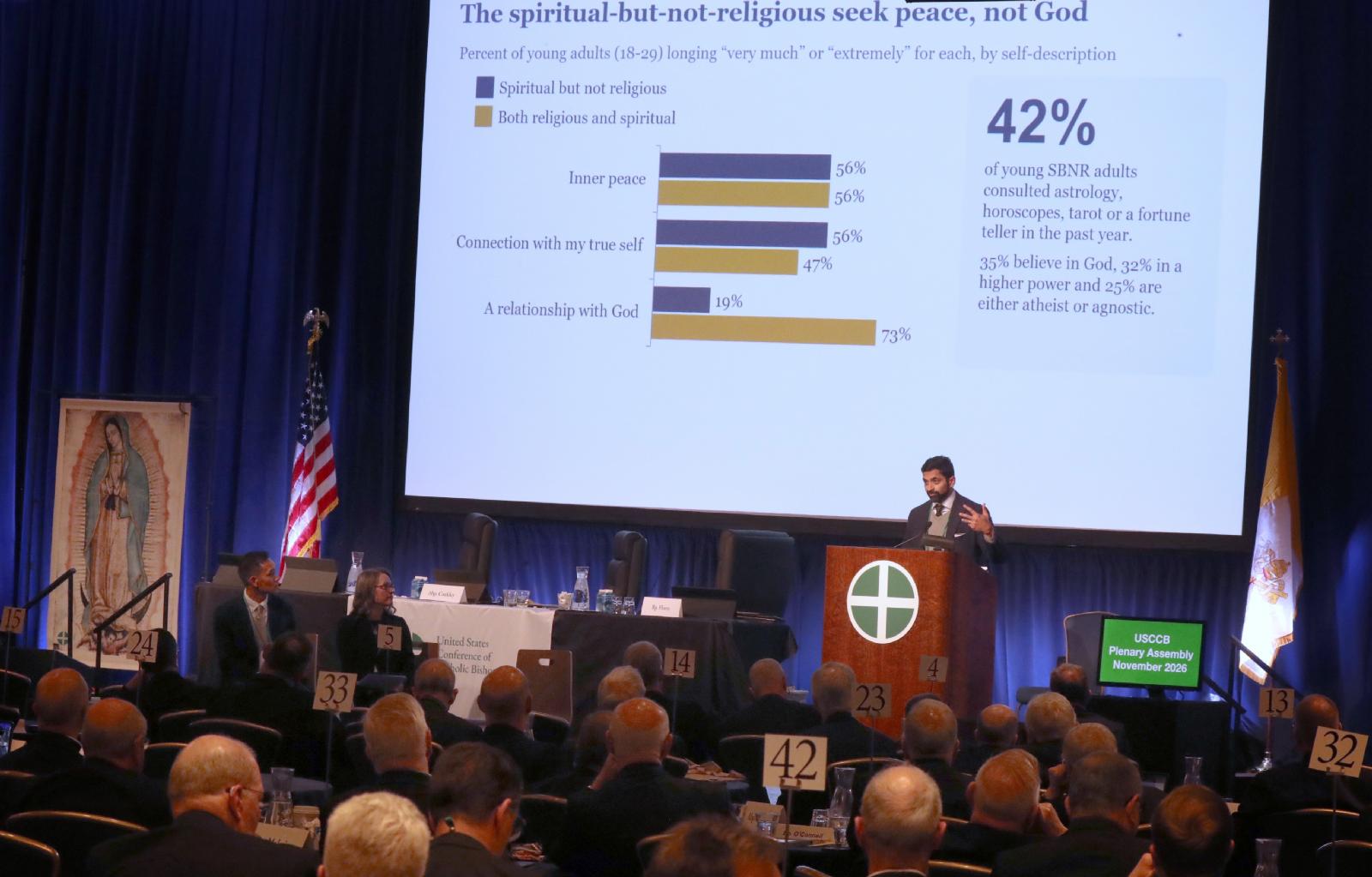
Brandon Vaidyanathan, a professor of sociology at The Catholic University of America, opened the discussion with findings from Gallup’s 2026 Beauty and Belief survey which took place in March and April of 2026. He went into detail into the findings that 64% of Catholic young adults say religion is more important to them now than it was five years ago compared to 41% of Catholic adults over 30.
Vaidyanathan and other Catholic University experts did a deep dive into the data, answering bishops’ questions afterward, but overall making clear that the Church is still “pretty far away in terms of revival.”
The presentation made clear that the present generation of young adults identifies less as “spiritual” and more as “religious but not spiritual” than the older generation. It noted that young men and women under 30 are equally likely to consider themselves religious, but with men gravitating toward identity and women toward the interior life. It noted they report a strong desire for community and moral guidance. It also noted that 58% of Catholics ages 18-29 are Hispanic, but they attend Mass weekly at a lower rate.
Update on U.S. bishops’ new task force on AI
Bishop Oscar Cantú of San Jose, California — home to Silicon Valley and the hub of AI development — gave the bishops an update on the USCCB’s new Task Force on Preserving Human Dignity in the Age of Artificial Intelligence, which he chairs.
Acknowledging the fears, even among the bishops, that AI poses an existential threat to humanity, Bishop Cantu said this moment “represents a significant opportunity for the Church,” and drew a comparison to what the Church achieved following Pope Leo XIII’s 1891 encyclical “Rerum Novarum” during 19th century industrialization and Pope Leo XIV’s 2026 encyclical “Magnifica Humanitas” on the technological revolution driven by AI.

“The Church therefore has a duty similar to the one it embraced in 1891: not to reject progress, but to insist that progress remain ordered to the human person,” he said. “And just as ‘Rerum Novarum’ ultimately led to concrete results, including minimum wage laws, social security, and child labor restrictions, ‘Magnifica Humanitas’ asks us to work for policies and practices that keep artificial intelligence at the service of the human person.”
He explained the task force has begun implementing the USCCB’s mandate in the following areas: formation opportunities on AI for bishops and diocesan leaders; helping Catholic education with AI literacy and best practices; public policy work with the USCCB government relations team to continue advocating for clear guardrails on the development and use of AI; continued engagement with the tech sector that includes more voices in society as called for by “Magnifica Humanitas”; and developing a “theology of human dignity for the digital age.”
“At a moment when society is asking what machines can do, we must remind the world who the human person is. ‘Magnifica Humanitas’ calls us not to fear the future, but to help shape it, with humanity at the center,” he said, adding, “Let us together take up that responsibility together, with faith in Christ, who is the source of our hope.”
Bishops’ pastoral plan on pro-life activities last updated in 2001
Bishop Daniel E. Thomas of Toledo, Ohio, chair of the Committee on Pro-Life Activities, asked the bishops for permission to begin updating their pastoral plan on pro-life activities, last updated in 2001. He noted dramatic changes have taken place since then, with the overturning of the 1973 Roe v. Wade decision, the teachings on human life from three additional popes following St. John Paul II from the death penalty to other end-of-life issues.
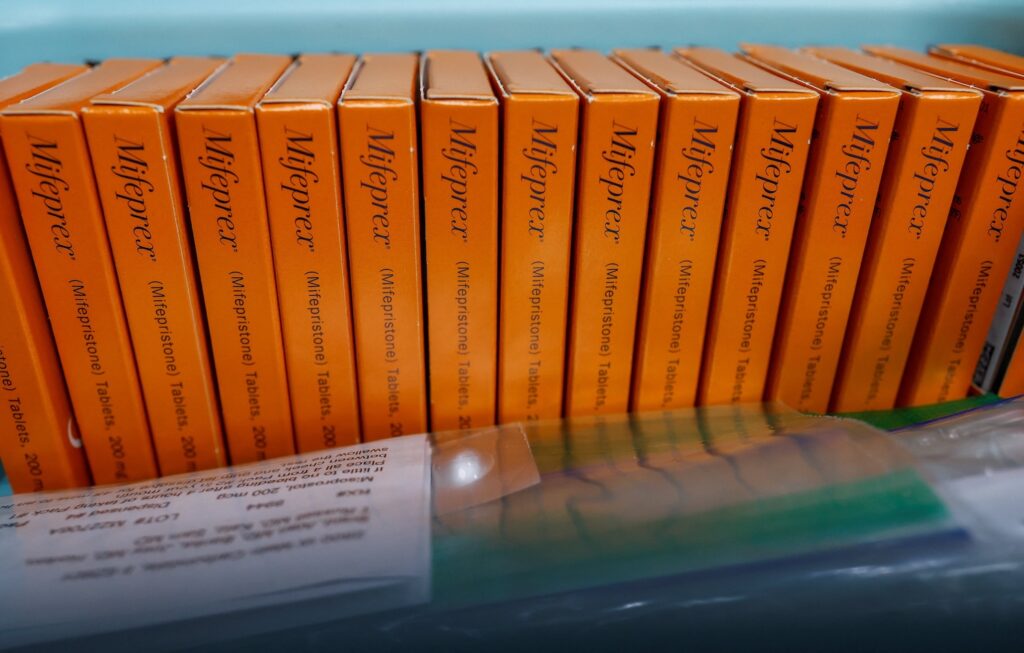
He also noted that abortions are on the increase, with pills to procure them widely available, with in vitro fertilization, or IVF, and other artificial reproductive technologies on the rise.
Archbishop William E. Lori of Baltimore, a former chair of the pro-life committee, spoke in support of developing a new pastoral plan, emphasizing it will also reflect the important work the pro-life committee has been doing the past two decades.
Archbishop Gabriele G. Caccia, the papal ambassador to the U.S., also spoke up and called for a revised plan to include advocacy for banning human surrogacy, which he described as a new form of trafficking worldwide and “another frontier” for the pro-life movement.
The bishops unanimously voted to update the plan, 205-0.
Bishop Daniel E. Garcia of Austin, Texas, chair of the Subcommittee for the Promotion of Racial Justice and Reconciliation, presented a proposal to designate the last Sunday in October as a day of prayer for racial justice. He noted that this observance would serve as a bridge between October, which is Respect Life Month, and November, which honors Black Catholics and Native American Catholics’ heritage and history. He said the Sunday readings for Mass also fit well with the theme.
CARA report on Catholics’ views of racism in local communities
Bishop Garcia referred to the findings of an Oct. 26 report from the Center for Applied Research in the Apostolate that indicated 60% of adult Catholics in the U.S. believe racism exists within their local community, with about 4 in 10 (39%) saying they have experienced racial discrimination generally.
Before the vote, Bishop Garcia told OSV News that ending racism “first and foremost” begins with prayer “asking God to heal our hearts of the wounds of the past, and to help us as we try to work through this complex situation that we encounter today, both civilly but also in the Church.”
The bishops were overwhelming in their approval, but not unanimous, voting 180-15 to approve the day of prayer for racial justice, with seven abstentions.
The bishops concluded the day’s presentations with a report by Bishop Brendan J. Cahill of Joliet, Illinois, chair of the Committee on Migration, marking a year since the U.S. bishops issued their special pastoral message on immigration.
Warning that ‘culture of indifference’ informing migrants’ treatment
Bishop Cahill warned of a “culture of indifference” informing the treatment of migrants in the U.S. and around the world. He in particular called out the U.S. government’s “manipulations of the truth, which dismiss God-given human dignity” that can be seen in its “emphasis on mass detention and mass deportation to the sudden revocation of legal status and work authorization for millions of people.”
He detailed the challenges the Church faced with the government, particularly in providing pastoral and sacramental ministry to Catholics in immigrant detention, but he also noted substantial relief had been obtained for religious workers from overseas who serve the Church in the U.S.
Bishop Cahill also noted the Justice for Immigrants campaign, the conference’s “You Are Not Alone” initiative, the recent Evangelical-Catholic Dialogue on Immigration, and the Cabrini Pledge, named for St. Frances Xavier Cabrini, as examples of its the conference’s ongoing work to advocate for the life and dignity of immigrants.
“As we pray and move forward together, may Mother Cabrini continue to inspire us and be a reminder to us that no task is too difficult as long as our purpose remains the Lord,” he said.
The meeting concluded with the Collect for St. Frances Xavier Cabrini, and a reminder for bishops to make sure their tablets were charged for the following day’s closed-door session.
Peter Jesserer Smith is the national news editor of OSV News. Gina Christian, Lauretta Brown and Kate Scanlon contributed to this report.
