


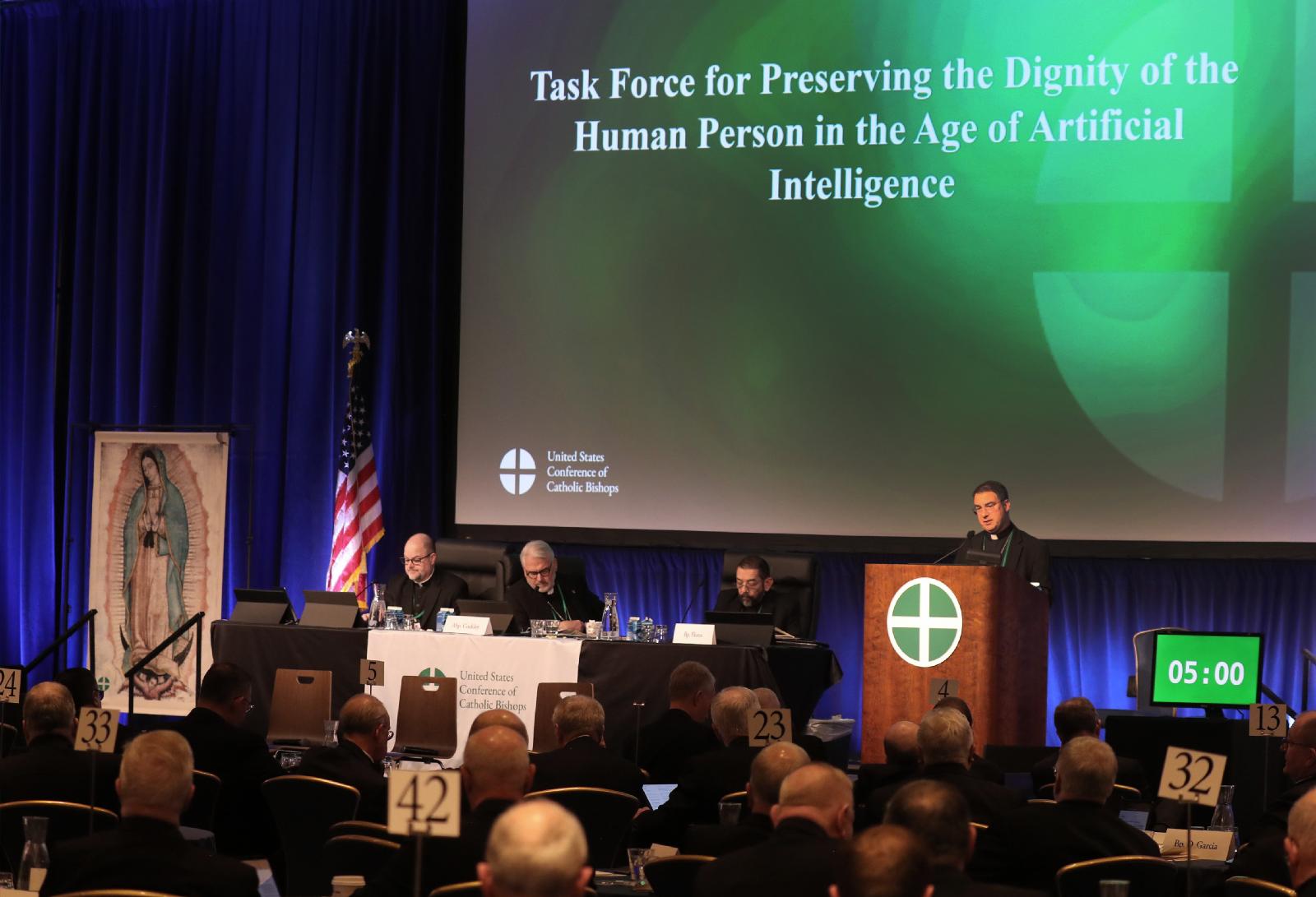
BALTIMORE (OSV News) — Humans must remain in control of artificial intelligence — and the clock is ticking for exerting that oversight to safeguard human dignity and the common good, said Bishop Oscar Cantú of San Jose, California, who heads the U.S. Catholic bishops’ AI task force.
The bishop — whose diocese is home to Silicon Valley — reflected on the task force’s work in an interview with OSV News and in a presentation during the U.S. Conference of Catholic Bishops’ annual fall plenary assembly, which is taking place Nov. 16-19 in Baltimore.
Bishop Cantú’s call for human-centered development and governance of AI echoes that of Pope Leo XIV in his encyclical “Magnifica Humanitas.”
The bishop’s message also comes amid a recent slew of high-profile technology disruptions that saw a rare nationwide ground stop at U.S. airports and a global Microsoft outage, as well as online snarls for several banks and Apple products.
While not thought to be directly related to AI, the disturbances nonetheless highlighted modern dependence on digital connectivity.
Bishop Cantú’s Nov. 18 plenary update on the work of the task force was also offered just hours ahead of the highly anticipated initial public offering of Anthropic, the frontier AI firm whose co-founder joined Pope Leo for the May release of his encyclical on the technology.
Bishops’ AI task force
Shortly after the encyclical’s publication, Bishop Cantú was named chair of the newly formed USCCB task force on AI, with the group focused on implementing Pope Leo’s vision to keep the technology firmly rooted in human dignity and the principles of Catholic social teaching.
Last month, the USCCB announced the full list of the committee’s eight episcopal members, who include Cardinal Blase J. Cupich of Chicago, and its three lay consultants: theologian and ethicist Charles Camosy of The Catholic University of America, philosopher Meghan Sullivan of the University of Notre Dame, and Kim Daniels, director of Georgetown University’s Initiative on Catholic Social Thought and Public Life.
‘Time is of the essence’
Speaking to OSV News the day prior to his USCCB presentation, Bishop Cantú said the mid-November whirlwind of flight and online service disruptions within the span of a few days “set us on edge and make us wonder what’s happening,” adding he hoped for “some calmer waters” ahead.
At the same time, he added, “time is of the essence with regard to this technology.”
“I wouldn’t say the technologists have warned us, but they’ve mentioned their timeline,” he told OSV News. “They expect this technology to be at full speed within six months to a year. And so we need to raise our voice. We need to educate ourselves quickly, calmly and raise our voice in the public square in this debate.”
Threats to human dignity, truth, work
In his Nov. 18 address at the USCCB plenary, Bishop Cantú — quoting extensively from “Magnifica Humanitas” throughout his presentation — said one of the greatest threats posed by AI is a diminished view of the human person.
“The Church’s contribution is to insist that every human being possesses inherent dignity that no algorithm can measure and no market can price,” something Pope Leo’s encyclical warns against, said Bishop Cantú. “God formed mankind with his own hands and continues to breathe life into humanity; that breath cannot be replaced by an algorithm.”
Truth is another potential casualty of AI, and a key pastoral concern, Bishop Cantú told his fellow bishops.
“Unfortunately, AI allows bad actors to produce convincing falsehoods,” such as generated images and disinformation, he said.
As a result, Bishop Cantú said in his address, bishops “should recognize that in the coming years there will be an unprecedented pressure on the public’s ability to distinguish truth from falsehood.”
The Church “must become a school of discernment in the digital age,” with its institutions as “places where people learn to verify, to slow down, and to reason together.”
Protecting children and vulnerable persons from harmful impacts of AI is also crucial, Bishop Cantú said.
With AI set to become “a permanent companion” for many young people, posing risks to their capability for critical thinking, “friendship, prayer, and genuine human encounter,” he said.
In his address, Bishop Cantú called on Catholic educators to “help us develop guidelines for children and young people regarding the prudent use of artificial intelligence.”
The impact of AI on labor markets, which tech leaders continue to debate, has “many Catholics” concerned about their own jobs and the future of “meaningful work” for their children, he said.
AI’s impact on modern warfare, particularly with respect to autonomous weapons, is “one of the most urgent themes” of Pope Leo’s encyclical on the technology, said Bishop Cantú.
“The Church must insist that moral responsibility in conflict cannot be delegated to an algorithm,” he said.
Dialogue, formation and guardrails for AI
At the same time, said Bishop Cantú, the USCCB’s AI task force has found “genuine openness to dialogue among major technology companies.”
“Most have expressed interest in ongoing conversation with the Church,” he reported. “Many recognize the deep moral and ethical questions at stake.”
With a majority of AI frontier labs based in the U.S., that openness “represents a significant opportunity for the Church, particularly here in the United States,” he said, adding, “the Church possesses something that Silicon Valley cannot engineer: over two thousand years of wisdom on the human person, truth, and the common good.”
Bishop Cantú said the USCCB AI task force will focus on providing bishops with “updates and formation opportunities” for prelates and diocesan leaders, with webinars for bishops set to begin after the new year.
The task force is positioned to “become a clearinghouse for best practices” in developing AI literacy in educational institutions and catechetical programs, he said.
The group will also partner closely with the USCCB’s government relations team to advocate for “clear guardrails on the development and use of AI, including transparency, accountability, and human oversight,” said the bishop in his address.
Continued and expanding engagement with society at all levels on the issue of AI will continue, he said.
‘Renewed confidence’ in humanity
Highlighting Pope Leo’s reflections on AI, Bishop Cantú urged the Church to “articulate with renewed confidence what it means to be human in the time of artificial intelligence.”
“Brothers, at a moment when society is asking what machines can do, we must remind the world who the human person is,” he concluded. “‘Magnifica Humanitas’ calls us not to fear the future, but to help shape it, with humanity at the center.”
Gina Christian is a multimedia reporter for OSV News. Follow her on X @GinaJesseReina.
