


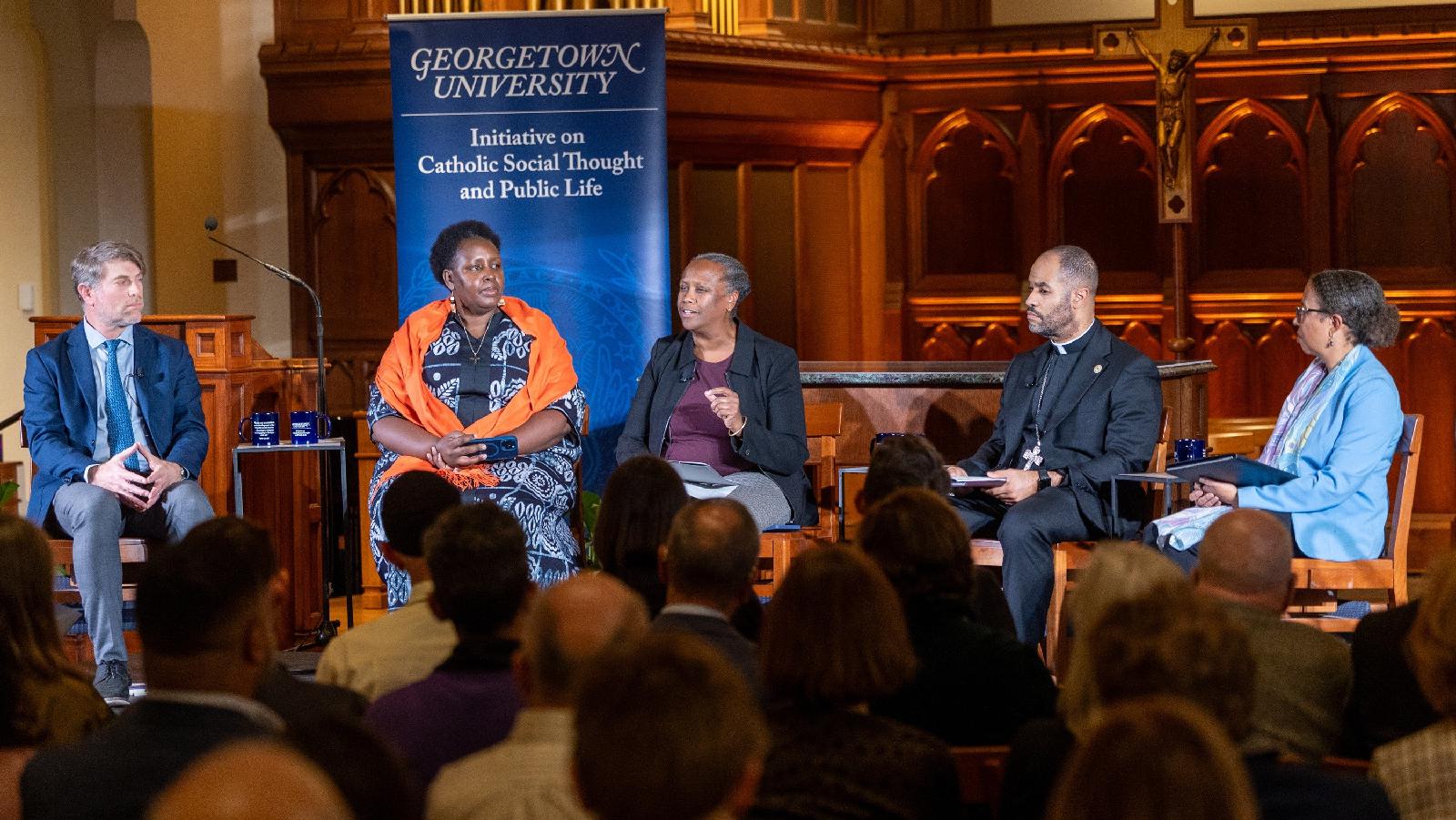
WASHINGTON (OSV News) — At a dialogue hosted by Georgetown University — which has been at the center of the U.S. Catholic Church’s acknowledgement and reckoning of its involvement with slavery — panelists praised Pope Leo XIV’s slavery apology in his recent encyclical on artificial intelligence, saying it offered a call to action to work for healing and justice.
Panelist Rachel L. Swarns said she was “deeply and profoundly moved” by the words of Pope Leo, who called slavery “a wound in Christian memory, one from which we cannot consider ourselves detached.”
Her 2023 book “The 272: The Families Who Were Enslaved and Sold to Build the American Catholic Church,” chronicled the story of how in 1838, the Maryland Society of Jesus, the Jesuits, sold 272 enslaved men, women and children to Louisiana sugar plantation owners, and that sale helped ensure the financial survival of Georgetown College, now the university.
Swarns noted that the pope in his encyclical, “Magnifica Humanitas: On Safeguarding the Human Person in the Time of Artificial Intelligence,” was “explicitly acknowledging the Church’s complicity in condoning and legitimizing the slave trade. He was explicitly asking for pardon, and he was saying quite clearly that … these efforts at atonement should be happening now.”
Slavery and human dignity in ‘Magnifica Humanitas’
Swarns — a journalist and contributing writer for The New York Times and an associate professor of journalism at New York University — was among the panelists at the Nov. 9 Dahlgren Dialogue on “Repentance, Repair and Prevention: Slavery and Human Dignity in ‘Magnifica Humanitas.'”
The dialogue was sponsored by three Georgetown entities: the Office of Mission and Ministry, the Center for the Study of Slavery and Its Legacies, and the Initiative on Catholic Social Thought and Public Life.
The panelists also included Washington Auxiliary Bishop Robert P. Boxie III; Adam Rothman, a professor at Georgetown and director of its Center for the Study of Slavery and Its Legacies; and Sister Mumbi Kigutha, a member of the Sisters of the Precious Blood of Dayton, Ohio, who is president of Friends in Solidarity, which promotes awareness and provides support for people in South Sudan and other African nations.
Like the other panelists that evening, Swarns emphasized that the pope was issuing a call for reflection and action to address the continuing impact of that injustice.
“So we cannot turn our backs, and I think it was very important for him to raise his voice in this way and in this time, and I think that the Church can play a very important role in this way and in this time,” Swarns said.
Catholic leaders’ apology for perpetuating the injustice of slavery
In opening remarks, Joseph Ferrera, Georgetown’s senior vice president for strategic engagement, recalled how following the recommendations of a working group, in 2017 the president of Georgetown, the leadership of the North American Jesuits and the Archdiocese of Washington offered an apology to descendants for perpetuating the injustice of slavery and the enslavement of their ancestors.
The university has also pledged to raise $100 million for the Descendants Truth and Reconciliation Foundation.
Ferrera noted how in the encyclical after asking for pardon for the Church’s involvement with slavery and the suffering it caused, the pontiff said, “What we have learned must be translated into discernment and responsibility in the present.”
Bishop Boxie in his remarks said it might seem that the issues of slavery and artificial intelligence in Pope Leo’s encyclical are unrelated, but the document’s emphasis on safeguarding human dignity ties together past injustices and emerging technologies.
“Slavery and the systems that allowed it to take hold reduced persons to economic value, property, prosperity for someone else, really denying that full dignity that they were given by the simple fact of being created in the image and likeness of God,” the bishop said.
‘You can’t determine value of a human by what they produce’
“AI has a related harm,” he added. “It’s run by algorithms, data collection, efficiency, profitability. … You can’t determine the value of a human by what they produce or what they’re worth or their economic output.”
“Technology isn’t the enemy, but it must progress along moral lines,” added Bishop Boxie, one of the country’s African American bishops. At age 46, he is also the nation’s youngest Catholic bishop.
In her remarks, Sister Mumbi Kigutha said “new forms of slavery are emerging. Slavery has never really disappeared from this earth.”
She noted how children in the world are being exploited as laborers and as child soldiers, and how young women from Africa and Asia sometimes end up as domestic workers in the Middle East in a “modern form of slavery,” drawn to abusive lives by technology, as were the African men lured to fight for Russia in that country’s war against Ukraine.
Sister Mumbi also pointed out that a recent documentary exposed how human trafficking of young girls is happening in Washington, not far from the U.S. Capitol.
Rothman underscored how Pope Leo in “Magnifica Humanitas” identified new forms of slavery connected to artificial intelligence and related technological advances, “for example, the exploitation connected to the mining of rare earth metals, (and) the exploitation of data workers who train the AI models, (who are) often underpaid and overworked.”
Church and country have not full reckoned with slavery
Bishop Boxie said slavery is an issue that the Church and this country have not fully reckoned with and pointed to a new national survey by the Center for Applied Research in the Apostolate found that 67% percent of those in the survey “agree that racism could end if we contend with the policies and institutional barriers that perpetuate it and preserve it.”
“Forty percent of Catholics have experienced race discrimination. That’s right now,” he said, “and the highest (rates are) among Blacks and Latinos and Asians. Sixty percent of folks believe that racism still exists in their community.”
Catholics as people of faith need to have “hard conversations” about these issues, “because ultimately all of us seek reconciliation, which is really a restoring of our relationship with God, with one another and with ourselves,” Bishop Boxie said.
He emphasized that the Church with its Catholic social teachings on human dignity and solidarity and its commitment to truth and healing has “an automatic framework to go about this work of healing and restoration.”
Rothman noted how the first marriage record at neighboring Holy Trinity Parish in Washington from 1795 records the marriage of a free man of color with an enslaved woman in “the college chapel.”
‘A difficult history’ that’s ‘very present with us’
That is one of many records that show the close connection of Georgetown University with the history of slavery, which he said is “a difficult history, but a history that’s very present with us.”
Swarns said that reluctance to confront history is not only coming from state, local and national officials, sometimes it comes from “the folks who we’re sitting next to in the pews. Sometimes it comes from our clergy. To be Black and Catholic in this country is to be painfully aware of just how much work needs to be done,” she said.
Catholic institutions, she added, can “provide spaces and opportunities for education about this history, for reflection about this history, and for reconciliation and repair.”
Sister Mumbi said, “Peace building is not just cultivating a culture of reconciliation. It’s also providing the basic necessities, ensuring that people have access to shelter, food, water, health care and education. And this is not just an issue in countries facing conflict. This is an issue right here in America, that there are more people now going hungry than ever before.”
Reconciliation must become a part of ‘everyday living’
She said she hopes that “reckoning with slavery leads to reckoning with so many other things that are interconnected,” including ways that people continue to be stripped of their dignity today. Reconciliation “is a practice we need to inculcate in our everyday living,” she said.
Rothman quoted John DeGioia, Georgetown’s former president who launched its reconciliation efforts and once said, “A knowledge of history can expand our moral imaginations.”
Bishop Boxie said that as Georgetown students learn about their university’s history and later graduate and move out into the world, he hopes their hearts are transformed to “do something about it as citizens of this country, citizens of the world, and as members of the Church, that they feel compelled to work on healing and reconciliation, because what they received here at this university is directly tied to this painful legacy of slavery.”
Mark Zimmermann is editor of the Catholic Standard, the news outlet of the Archdiocese of Washington. This story was originally published by the Catholic Standard and distributed through a partnership with OSV News.
