


There is a quote attributed to Heraclitus which can be paraphrased, “No man ever steps in the same river twice, for it is not the same river and he is not the same man.”
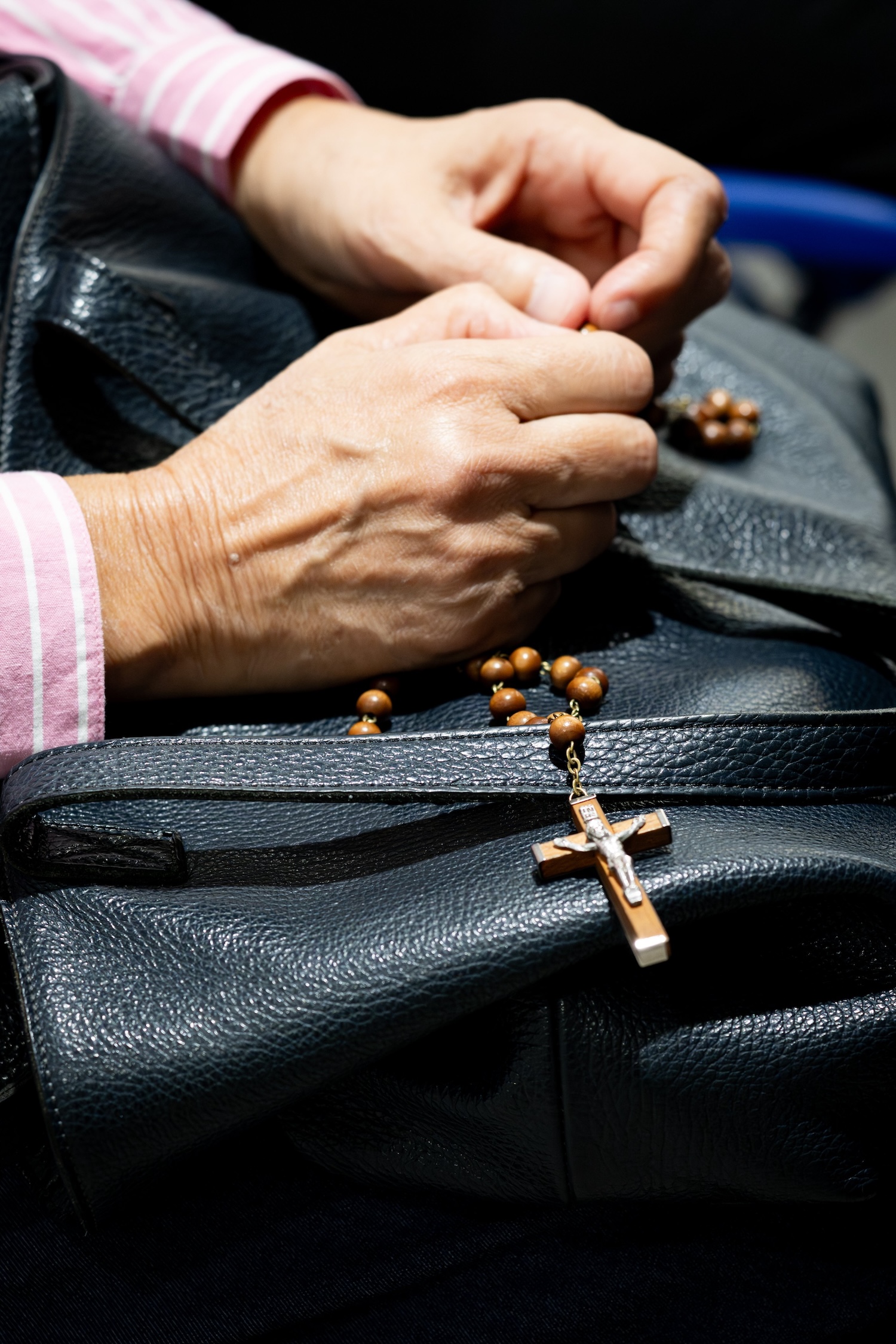
It’s a phrase I recall whenever I hear someone call the rosary a practice of “vain, repetitious prayer” (Mt 6:7). Just as the river is constantly moving and changing, so do our meditations as fingers move to the next bead and the next literally “new” moment.
Our prayer then becomes “new,” too: new breath, new mystery, new errant distractions, new earnest intentions remembered — they all arise and flow like water at the narrowing banks as we “pray ceaselessly” the entirety of the Gospels before God.
Patience with the rosary
Not everyone loves the rosary, and that’s fine; no one is required to. In “The Story of a Soul,” St. Therese of Lisieux writes, “I feel then that the fervor of my Sisters makes up for my lack of fervor; but when alone … the recitation of the rosary is more difficult for me than the wearing of an instrument of penance.”
Many Catholics can empathize. While I’ve prayed the rosary all my life, it has not always been with patience or a real sense of connection to the mysteries. That has changed thanks to some seemingly minor things that have organically splashed into my little river of prayer, and keep renewing my experience of it.
For instance, after praying the Liturgy of the Hours (LOTH) for decades, it has become habitual to bow while reciting the Doxology. Now, while closing each rosary decade with the “Glory Be,” I will face the East and make a deep bow.
It’s a small thing but adding the physical act of bowing seems to recharge my battery for the next mystery, the next 10-bead meditation.
Again perhaps because of the antiphon-heavy LOTH, I’ve begun prefacing each decade by recalling a brief quote from Scripture. Approaching the Visitation, I might recall Elizabeth’s words, “Whence is this that the mother of my Lord should come unto me?” That minor addition helps my imagination to leap (like John in Elizabeth’s womb) into the heady biblical moment of recognition and wonder before us. I am drawn further into the scene, closer to these two be-graced women; the depth of my prayer follows.
Praying with saints
The communion of saints also plays into my daily rosary, in a way that makes the devotion seem both fast and particularly efficacious. In 2010, when St. Philip Neri was my “patron” for the year, I would ask him to “teach me what you know.” Somehow, that evolved into my inviting him — within that communion — to “pray this rosary with me,” particularly if I was feeling a bit dragged.
I confess to wondering whether my summons was inspired or simply fanciful, but the energy of my prayer was undeniably changed — made lighter yet more devout, in a very Nerian way. Over the years, I have invited many saints and angels and departed holy men and women to pray the rosary with me, to the point where I rarely feel like I am fully alone at prayer.
Sometimes they even urge me on, into reciting another five-decade mystery, all unplanned, for more intentions recalled. Rather than feeling tired, afterward, I am invigorated and spiritually refreshed.
Often, when I am praying a rosary for a specific issue — for a friend’s health concern, perhaps, or someone who I think has wronged me — I will invite their Guardian Angel and my own to pray with me. This can never hurt and, in that second instance, it has the surprising effect of reminding me that we don’t know anyone else’s story; that everyone has something going on that should light our compassion.
Lately I have invited saints from countries experiencing violent and frightening unrest to pray with me — French and German saints, the English martyrs and others.
On the All Souls Day preceding our recent election, I invited all the departed holy men and women through time — hundreds of millions — to pray the rosary with me, if they wished to, for the sake of the whole world. Continent by continent (sometimes nation by nation), I prayed for all of us; I felt very much joined in prayer by something huge, faithful and — dare I say it — ultimately full of joy.
Seated or kneeling, bowing or erect, alone or with the holy multitudes, it is good (and never repetitious) to pray the rosary.
Elizabeth Scalia is editor-at-large for OSV. Follow her on X @theanchoress.
