


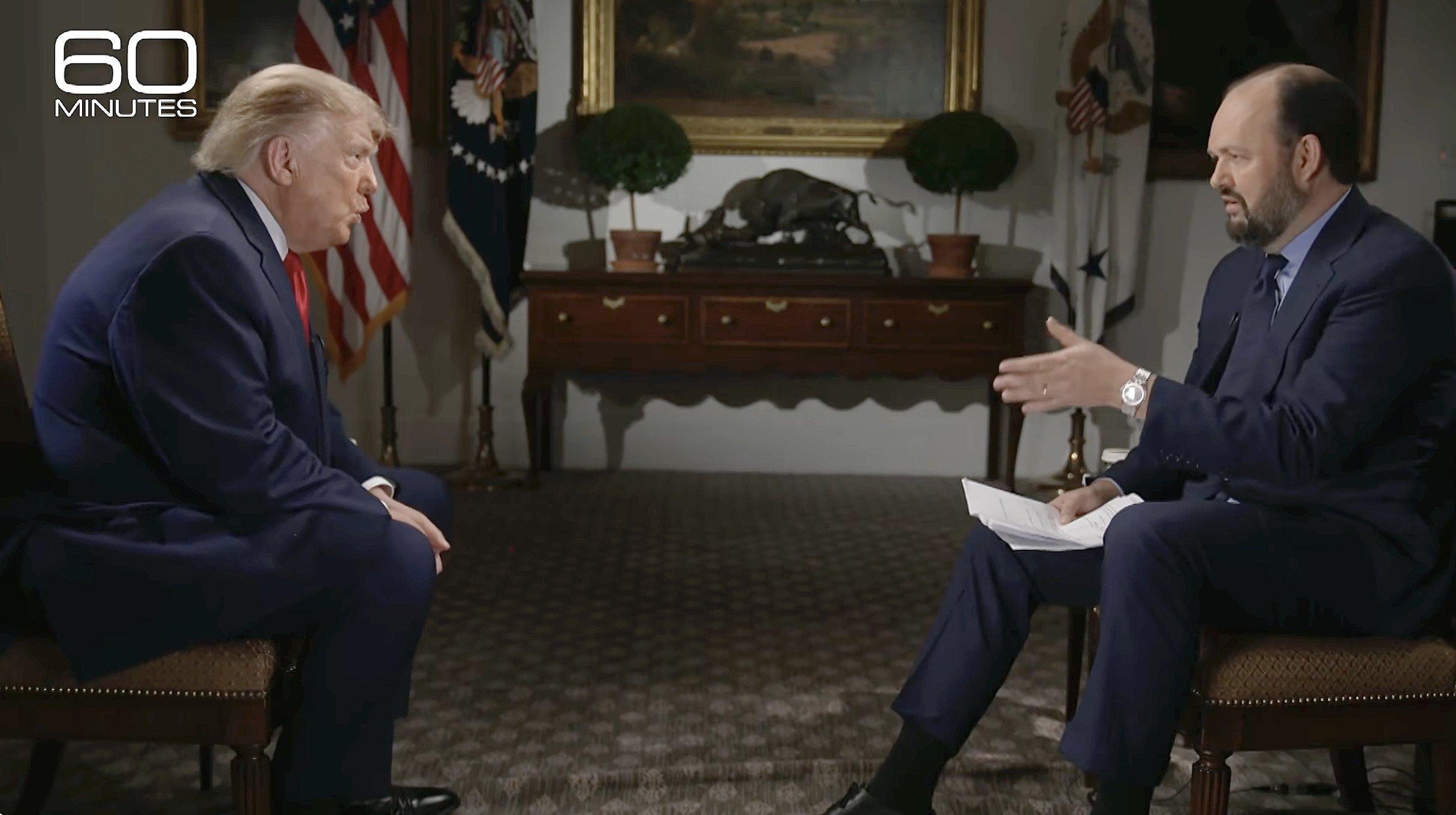
(OSV News) — Days after midterm elections that saw Democrats win landslide victories in Congress and flip a number of statehouses across the U.S., President Donald Trump admitted his administration’s immigration crackdown “is too tough” and suggested that he could “work something out” with Democrats on immigration.
“I’d love to do something on immigration,” the president said on the CBS News program “60 Minutes” in a nearly half-hour interview in Washington with correspondent Ross Douthat, a Catholic and well-known political analyst. The wide-ranging interview, which aired Nov. 8, started with a look at the main issues that voters went to the polls about including the war with Iran and immigration.
“I think ultimately that hurt me,” Trump said, regarding his mass deportation push. He said the policy was “too tough,” in response to Douthat’s questions about the impact of his immigration policies on the election and whether he would pursue a deal with Democrats.
“I think it (immigration) both helped and hurt. I think I got an A+ for closing up the border. I get very high marks for getting the bad ones out,” he said. “But I get hurt because we also took people that had good jobs, that — that created one violation, or breaking of the law, and that was that they came into the country illegally.”
Voters on Nov. 3 delivered historic losses to Trump, GOP
The Nov. 3 election saw voters deliver historic losses to Trump and the Republicans with the GOP suffering staggering losses not seen since the 1948 elections. As of Nov. 9, the U.S. Senate is now at 54 Democrats and 44 Republicans, with two races too close to call; and the U.S. House has 254 Democrats and 164 Republicans with 17 races yet to be called.
Trump told Douthat, “When you go into a hotel and you have a woman that’s worked there as– you know, as a maid, as a cleaner, as a this, as a that, as a waitress — a lotta good things, great jobs — and all of a sudden, they’re being taken outta the country, it’s tough,” he said. “It’s a tough thing. But there’s a group of people that I would say, on the sort of pretty far right, that would like everybody taken out.”
He added, “There’s also people that are more modified on that. In other words, get the killers out. Get all the– the rough ones out. Get the drug dealers out. But let the people that are here — and in some cases here for 10 and 15 years — work a deal for them.”
Trump said he believed Democrats in Congress would be interested in achieving an immigration deal and that “people have already called me.”
According to the Migration Policy Institute’s latest “Fact Sheet” report, 35% of the 980,000 people deported under the Trump administration — from January 2025 through July 2026 — involved people intercepted and turned around at the border. Another 34% were initially arrested at the border and then deported by U.S. Immigration and Customs Enforcement after ICE processed them for removal within the U.S. The remaining 31% were people arrested in the U.S. and most likely to have had years of residing in U.S. communities.
Domestic arrests increased from 8,000 to 19,000 in Trump’s first 3 months
The October 2026 report also noted an increase in domestic arrests from 8,000 per month in the first three months of Trump’s term to 19,000 per month from May through July 2026.
It added that of those deported by ICE, 61% had been in the U.S. at least two years and 15% had lived in the U.S. 10 years or more. Of these immigrants, 71% had never been convicted of a crime, and 61% of those in the U.S. 10 years or more had no criminal convictions.
Catholics who work with migrants have expressed surprise and caution over the president’s words.
Dominican Father Brendan Curran, the Chicago-based promoter of justice and peace for the Dominicans of Canada and the United States, said he was “delightfully surprised by the tone and content” of what he called the president’s rhetoric on “60 Minutes.”
“Let us be clear,” Father Curran told OSV News Nov. 9. “No matter who is the leadership, no matter what party or their track record, it always has to deal with detail and actual real negotiation. What we’re delighted by is that the rhetoric is speaking of something more healthy, more productive and more reflective of what we see.”
People are asking for ‘an absolute sign of respect’
“The vast majority of folks in our communities, especially and particularly Catholics, want decency, dignity, held above all as a highlight and priority value,” he said. “And moving in this direction as the president indicated, in part, on recognizing decency and dignity needs to be adjusted, is an absolute sign of respect for what people are asking for.”
The head of the Catholic-run Coalition for Public and Spiritual Leadership, Michael Okinczyc-Cruz, expressed reservations, and pointed out the Trump administration’s immigration crackdown continues.
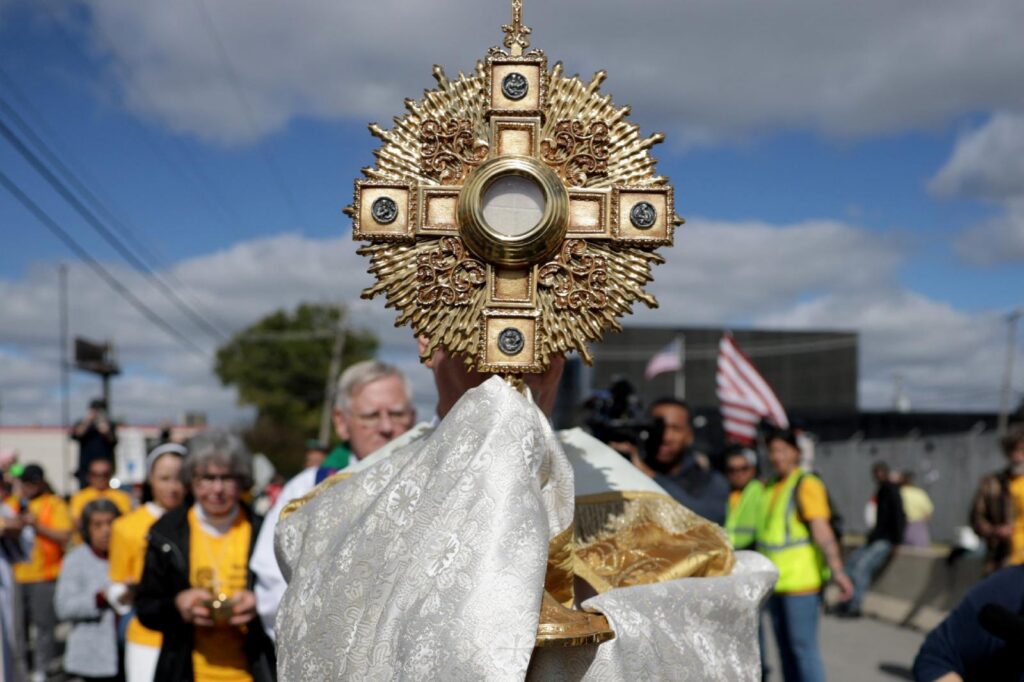
The coalition sued the Department of Homeland Security a year ago and was eventually granted daily entry into the ICE facility in the Chicago suburb of Broadview to give detainees holy Communion and spiritual care.
The Archdiocese of St. Louis filed a lawsuit Oct. 5 on similar grounds, saying ICE “prohibits Catholic priests from offering, and Catholic detainees from receiving, the sacraments of confession and communion.”
“The people who are being detained are most often mothers and fathers, siblings, grandparents, people who’ve been ripped and torn away from their loved ones in their parishes, in their communities,” Okinczyc-Cruz said, calling the experience “shattering” to witness.
Over 10 million Christians in U.S. vulnerable to deportation
A joint report issued last year by the U.S. Conference of Catholic Bishops’ Migration and Refugee Services, the Center for the Study of Global Christianity at Gordon-Conwell Theological Seminary, and World Relief, found that more than 10 million Christians living in the U.S. would be vulnerable to deportation under Trump administration policies implemented in 2025. A majority of them were Catholic followed by a sizable number of evangelicals.
It also found more than 1 in 6 Catholics are either vulnerable to deportation themselves or could see a family member deported, barring law or policy changes.
“To recognize how many families have been devastated by a federal government’s actions is heartbreaking. And so we need comprehensive immigration reform in our country that is fair and just, and that offers people a pathway to citizenship,” he added.
Okinczyc-Cruz said he felt “neither hopeful nor pessimistic” about Trump’s remarks, because “the reality on the ground” is the same as before the midterm elections and after the “60 Minutes” interview aired.
Douthat noted in his narrative during the “60 Minutes” segment that an hour after the interview, Trump selected Stephen Miller, whom he called “the architect” of the administration’s mass deportation operations, to replace his White House chief of staff.
Immigration expert says reform is not an easy task
Kevin Appleby, senior policy and communications fellow with the New York-based Center for Migration Studies, pointed out immigration reform is not an easy task.
Catholic social teaching on immigration balances three interrelated principles — the right of persons to migrate in order to sustain their lives and those of their families, the right of a country to regulate its borders and control immigration, and a nation’s duty to regulate its borders with justice and mercy.
“Certainly the Church wouldn’t be opposed to a measure that moves the ball forward and we certainly wouldn’t say no to legalizing agricultural workers, for example,” Appleby told OSV News. “But in terms of an immigration reform bill, it has to include immigrants who have families, who have been here for a while, who have contributed over the years.”
Appleby expressed “healthy skepticism” regarding Trump’s remarks on making an immigration deal with Democrats.
“I would just be shocked if there was a bill that got to his desk, that would meet those criteria and that his base would allow him to sign,” he said.
Simone Orendain is an OSV News correspondent. She writes from Chicago. OSV News staff contributed to this report.
