


(OSV News) — Is there a resurgence of faith among the young? What are they seeking in their search for deeper meaning? The U.S. bishops considered those questions as part of a presentation Nov. 18 on how young people today seek faith.
The discussion took place during the bishops’ fall meeting in Baltimore. It featured the results of a survey on young people’s beliefs and relationship to religion, an exploration of identity in society today and some firsthand accounts from a Gen Z campus minister.
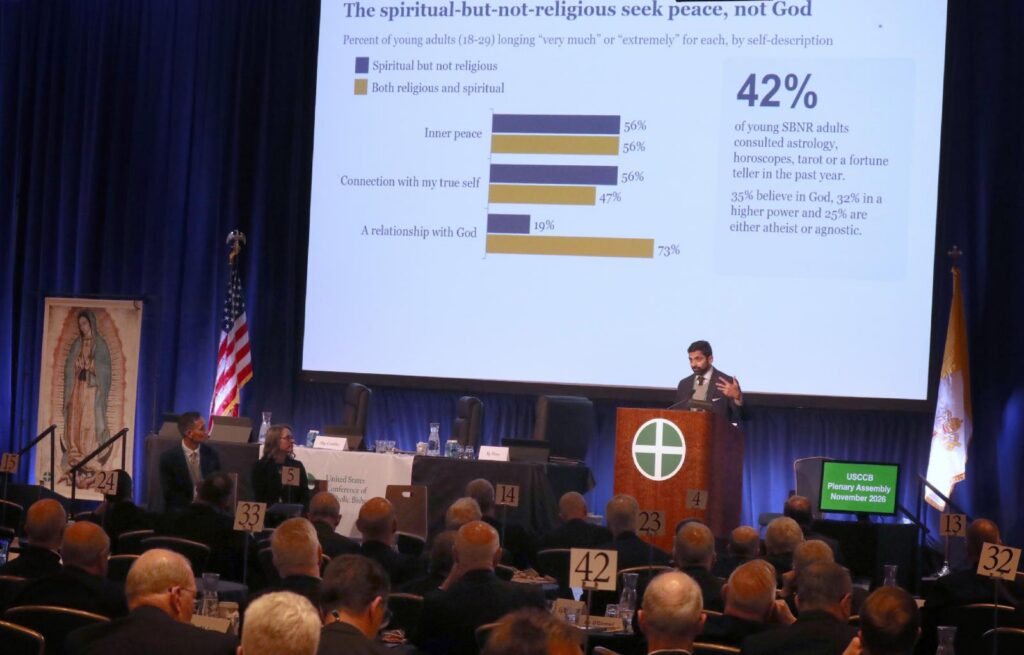
Brandon Vaidyanathan, a professor of sociology at The Catholic University of America, opened the discussion with findings from “The 2026 Beauty and Belief Survey,” which CUA and Gallup conducted in March and April of 2026. The organizations surveyed nearly 5,000 U.S. adults total, including 1,165 young adults ages 18 to 29.
He highlighted that young adults, and especially young Catholics, say religion has grown in importance for them, as 64% of Catholic young adults say religion is more important to them now than it was five years ago, compared to 41% of Catholic adults over 30. For 82% of young Catholics who said their faith grew, they reported that encountering beauty in religious spaces or rituals was important to that change.
‘Religious but not spiritual’
This generation identifies as less “spiritual” and more “religious but not spiritual” than its elders, as 30% of young Catholics describe themselves as “religious but not spiritual,” in comparison to 12% of older Catholics, and only 14% of young Catholics are “spiritual but not religious.”
Another significant finding was that while the next generation of U.S. Catholics are mostly Hispanic (58% of young adults and 29% of adults age 30 and older), Hispanic young Catholics attend weekly Mass at about half the rate as non-Hispanic Catholics, 18% compared to 33%.
He noted that the young overall — more than those over 30 — yearn for connection to community (33% to 20%), moral guidance (26% to 16%) and a relationship with God (41% to 40%).
Desire for identity
Angela Franks, associate professor of theology at CUA, spoke to the bishops about the desire for identity among the young and what evangelization opportunities and pitfalls that presents the Church.
In her analysis, she employed sociologist Zygmunt Bauman’s term “liquid modernity” and his thinking that “in our contemporary moment, we privilege things such as fluidity, flexibility and change” in contrast to “pre-modern societies that valued stability, solidity.”
“In solid societies,” she explained, “we form our identities in dialogue with solid social structures,” but “in liquid societies, our identities are much more difficult to form. We tend to mistrust solid institutions. Thus, in modernity, identity becomes a project.”
Identity politics provide “very visible identities behind which there’s usually a group of noisy supporters for that identity,” Franks said. However, these assumed identities “tend to be easy to join, but also easy to leave” and are “often very superficial.”
While “some people love this very liquid nature of identity formation because it’s wrapped up with freedom, other people are deeply uncomfortable with it,” she said, noting “The 2026 Beauty and Belief Survey” findings that many young people are seeking moral guidance.
“There is therefore a desire for stability, and in this situation, the Catholic Church is perceived often as the most solid possible institution they can find,” she said, which she sees as one driver of young adult conversions.
Church both solid and fluid
Franks noted that the “problem” with this is that “it is only a half-truth that the Church is solid.”
“Against the background of our very liquid culture, Christianity looks exceptionally solid,” and while “there is plenty that is solid about Christianity” such as its dogmas, traditions, ecclesiastical hierarchy and ordered liturgy, when Christianity arose in antiquity “it actually served as a liquefying force in many ways, especially with identity.”
She gave examples from the New Testament, including Simon Peter, who, she said, “is pulled out of all of the solid structures that would have constituted his identity. He’s given a new name; he’s given a new mission.” She noted “Saul’s life being turned 180 degrees: He becomes Paul.”
The Church, however, stands against extreme fluidity, as the Church is “never promoting unprecedented novelty, because she’s interpreting the person of Jesus Christ who is the revelation of the Father,” Franks said.
Meanwhile, against extreme solidity, the Church develops “our understanding of this teaching through time as questions arise,” she said. “And so therefore we have the Magisterium, guided by the Holy Spirit, to work in these new historical situations.”
She advised “a better psychology as well as a better ecclesiology, recognizing that my personal foundation is rooted in the triune God, and therefore is rooted in his reliable personal love for me, but also that the Church is divinely equipped to ride through the vicissitudes of history.”
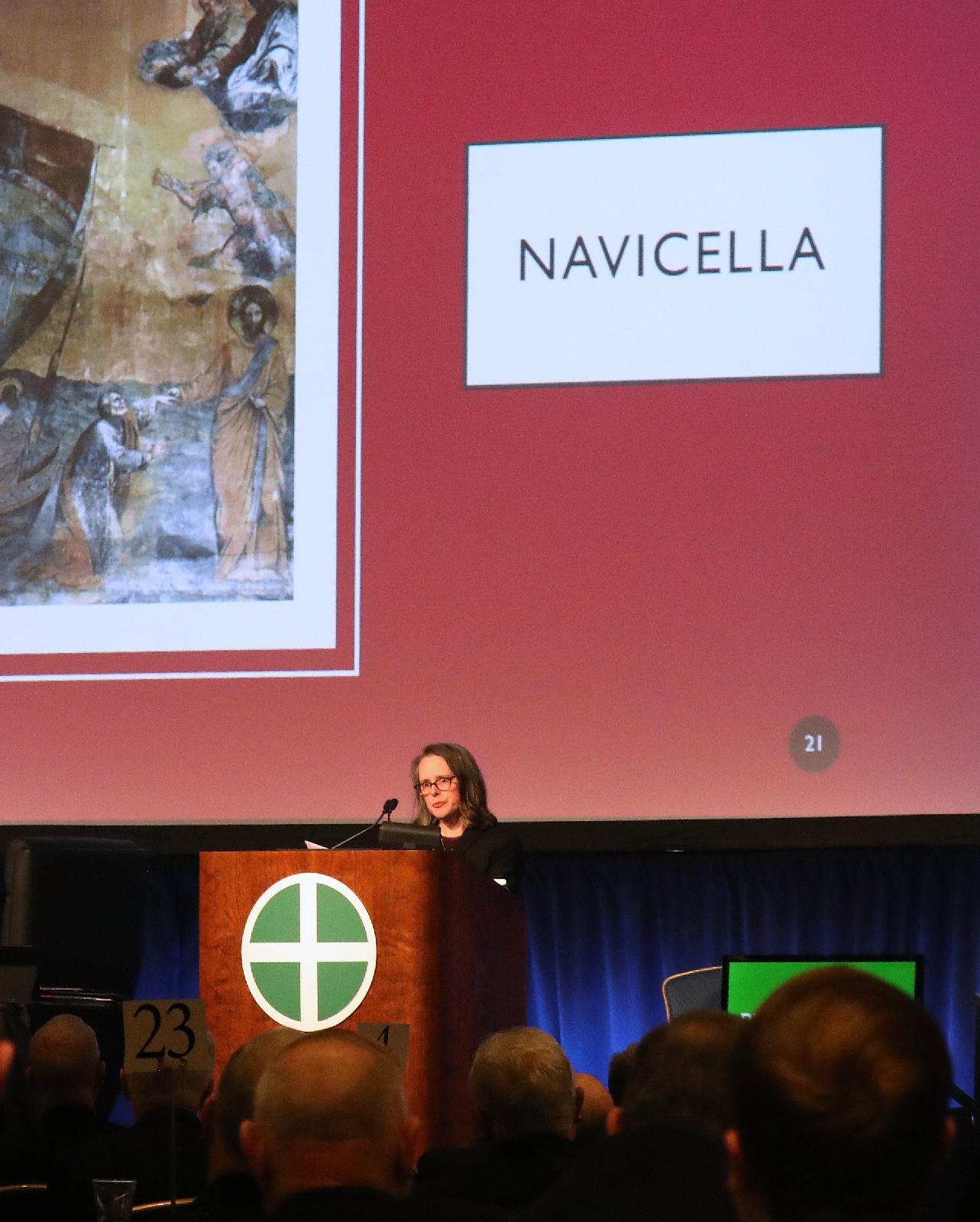
Franks concluded by showing an image of the “Navicella,” a large, 13th-century mosaic by Giotto that was on the facade of the old St. Peter’s Basilica in Rome. It depicts the Church “as a solid boat right in the midst of the liquid world, following her Lord, who has stepped out into this liquid world,” she said.
Gen Z campus minister’s testimony
Joshua Abando, campus minister for undergraduate formation at CUA and himself a member of Gen Z (which is generally defined as someone born in 1997-2012), told the bishops that he did not have slides or data, but rather “stories to tell” about his own journey of deepening his faith and the faith journeys of the young adults he works with.
Abando was raised Catholic by his parents, who immigrated to the U.S. from the Philippines. He said that while he knew the rules of the faith, having an intimate relationship with Christ was “something that was a little bit foreign to me.”
He attended college at George Mason University in Virginia and became involved in campus ministry. Peers and missionaries from the Catholic campus evangelization organization FOCUS helped him to grow in his faith.
One of Abando’s mentors made an impact through being present “carefully, patiently, each and every day, to just talk about simple things about the faith, but the most important thing was to actually challenge me to grow in the faith life,” he said.
‘Actually walking with people’
Abando eventually felt called to be a FOCUS missionary himself, and he served at a secular university in New Jersey. “One of the most beautiful times I had as a missionary out there was actually walking with people,” he said, “teaching them how to pray, to open the Bible, like what exactly is the core root of the Gospel? What is actually the whole entire story here? What exactly is the Mass? How do I pray the rosary? How do I actually have authentic friendships that are rooted in Christ?”
He said that his role as a CUA campus minister has challenged him in a different way, as it is “a Catholic university where the majority are Catholic, but there’s this need and desire to go deeper into the faith.”
He noted the survey’s finding that young people interested in religion or spirituality are seeking direction and peace. He has witnessed in his role that students who lead peer-to-peer small groups and encourage their friends to encounter the faith felt “empowered to be doing this, and they felt encouraged to think that they’re able to share the faith.”
“They need constant encouragement,” he said. “Words of affirmation, yes, but they want to be able to see people with themselves on the same mission. One of the most beautiful things that I get to do on a weekly basis is table with our students in our student center. And sometimes their friends will stop them, but I get to see their boldness kind of grow.”
“This generation is more connected than ever,” he added, “Through social media, everything that’s going on and I think that’s honestly a beautiful thing. And because of that, there is that deep sense of yearning for community.”
‘A generation willing to get vulnerable’
“This is a generation that is willing to get vulnerable,” he said. “They want to ask the tougher things and even sometimes be a little bit too vulnerable, but there is something beautiful that they are willing to just share their hearts directly in a way with their peers.”
In this time of artificial intelligence, he said, “I think more than ever, this generation is looking for something solid, something that is proven, something that is real, tangible, and that’s done with this Church and with this community.”
The panelists then fielded several questions from the bishops, including one from Archbishop Thomas G. Wenski of Miami, who said that if secularism was viewed as a sort of disenchantment, this new seeking from the young could be “a search for re-enchantment,” which he sees in “the young people that go to Latin Mass and insist on going to Latin Mass.” He sees them “looking for the rediscovery of the magic, if you will, the enchantment of what the Catholic Church has in great numbers.”
Vaidyanathan replied that he believes “we’ve moved away the locus of enchantment from traditional religion to all of these other forms, the tarot and so on, that at least the millennials have been indulging,” but he believes that today with “the plateauing of secularization to some degree” comes a “questioning of whether we can find enchantment in some of those traditional forms we’ve abandoned, whether or not we’ve been too hasty to abandon them.”
Vaidyanathan said he sees that question emerging for Gen Z in a way that it did not for millennials.
Lauretta Brown is culture editor for OSV News. Follow her on X @LaurettaBrown6.
