

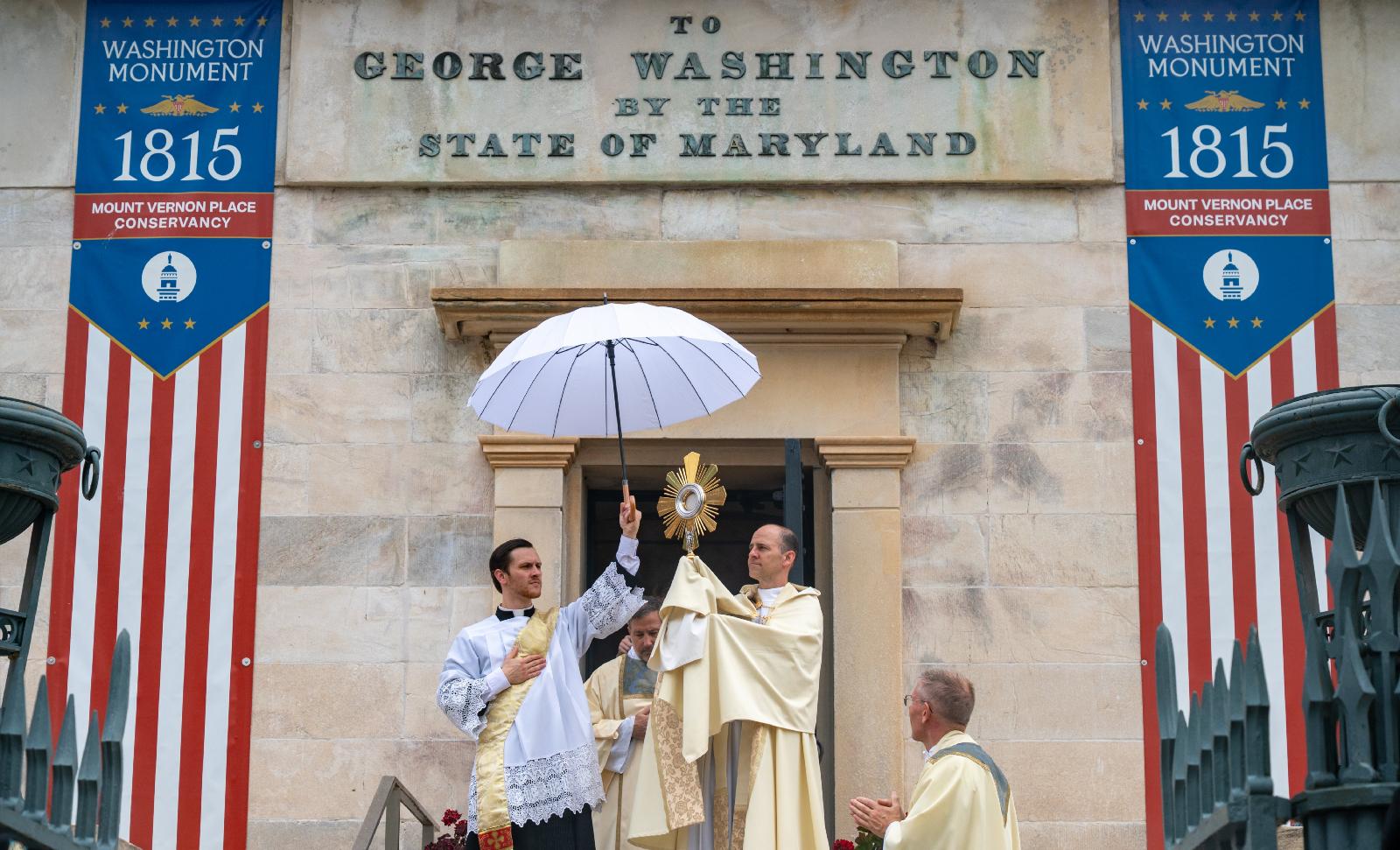
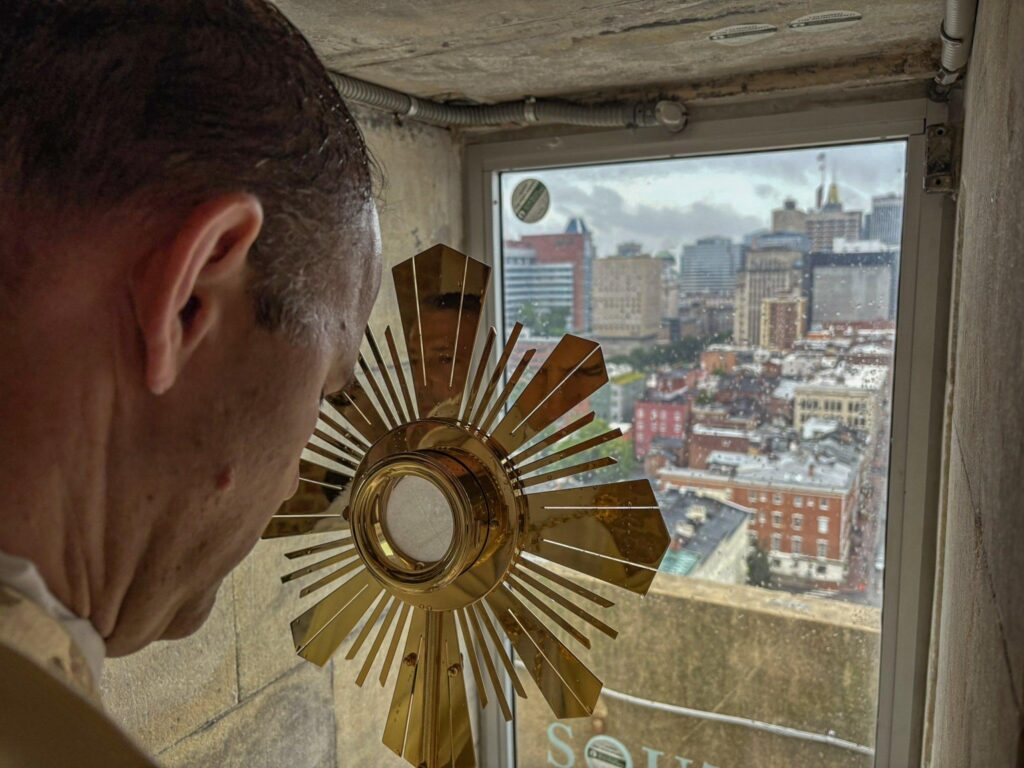
BALTIMORE (OSV News) — Carrying a golden monstrance containing the Blessed Sacrament, Father Michael DeAscanis paced his 227-step climb up downtown Baltimore’s Washington Monument June 10, repeatedly praying one complete “Glory Be” for every 10 steps until he reached the top.
The steady spiral ascent brought the priest of the Archdiocese of Baltimore more than 120 feet above the city to a lookout inside the historic monument. There, framed by windows facing in every direction, he raised the monstrance and traced the Sign of the Cross — blessing Baltimore from north, south, east and west.
Below, more than 200 people gathered outside the monument, designed in 1815 by American architect Robert Mills, who later designed the Washington Monument in Washington.
As Father DeAscanis offered a prayer for Baltimore and the nation, the crowd — wet from morning showers — sang religious and patriotic hymns, including “God Bless America.”
The poignant moment was part of the June 9-11 Baltimore leg of the 2026 National Eucharistic Pilgrimage, which began May 24 in St. Augustine, Florida, and is making its way up the East Coast to Maine and then back down to Philadelphia as part of celebrations surrounding America’s 250th anniversary. Nine young adults, known as “perpetual pilgrims,” are on the route and plan to travel every mile.
Held under the theme “One Nation Under God,” the pilgrimage arrived in the Baltimore Archdiocese June 9. The June 10 events in Baltimore began with morning Mass at the Basilica of the National Shrine of the Assumption of the Blessed Virgin Mary, the United States’ first Catholic cathedral.
People ‘looking for hope’
Kathy Bentz, a parishioner of Our Lady of Hope in Dundalk, Maryland, took a day off from work to attend the pilgrimage. Faith is needed more than ever, she said, because people are “looking for hope.”
“I need to be around people who get me and I get them,” she said. “And that’s why I’m here. I feel like I’m in the presence of good and it makes me want to do better.”
A young man from Glen Burnie, who helped carry an ornate baldacchino sheltering the Blessed Sacrament as it processed through the streets, called it an honor. He declined to give his name but said he came to pray for the nation — and was looking ahead to June 11, when U.S. bishops planned to consecrate the U.S. to the Sacred Heart of Jesus during their spring plenary assembly in Orlando.
“I think that the consecration to the Sacred Heart is going to make a tangible difference in our country,” he said. “I care about our country.”
The first Washington monument
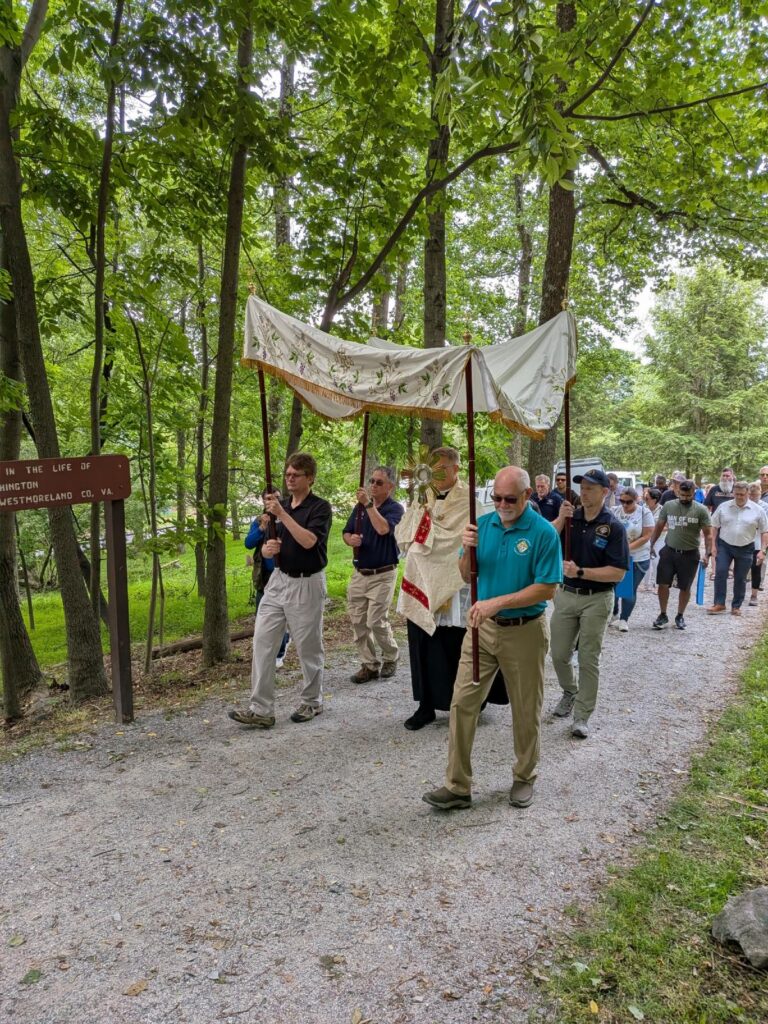
The National Eucharistic Pilgrimage began its journey through the Baltimore archdiocese with a June 9 procession at the site of the nation’s first monument to George Washington — a stoic stone tower in Boonsboro, just off the Appalachian Trail in Washington Monument State Park.
As the nine perpetual pilgrims followed the Eucharist under a baldacchino to the monument, they were joined by 130 others from all over the archdiocese and beyond to watch Father Jeffery Dufresne of the Archdiocese of Indianapolis take the holy Eucharist to the top of the monument and down, before presenting it on the altar.
“It was extremely beautiful to see Jesus overlooking the valley that he created,” said Zachary Robinson, a Catholic from Westminster, Maryland, as he hiked back. He called it “an experience of God just delighting in the beauty of his creation.”
From Boonsboro, the pilgrimage traveled to Hagerstown, where close to 450 people attended Mass at St. Mary June 9 before joining a procession on the streets around the church.
Birthplace of Declaration’s Catholic signer
From Hagerstown, the pilgrimage went to Baltimore for the June 10 morning procession and then continued to Severna Park for an afternoon retreat focused on the Sacred Heart. The pilgrims ended the day in Annapolis, Maryland’s capital and home to the U.S. Naval Academy, with a procession beginning at the city’s historic St. Mary’s Church, followed by sunset Eucharist adoration.
St. Mary’s campus includes the birthplace of Charles Carroll of Carrollton, the only Catholic signer of the Declaration of Independence. Charles Carroll was the cousin of Archbishop John Carroll, the first bishop of Baltimore.
While a thunderstorm greeted everyone as they arrived at St. Mary, only a few raindrops were falling when the Eucharistic procession to the State House began. Singing songs and saying prayers in both English and Spanish, participants waved white flags, carried signs saying “Jesus, I Love You” and smiled at those gathered to watch the procession.
As they walked, the nine perpetual pilgrims reached out to those lining the parade route asking if they knew what the procession was about and sharing information about the Eucharist.
“It’s part of our ministry,” said pilgrim Raymond Martinez II of the personal encounters, noting that along the way he has met both non-Catholics and Catholics who have lapsed in their faith.
Continuing northward
The pilgrimage continued from the Archdiocese of Baltimore into the Diocese of Wilmington, which encompasses the state of Delaware and Maryland’s Eastern Shore, June 11-12. Events there are expected to include a procession on the boardwalk in Ocean City, Maryland.
Pilgrims then plan to spend the June 12-14 weekend in the Diocese of Camden, New Jersey, with a stop in Gloucester City to commemorate Fort Nassau, the state’s first European settlement.
Since its Pentecost Sunday launch, the pilgrimage has traveled through the dioceses of St. Augustine, Florida; Savannah, Georgia; Charleston, South Carolina; Charlotte, North Carolina; Richmond, Virginia; and Arlington, Virginia; and the Archdiocese of Washington.
George P. Matysek Jr. is the managing editor for the Catholic Review, the newspaper of the Baltimore Archdiocese. Contributing to this story was Catholic Review Media news correspondent Katie V. Jones and OSV News. This article was published in Catholic Review and distributed in partnership with OSV News.
