



WASHINGTON (OSV News) — The U.S. Supreme Court on Oct. 15 heard oral arguments in a case over a key provision of the Voting Rights Act intended to protect racial minorities.
The same week in Washington, the federal government shutdown continued, and senators questioned the FDA’s recent approval of a new generic form of mifepristone — a pill commonly, but not exclusively, used for abortion.
Supreme Court considers provision of Voting Rights Act
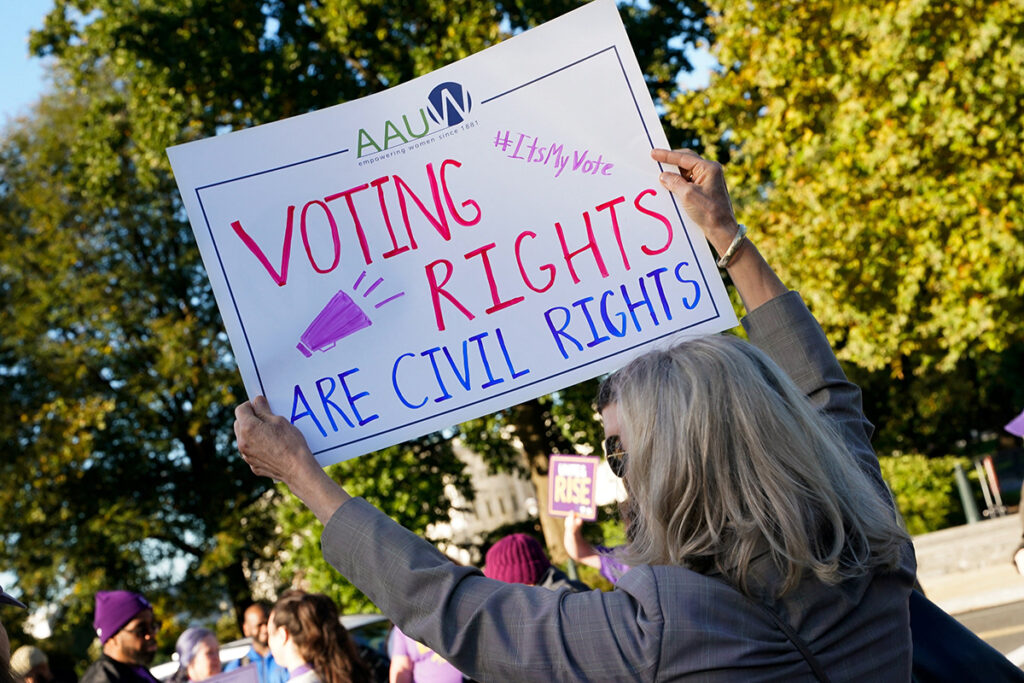
The U.S. Supreme Court on Oct. 15 heard oral arguments in Louisiana v. Callais, a case that might result in changes to the landmark Voting Rights Act.
The case also concerns the drawing of a second majority-Black U.S. House district in Louisiana, which has been challenged as unconstitutional racial gerrymandering, a term used to describe when district maps are drawn in such a way as to benefit one party or sometimes a particular individual to be elected to represent it.
Although the law aims to protect the electoral influence of racial minorities, the justices weighed whether incorporating race as a factor in redistricting — as courts have previously interpreted as protected by the Voting Rights Act — is constitutional.
Section 2 of the Voting Rights Act — a law first signed by President Lyndon B. Johnson during the height of the civil rights movement and later reauthorized by President George W. Bush — has long aimed at blocking states from deliberately “packing” Black voters into a small number of House districts in an attempt to dilute their electoral influence.
Depending on the scope and timing of the court’s ruling in the case, it could have a significant impact on the district maps for the 2026 midterm election cycle.
Government shutdown continues
The federal government shutdown reached its 17th day on Oct. 17 as Congress continued to appear deadlocked on funding legislation.
During a government shutdown, some types of essential government services are exempt, including Social Security payments to older adults, but many other functions of government are suspended. Hundreds of thousands of federal workers are subject to furloughs, meaning they must stop working and will not be paid until the federal government reopens.
As a path to ending the shutdown remained unclear, an Oct. 17 AP-NORC poll found that majorities of Americans blamed President Donald Trump and both major parties for the stalemate.
The largest majority (58%) said Trump and congressional Republicans deserve a “great deal or quite a bit” of blame for the shutdown, while 54% said the same of congressional Democrats.
Senators ask FDA why it approved a new generic pill for abortion
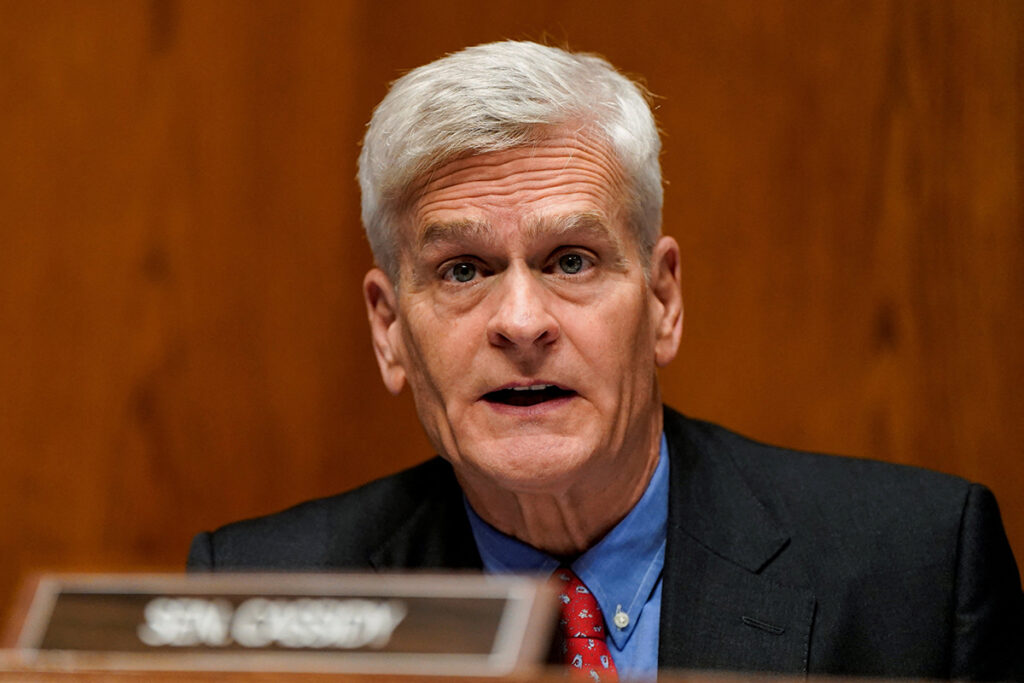
Sen. Bill Cassidy, R-La., chair of the Senate Health, Education, Labor and Pensions (HELP) Committee and a medical doctor, sent an Oct. 16 letter to the head of the Food and Drug Administration asking about its recent approval of “another generic form of the chemical abortion drug, mifepristone.”
Cassidy, joined by some of his Republican colleagues, wrote to FDA Commissioner Dr. Martin Makary, “it is imperative that you provide an update on your review of mifepristone and your plans to reinstate necessary safeguards.”
On Sept. 30, the FDA notified Evita Solutions that its generic version of mifepristone was approved, despite previous suggestions from FDA and Department of Health and Human Services officials that mifepristone would undergo a review.
“To be clear: this approval fails to mitigate the risks to women that have been identified and fails to protect women from the coercive use of the drug,” the senators wrote. “It also flies in the face of President Trump’s strong statement that he is ‘the most pro-life president’ in history and his dedication to protecting the lives of unborn children and keeping women safe.”
Previously, 51 senators, led by Sen. Lindsey Graham, R-S.C., sent a similar letter Oct. 9.
The Trump administration’s approval of the generic drug prompted criticism from pro-life advocates, including former Vice President Mike Pence.
Approved by the FDA for early abortion in 2000, mifepristone — the first of two drugs used in a medication-based abortion — gained the moniker “the abortion pill.” However, the same drug combination has sometimes been used in recent years for miscarriage care, where an unborn child has already passed, a situation that Catholic teaching would hold as morally licit use.
Trump IVF policy draws reaction from bishops
Trump on Oct. 16 announced a policy proposal to increase access to in vitro fertilization, including issuing guidance urging employers to offer fertility benefits directly to their employees.
Trump previously campaigned on requiring the government or insurance companies to pay for IVF, which is a form of fertility treatment opposed by the Catholic Church on the grounds that it often involves the destruction of human embryos, among other moral and ethical concerns.
In an Oct. 17 statement, Bishop Robert E. Barron, chairman of the U.S. Conference of Catholic Bishops’ Committee on Laity, Marriage, Family Life and Youth; Bishop Kevin C. Rhoades, chairman of the Committee for Religious Liberty; and Bishop Daniel E. Thomas, chairman of its Committee on Pro-Life Activities, said, “Every human life, born and preborn, is sacred and loved by God. Without diminishing the dignity of people born through IVF, we must recognize that children have a right to be born of a natural and exclusive act of married love, rather than a business’s technological intervention. And harmful government action to expand access to IVF must not also push people of faith to be complicit in its evils.”
“We will continue to review these new policies, and look forward to engaging further with the Administration and Congress, always proclaiming the sanctity of life and of marriage,” the bishops said.

In an Oct. 17 statement, Bishop Michael F. Burbidge of Arlington, Virginia, said, “It is imperative that law and policy uphold the dignity and rights of each person from the very first moment of his or her existence.”
“Thankfully, the White House has not introduced any federal mandate that medical insurance cover IVF, and these recent announcements do not directly violate religious liberty or conscience rights,” he said. “Yet, the fact remains that IVF is contrary to the common good and therefore it is wrong for the federal government to promote IVF as if it were a morally neutral form of fertility care.”
IVF is among the fertility treatments to which the Catholic Church objects in its teaching. The 1987 document from the Congregation (now Dicastery) for the Doctrine of the Faith known as “Donum Vitae” (“The Gift of Life”) states the church opposes IVF and related practices, including gestational surrogacy, in part because “the connection between in vitro fertilization and the voluntary destruction of human embryos occurs too often.”
Charlie Kirk posthumously awarded Medal of Freedom
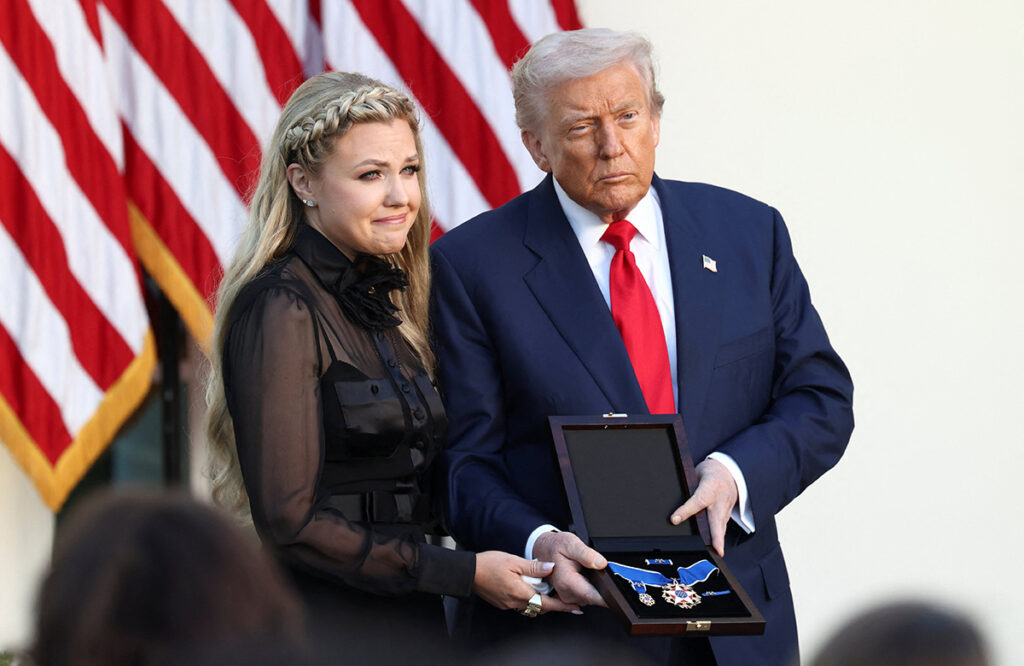
Trump on Oct. 14 posthumously awarded the Medal of Freedom to the late conservative activist Charlie Kirk.
Kirk was killed Sept. 10 during an event at Utah Valley University in Orem. After his death, Kirk received praise from his allies in conservative politics for his willingness to debate and his advocacy for their cause. However, in discussions about his legacy, his critics also pointed to his controversial political rhetoric on subjects including race, persons experiencing same-sex attraction or gender dysphoria, and immigrants, with some Christians saying it presented an incoherent witness to the Gospel.
Trump presented the award, the nation’s highest civilian honor, to Kirk’s widow, Erika Kirk, on what would have been his 32nd birthday.
During the ceremony, Trump said he couldn’t change the date despite his travel to the Middle East marking the initial ceasefire between Israel and Hamas.
“I was going to call Erika and say, ‘Erika, could you maybe move it to Friday?’ And I didn’t have the courage to call. But you know why I didn’t call? Because I heard today was Charlie’s birthday.”
During her own remarks, Erika Kirk said that her late husband “probably would have run for president, but not out of ambition.”
White House marks Down Syndrome Awareness Month
White House press secretary Karoline Leavitt shared on social media Oct. 14 Trump’s message marking Down Syndrome Awareness Month, in which the president said, “We celebrate the extraordinary individuals living with Down Syndrome who bring joy, wonder, and meaning to the world — and we extend our heartfelt gratitude to the families and caregivers who navigate the challenges and blessings of raising children with developmental disabilities with unconditional love.”
“Every year, an estimated 5,000 babies — 1 in every 775 — are born in the United States with Down Syndrome,” the original Oct. 10 message said. “This condition alters the course of a child’s development and causes cognitive delays that bring uncertainty and fear to affected families. Thankfully, advancements in research, screening, protocols of care, intervention therapies, and treatments have extended the quality of life and the life span of children and adults living with Down Syndrome.”
“There are now more opportunities than ever before for independence, meaningful employment, and integration into classrooms and communities so that all individuals with Down Syndrome can enjoy full participation in American life,” Trump added.
Kate Scanlon is a national reporter for OSV News covering Washington. Follow her on X @kgscanlon.
