


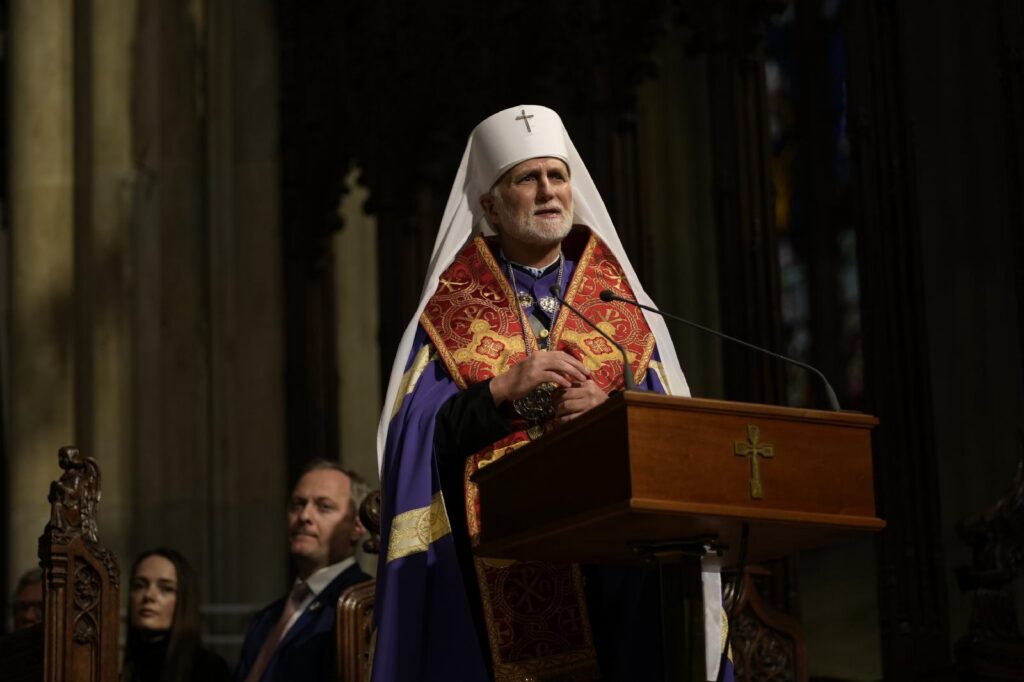
NEW YORK (OSV News) — “God’s truth will prevail” over past and present Russian atrocities in Ukraine — and people of goodwill are called to do their part through prayer, awareness and advocacy, said Metropolitan Archbishop Borys A. Gudziak of the Ukrainian Catholic Archeparchy of Philadelphia.
The archbishop joined Archbishop Daniel of the Western Eparchy of the Ukrainian Orthodox Church of the USA in presiding over a Nov. 21 prayer service at St. Patrick’s Cathedral in New York honoring the victims of the Holodomor famine.
Also on hand for the memorial — which saw the cathedral’s pews filled — were Ambassador Andrii Melnyk, Ukraine’s permanent representative to the United Nations; Denys Sienik, chargé d’affaires at the Embassy of Ukraine in the U.S.; human rights lawyer Oleksandra Matviichuk, chair of the Nobel Prize-winning Center for Civil Liberties; and Michael Sawkiw Jr., president of of the Ukrainian Congress Committee of America and chair of the U.S. Committee for Ukrainian Holodomor Genocide Awareness.
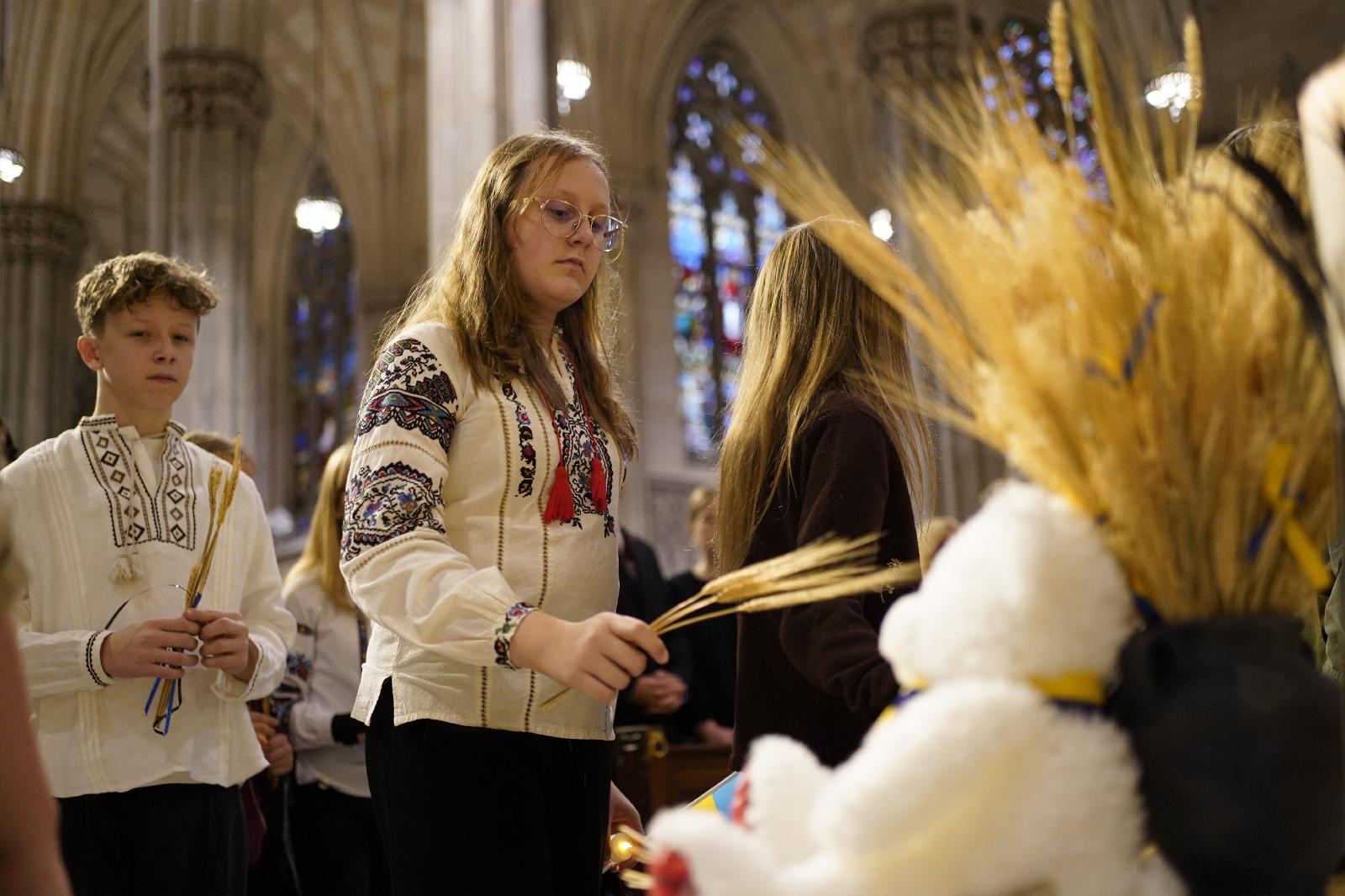
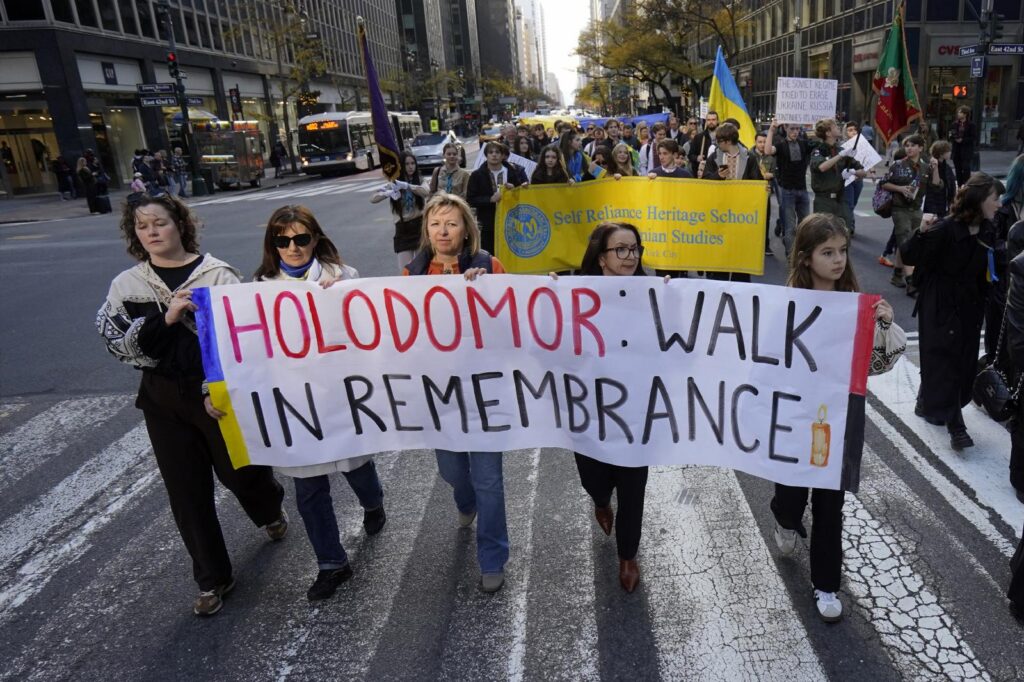
Prior to the gathering, several hundred participants processed more than 2 miles to the cathedral from St. George Ukrainian Catholic Church in the city’s East Village section, carrying signs along with symbolic stalks of wheat, which they laid on a table before the cathedral’s sanctuary. Two wounded Ukrainian soldiers, Valentyn and Artur, solemnly traversed the cathedral’s aisle in military attire.
‘Panakhyda’ is memorial for the deceased
The prayer service — a “panakhyda,” or Eastern Catholic and Christian memorial for the deceased — took place ahead of the Holodomor Remembrance Day, which will be marked Nov. 28 this year.
Named for the Ukrainian words signifying “hunger” and “death,” the Holodomor was a 1932-1933 starvation campaign orchestrated by Soviet dictator Joseph Stalin as part of a brutal Soviet policy of collectivization, theft, terror and abuse that sought to erase Ukrainian cultural and political identity.
According to analysts, the famine claimed approximately 4 million Ukrainian lives, with some estimates counting 7 million to 10 million slain. At its height in June 1933, the Holodomor saw approximately 28,000 Ukrainians die each day, according to the U.S. Committee for Ukrainian Holodomor Genocide Awareness.
The Holodomor has officially been recognized as a genocide by more than 30 countries, as well as by over 30 U.S. states.
And, said speakers at the Nov. 21 prayer service, genocidal aggression against Ukraine continues as Russia’s war on that nation — initiated in 2014 and accelerated by a 2022 full-scale invasion — approaches the 13-year mark.
Long-running blockade has left residents starving in Oleshky
A long-running blockade in the Russian-occupied town of Oleshky, located in Ukraine’s Kherson Oblast, has seen residents resort to eating soup made from weeds, with starvation deaths and a lack of basic necessities triggering sanitation and humanitarian crises, according to the Institute for the Study of War, or ISW.
In September, the Ukrainian Council of Churches and Religious Organizations appealed for urgent action to address “the humanitarian catastrophe in the city of Oleshky.”
While still in Rome’s Gemelli Hospital following his October lung cancer surgery, Pope Leo XIV called Russian President Vladimir Putin to urge a ceasefire and the delivery of humanitarian aid to the besieged community.
Despite the Oct. 27-Nov. 1 ceasefire and the evacuation of some 800 civilians, conditions in Oleshky have continued to erode, with an estimated 1,300 residents again facing “critical shortages of food, medicines, and firewood for heating,” said ISW in a Nov. 19 update.
“The historical parallels are impossible to ignore,” said Sawkiw.
Archbishop Gudziak echoed that observation.
Children are being ‘reduced to frail, skeletal figures perishing in silent agony’
“Chills went down my spine as these children came up, placing symbols of God-given life and sustenance … on this table, when I thought of children like them reduced to frail, skeletal figures perishing in silent agony,” he said. “And the chills continue when I realize that every hour of every day in Ukraine, children are being bombed, children are being abducted, brainwashed, stripped of dignity, identity … of their very life.”
Action must accompany the lament for and remembrance of human suffering, the event’s speakers stressed.
Sienik said that Russia’s current attacks on Ukraine constitute “genocide unfolding again before the eyes of the world,” warning that “unpunished evil always returns” and that “appeasement only feeds its appetite.”
Melnyk quoted from the Book of Obadiah, in which the prophet condemns the inaction of those who witness suffering but fail to intervene.
Even amid the horrors of the Holodomor and the anguish of Russia’s current aggression in Ukraine, hope prevails, said speakers.
Matviichuk — who shared she was the descendant of Holodomor survivors — said the famine is “a story about pure horror, but also the unbelievable strength to continue,” she said.
Archbishop Gudziak described Ukraine’s survival as “a miracle.”
“It’s the grace of God,” he said. “It’s God’s will to protect the innocent.”
Urging those present to “pray, advocate and help,” he quoted from St. Paul’s Letter to the Romans: “Hope does not disappoint, because the love of God has been poured into our hearts through the Holy Spirit” (Rom 5:5).
“The Holy Spirit is in your hearts,” he said. “Feel it, and his hope will prevail.”
Gina Christian is a multimedia reporter for OSV News. Follow her on X @GinaJesseReina.
