


BALTIMORE (OSV News) — The U.S. Conference of Catholic Bishops has agreed on updates to its guidelines for socially responsible investment, addressing among other concerns artificial intelligence, private prisons, cryptocurrency and prediction markets.
The move came amid the USCCB’s annual fall plenary assembly, held Nov. 16-19 in Baltimore.
The Nov. 18 vote on refining the guidelines — which were last revised in 2021 — was almost unanimous, with 217 bishops in favor, one abstaining and none against the action item.
The USCCB relies on the guidelines in its investment strategy, and shares them with dioceses, eparchies, religious communities and other Catholic organizations for their voluntary use.
In its investment guidelines, the USCCB clarifies that it “does not endorse the services or products of any financial advisors and investment firms.”
But the document said the bishops’ conference remains firm on doing “all we can to ensure that we invest in those corporations and institutions that promote human dignity and enhance the common good.”
Balancing profit and social benefit
Often referred to as simply SRI, socially responsible investment balances profitable returns with benefit to society. Emerging in the 1970s amid a number of social justice movements, the practice increasingly gained traction in the 1980s and 1990s.
In North America, Catholic women religious — along with civil rights proponents and faith-based organizations — were among the early advocates of SRI strategies, according to a 2020 historical overview by Blaine Townsend of Bailard, a national independent wealth and asset management firm.
The Church’s social teaching — which draws on papal, conciliar and Church documents to articulate the means of building a just society and living out holiness in modern life — “provides investors with tools for proper discernment, making prudent and faith-based decisions for obtaining good value that is also of a wider common good,” said the USCCB in its investment guidelines.
The bishops frequently cited “Mensuram Bonam,” a 2022 publication by the Pontifical Academy of Social Sciences that outlines faith-based measures for Catholic investors.
The Church’s wisdom is crucial in navigating “the entangled web of corporate relationships that is today’s economy,” said the bishops in their guidelines.
Policy areas, strategies and tactics
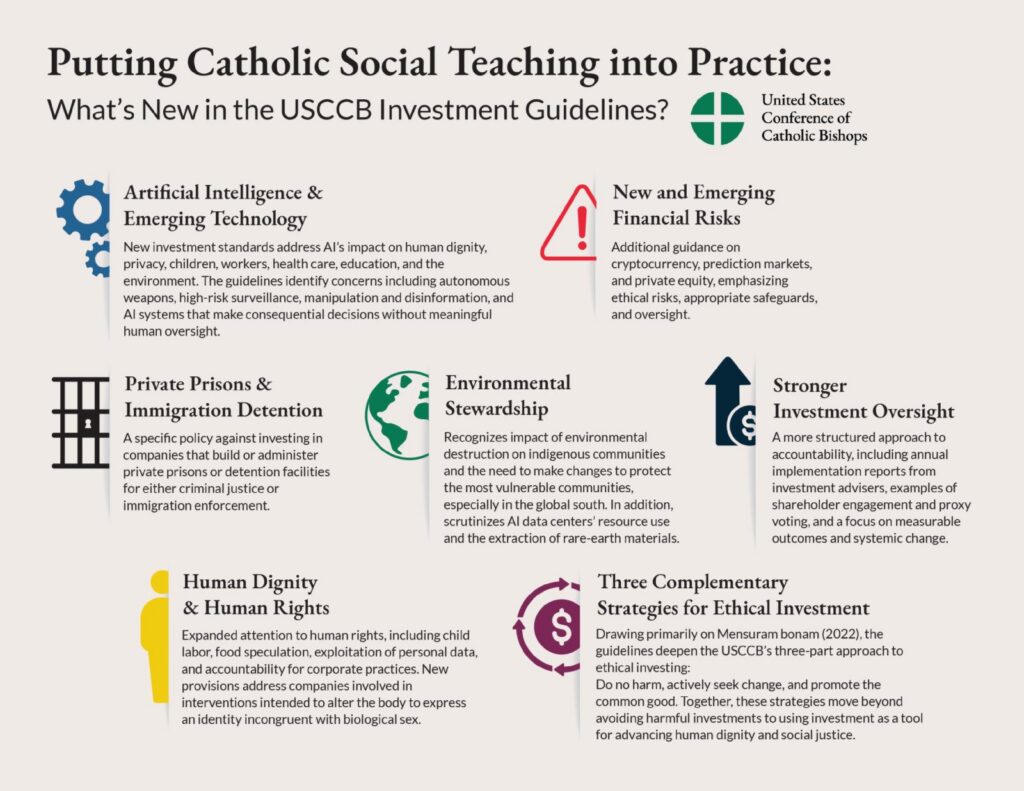
The USCCB’s investment guidelines span five key categories: protecting human life, promoting human dignity, enhancing the common good, pursuing economic justice and care of creation.
Three strategies shape the bishops’ investment policies: avoiding harm, actively working for change and promoting the common good.
The bishops rely on two key tactics in discerning their investments.
One is shunning companies that directly engage in or support activities gravely contrary to Catholic teaching.
Those activities include abortion, euthanasia, assisted suicide, in vitro fertilization, embryonic stem cell and fetal tissue research, human cloning, pornography and commerical sexual exploitation, sexual alteration or contraception.
Consistent with their long-running concerns over the privatization of the prison industry — a stance they made clear in their 2000 pastoral statement on the criminal justice system — the U.S. bishops also refuse to invest in “companies that build or administer private prisons or private detention facilities, either for the criminal justice system or the system of immigration enforcement.”
Where corporate activities or affiliations present gray areas, the bishops employ a second approach — shareholder advocacy, which relies on dialogue and voting to tackle social concerns.
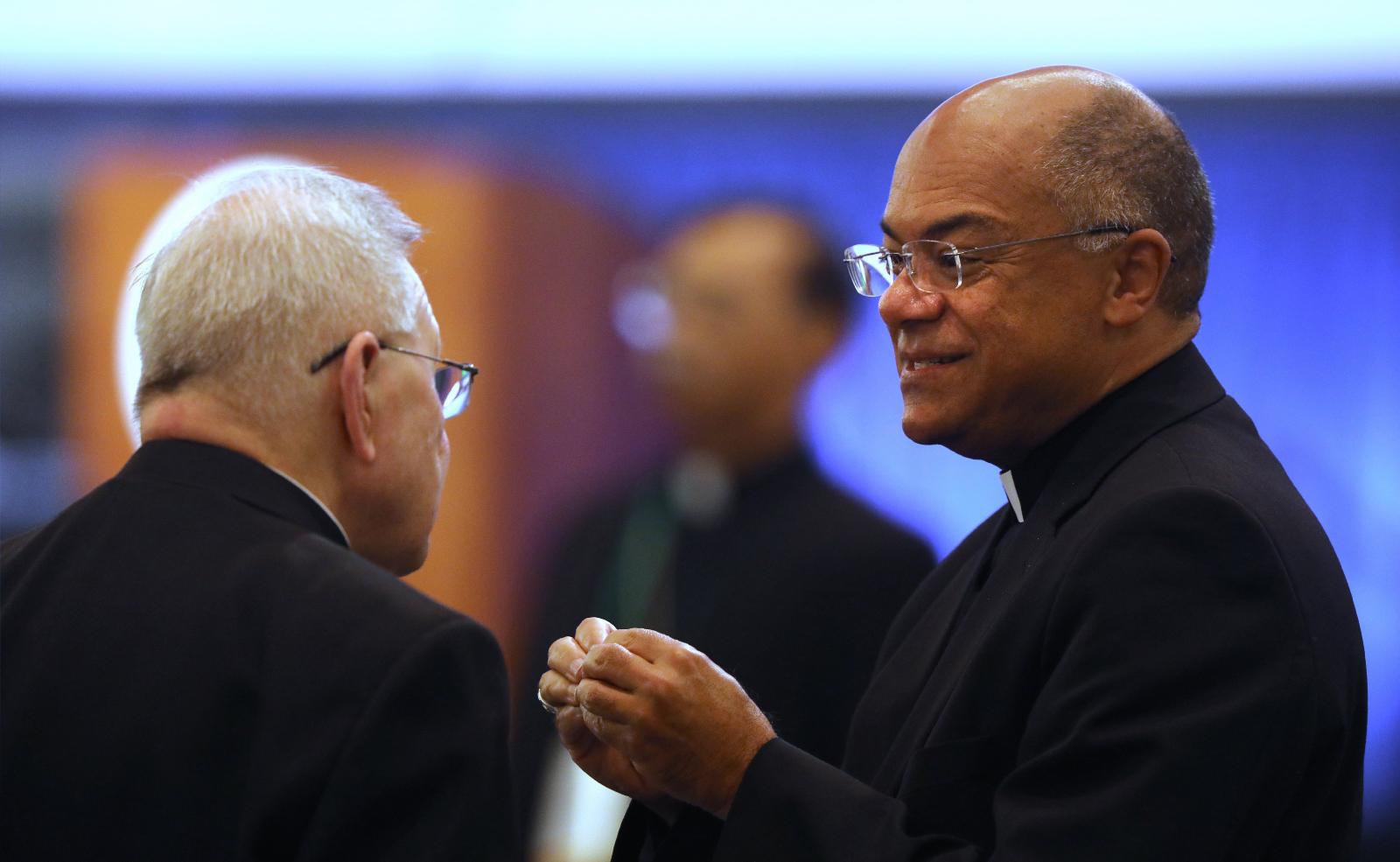
“You have a right as a shareholder to approach those who lead the investment fund that you are in, and to share your thoughts, to respond to proposals they are making and to encourage them to be moral in what they do,” Archbishop Shelton J. Fabre of Louisville, Kentucky — who presented the proposed guideline revisions in his role as chair of the USCCB’s Committee on Domestic Justice and Human Development — told OSV News.
Still, said Archbishop Fabre, even with the most earnest shareholder advocacy, “you might reach that place where you have to disinvest.”
A mixed methods approach
In a number of cases, the USCCB relies on a combination of tactics when implementing its SRI decisions.
For example, the conference refuses to invest in firms that “derive any revenue” from producing “weapons inconsistent with Catholic teaching on war,” such as biological and chemical weapons, landmines, nuclear weapons and weapons of mass destruction.
At the same time, the USCCB relies on shareholder advocacy regarding “companies that may cause, contribute to, or be linked to warfare, such as technology companies or financial institutions.”
Along with weapons and warfare, AI is another issue for which the bishops rely on their full range of investment options — flatly refusing to invest in companies that “design, develop or manufacture AI technologies that fail to safeguard the dignity of the human person,” while identifying multiple “areas of challenge” and “opportunity.”
Emerging issues
The USCCB investment guidelines also note several “emerging issues” that present moral and ethical quandaries for portfolios.

The bishops stressed that cryptocurrency — digital currencies whose value is based on market and technology conditions, rather than actual legal tender — “should be viewed with caution.”
While cryptocurrency “has grown in popularity over the last ten years,” the “lack of a unified regulatory framework” has meant that “cryptocurrencies have sometimes been associated with illicit or criminal activities.”
The bishops also observed that “most forms of cryptocurrency require high energy and water usage to support computing power,” with the currencies ultimately “volatile” and posing “significant risk to investors.”
Prediction markets, where investors hedge their bets on the potential outcome of a future event, “raise ethical concerns, including questions around corruption, insider trading and the monetization of violence and human suffering,” the USCCB guidelines said.
Archbishop Fabre said the USCCB investment guidelines were a means of living out “who we are as Catholics, and that which is important to us.”
Gina Christian is a multimedia reporter for OSV News. Follow her on X @GinaJesseReina.
