


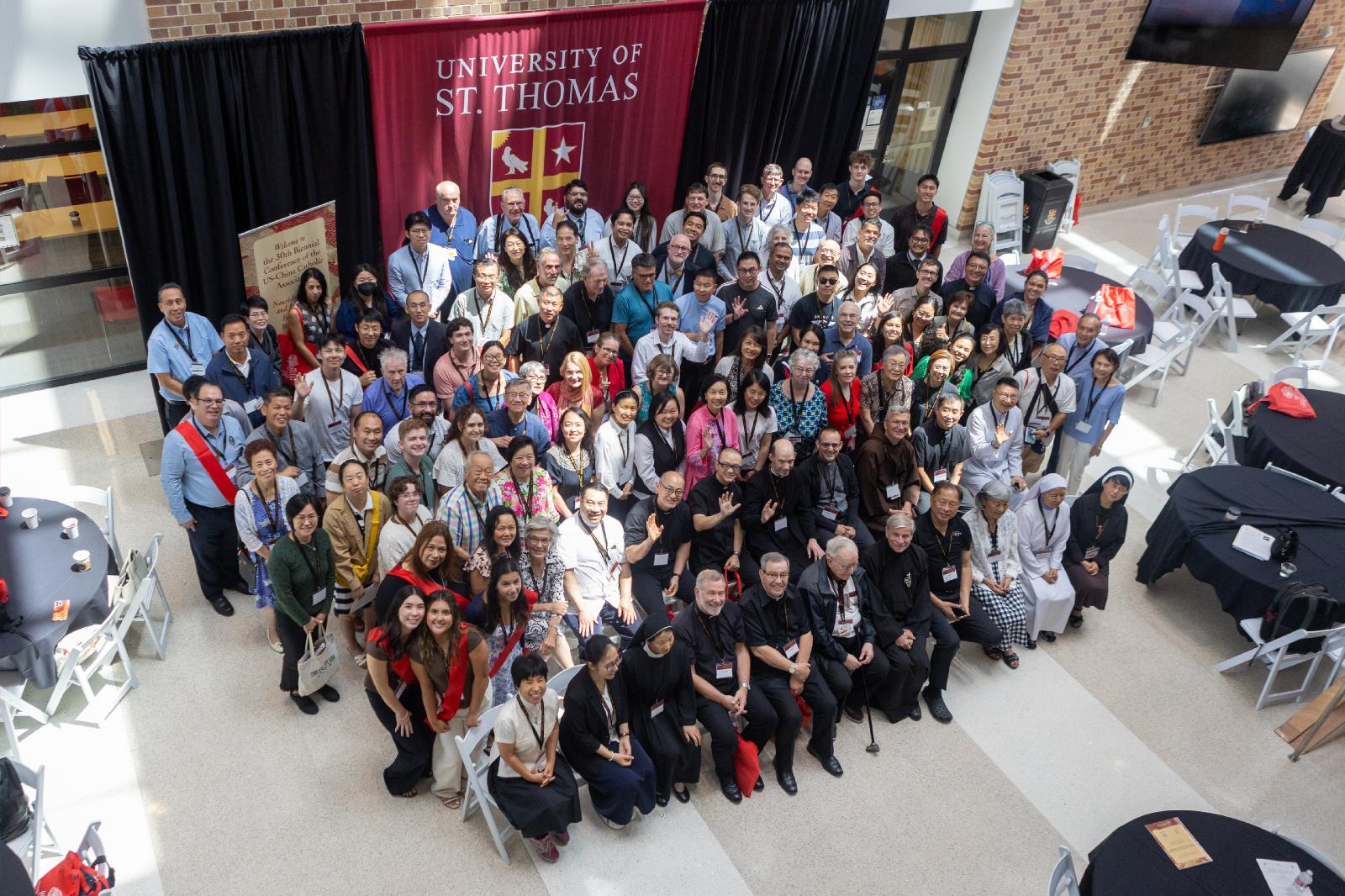
HOUSTON (OSV News) — Catholic leaders, scholars, clergy and lay faithful gathered in Houston from July 31 to Aug. 2 for the 30th Biennial International Conference of the U.S.-China Catholic Association, founded in 1989 to foster relationships between Catholics in the United States and China.
The conference, hosted primarily at the University of St. Thomas under the theme “Nourishing Trust and Friendship: Following the Way of Christ,” included an Aug. 1 vigil Mass at Ascension Chinese Mission in Houston’s Asiatown.
“What a long journey is ahead of the Church … to enter and sow the seed that dies and produces fruit in the land of China,” said Auxiliary Bishop Italo Dell’Oro of Galveston-Houston during his homily. “It’s an incredible amount of territory and population that has yet to hear the truth of Jesus.”
The bishop — citing St. Paul’s question, “Who will separate us from the love of Christ?” — said Christians must remain hopeful as they continue proclaiming the Gospel. Bringing Christ to China remains an “immense task,” he said, but one grounded in God’s love.
Approach to mission has changed over years
Several speakers said their approach to mission has changed over the years, emphasizing mutual learning alongside evangelization, an outlook they connected to Pope Francis’ emphasis on synodality and listening across cultures and experiences.
“We used to feel like we can teach the Chinese Catholics how to be good Catholics, like a missionary mentality. Now we feel like we can learn from them,” said Father Francis Li, pastor of St. Mother Teresa of Calcutta Parish in Chicago, who spoke on a keynote panel about generational changes in the Catholic Church in China.
“People come from different locations, different background(s), different faith stage(s), cultural backgrounds,” he said. “We work together for a few days on our shared interests, shared mission, shared desire for dialogue and friendship. Obviously, the Holy Spirit is working.”
Father Li pointed to a priest who began outreach to Chinese residents in his diocese and later welcomed 10 converts into the Church. He said the effort reflected Pope Francis’ call to missionary discipleship and showed how opportunities for evangelization are often present in local communities.
‘It’s God’s work through us’
“We used to send missionaries literally from U.S., Europe to China to save souls, and now they are here, part of our dioceses, part of USCCA’s serving territory,” Father Li said. “What are we willing to do, and how passionate are we about connecting with them, encountering them, sharing Jesus with them? So this priest, his ministry, was a moment of the work of the Spirit to me. … Examples like that remind me: it’s not my work; it’s our work; it’s God’s work through us.”
The conference’s focus reflected the origins of the USCCA. The organization was founded after Church leaders learned that Catholic communities in China had survived decades of political upheaval and isolation.
“Most people had thought (the Church in China) had died under the situation of post-’49,” said Passionist Father Rob Carbonneau, a historian at Boston College and conference chair.
“Catholics who had kept the faith reached out to the religious orders … and that really surprised a lot of people. This organization, the United States-China Catholic Association, was founded to keep that dialogue and that friendship alive.”
Estimates of China’s Catholic population
According to data from the Pew Research Center and the Hong Kong-based Holy Spirit Study Center, estimates of China’s Catholic population range from roughly 6 million Catholics affiliated with state-recognized churches to as many as 10 million to 12 million when members of unregistered underground communities are included.
“There’s an equality of faith of the Chinese voice that is now equal to the United States faith of the Chinatowns or the academic community,” Father Carbonneau said. “I don’t pray for the Church in China anymore. I pray with the Church in China. Once you begin to pray with, your compassion increases … now begins the healing process.”
Father Shuxin “Roger” Zhang, pastor of Ascension Chinese Mission in Houston, said parish life in the United States can influence families and communities abroad through personal relationships.
“Supporting Ascension Chinese Mission is supporting the Church in China,” Father Zhang said. “When our parishioners live up their faith well and share their faith with relatives and friends who live in China, Taiwan, or Hong Kong, that is evangelization.”
Houston’s large Chinese, Taiwanese population
Organizers said Houston was a fitting host city because of its large Chinese and Taiwanese population and the presence of Ascension Chinese Mission.
“Coming to Houston is a blessing for our organization,” Father Li told the Texas Catholic Herald, news outlet of the Galveston-Houston Archdiocese. “We want to share this good news about the ministries and missions of the USCCA with this local church.”
An estimated 80,000 to 90,000 residents of Chinese and Taiwanese descent live in Greater Houston, according to 2023 American Community Survey data and research from Rice University’s Kinder Institute for Urban Research.
The community’s roots trace back to an 1870s railroad labor force before the development of Houston’s first Chinatown east of downtown and the later growth of the Bellaire Boulevard corridor — the economic and cultural heart of the region’s Asian American community — and surrounding suburban communities.
Ascension Chinese Mission is the only parish in the region dedicated specifically to serving Chinese Catholics.
Venerable Matteo Ricci Award
Before the end of Mass, the USCCA presented its Venerable Matteo Ricci Award to 95-year-old Father Jeroom Heyndrickx, a Missionhurst priest and founder of the Ferdinand Verbiest Foundation at Catholic University of Leuven in Belgium. The award recognizes his lifelong work promoting understanding and cooperation between Catholics and China. Sister Gabriella Yang of the Verbiest Foundation accepted the award on Father Heyndrickx’s behalf.
As the liturgy concluded, Bishop Dell’Oro returned to a theme from his homily: Evangelization takes time.
“We are the ones who have known and met Christ,” Bishop Dell’Oro said. “It’s a long journey; it cannot happen in a short time.”
James Ramos is content editor for the Texas Catholic Herald, newspaper of the Archdiocese of Galveston-Houston. This story was originally published by the Texas Catholic Herald and distributed through a partnership with OSV News.
