


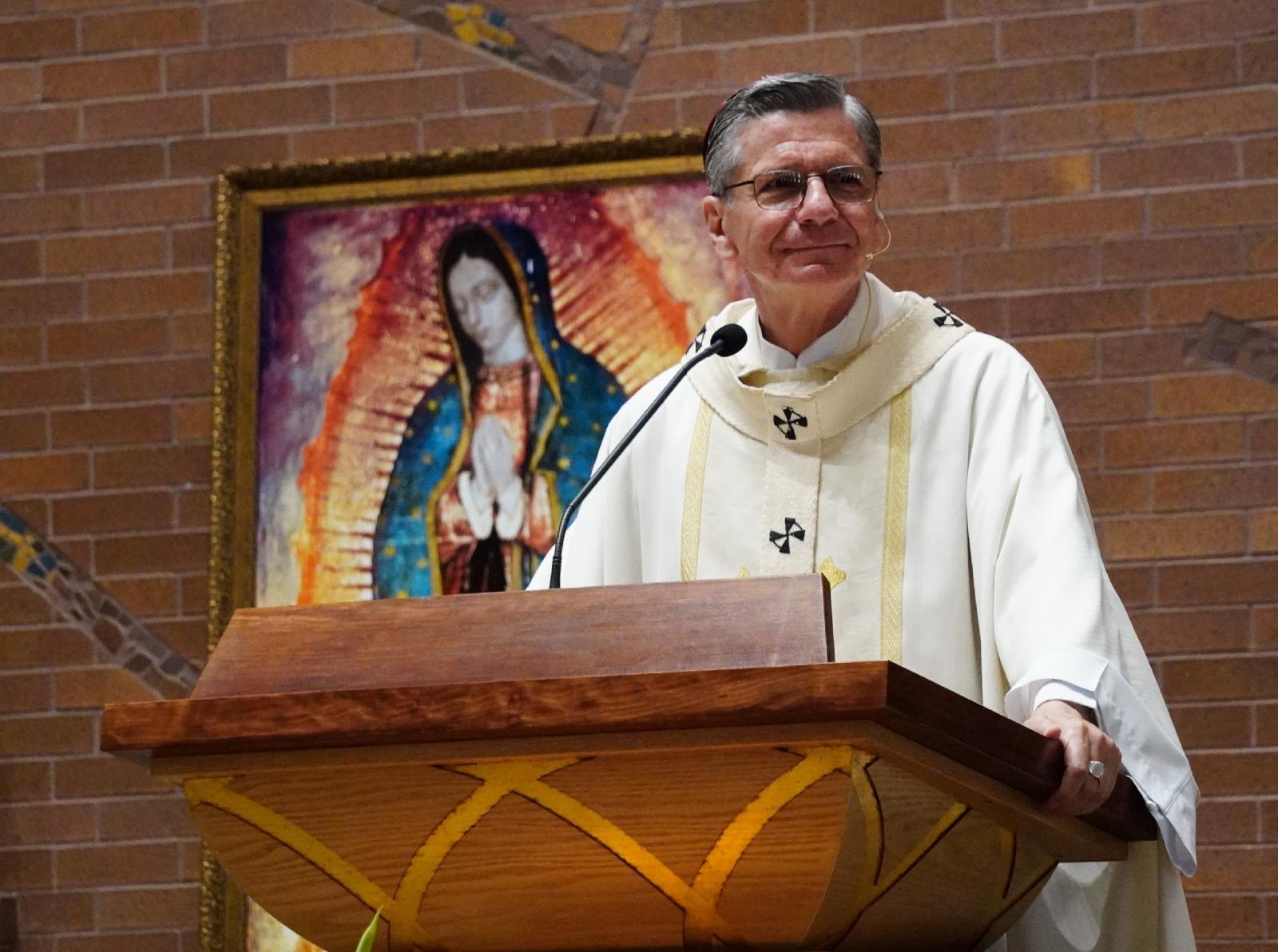
(OSV News) — At “an unprecedented moment” in U.S. immigration policy, Archbishop Gustavo García-Siller of San Antonio is assuring migrants in a new pastoral letter that the Church “will come to you.”
Drawing on Scripture, Church teaching, human rights reports, history and lived experience, the text underscored the need to recognize migrants’ God-given human dignity, which “does not hinge on a passport, a visa, or a work permit.”
Moreover, stressed the archbishop, the “the movement of peoples” is “not an interruption of God’s plan but part of the very fabric of salvation.”
On Aug. 3, Archbishop García-Siller released “We Will Come to You: United in Solidarity with Our Brothers and Sisters in Migration.”
The 57-page document’s unveiling, which took place at San Fernando Cathedral, coincided with the 100th anniversary of San Antonio’s elevation to a metropolitan archdiocese.
Archbishop García-Siller dedicated the letter to his confirmation patron, St. Augustine of Hippo, who “taught the Church that we are all pilgrims in life, sojourners traveling toward our true homeland in heaven.”
Fear, detention and human rights abuses
In his pastoral message, the archbishop warned that while “immigrant detention and deportation at scale are not new to U.S. history,” current policy conditions — part of the Trump administration’s broad crackdown on immigration — reflect “structural and legal tactics” of “relative novelty.”
The archbishop cited several examples, including the “recission of federal protections” that once kept sensitive locations, such as churches, free from immigration enforcement; the invocation of the 1798 Alien Enemies Act “to deport people without due process”; and a $45 billion allocation to build immigration detention facilities “at a scale unmatched in U.S. history.”
Amid such actions –which call for “the careful and well-formed moral discernment of every Catholic conscience” — “fear has taken root” throughout the San Antonio Archdiocese, as a “constant, grinding anxiety” drives many to shun basic errands, medical care and Mass itself, said the archbishop.
“Pastors sit in living rooms with families afraid to open their blinds,” he said, noting that “attendance at Spanish-language Masses” in the archdiocese has declined.
“They hunger for the Eucharist and for communion with the Risen Christ that gives meaning to their week. While the Body of Christ gathers just blocks away, their front door remains closed, and they sit together in silence and fear,” lamented the archbishop, adding, “This is a spiritual wound borne by all of us.”
The archbishop said that during visits to the three immigration detention centers within the archdiocese — including a family detention center in Dilley — he had “witnessed, firsthand, violations of human dignity within their walls.”
He also cited data from an investigation led by Democratic Sen. Jon Ossoff of Georgia, which found “more than 1,000 credible reports of human-rights abuses in immigration detention since January 2025, including medical neglect, denial of food and water, overcrowding, sleep deprivation, and the separation of breastfeeding mothers from their infants.”
Archbishop García-Siller described “widespread,” documented patterns of “abuse, neglect and dehumanization” in immigration detention “neither accidental nor marginal.”
Broken system, racial disparity in need of ‘honest reform’
He noted that the overwhelming majority of those in immigration detention have no criminal convictions. According to Syracuse University’s Transactional Records Access Clearinghouse, that figure is at 70.6% as of July 11.
The archbishop underscored the urgent drivers of migration, saying that “those who migrate do so to survive, to keep their families alive when no other way remains in their countries of origin.”
“If legal pathways were open to them, the great majority would use them,” he said. “But the pathways into the United States now take years to access, if they remain open at all. Our sisters and brothers cannot wait years for their children to eat. They cannot wait years for their family to be safe.”
Archbishop García-Siller said that the U.S. immigration system’s “brokenness is not merely a matter of policy failure,” since “the history of U.S. immigration law has long been entangled
with racial categories about who is welcome and who is not.”
He pointed to recent, documented “patterns of racial disparity in enforcement against Hispanics, Latinos, and other people of color.”
While affirming the Church’s social teaching that law enforcement must “uphold the common good,” the archbishop asserted that “when the enforcement of law violates human dignity,” justice itself is betrayed.
The Church ‘will come to you’
Throughout his letter, Archbishop García-Siller reaffirmed the centrality of the Church’s understanding of human dignity, noting that the Incarnation itself “tells us who God is and where He chooses to dwell.”
Christ “unmistakably identifies Himself with the displaced,” said the archbishop, quoting Mt 25:35: “I was a stranger and you welcomed me.”
The archbishop quoted Msgr. Arturo Bañuelas, a retired priest of the Diocese of El Paso and himself “a child of the borderlands”: “Jesus is at the border; today He is crucified in the poor.”
That awareness demands a spiritual reckoning as well as charity in action, said Archbishop García-Siller.
“To receive the Eucharist on Sunday and refuse refuge to the desperate on Monday is to miss the sacrament’s moral claim,” he said.
The archbishop — a native of Mexico who was sent by his order, the Missionaries of the Holy Spirit, to the U.S. — highlighted the “enduring lesson” of the Cristero War, waged during the early 20th century in his homeland as the government persecuted the Catholic Church.
“A government may seek to organize itself against the faith, to legislate God from public life, and punish those who refuse to comply, but the faith endures,” said the archbishop.
Throughout his pastoral letter, Archbishop García-Siller recounted ministering directly to migrants caught between dire conditions in their countries of origin and in the U.S.
He recalled in particular the June 2022 deaths of 53 migrants who perished in a tractor-trailer not far from Joint Base San Antonio-Lackland in San Antonio.
“With legal pathways closed, desperation drove them into the hands of predators who profited from their fear,” he said. “I prayed at their bedsides and over those we could not save. There were no words to offer, only accompaniment, the presence of the Crucified Jesus,
and faith that the Holy Spirit was with us.”
Yet “hope survives amid such suffering,” said Archbishop García-Siller, since “suffering, when met with love, becomes the place where God is found.”
He outlined in his letter a “roadmap for action,” inspired by the Gospel and the Holy Spirit, for the Church as it ministers to migrants.
That roadmap emphasized the rediscovery of the family and home as the domestic Church, especially when fear of immigration detention precludes attending Mass and receiving the Eucharist.
The archbishop urged parishes to “develop active ministries of accompaniment” that look to host training on migrants’ legal rights, while designating parish response coordinators and a “rapid response team” to offer legal liaisons, food, transport, child care, translation services and prayer.
He also pointed to the need to provide mental health support for migrants and their families, and to prevent “notario fraud,” in which scammers — by misrepresenting differences among nations in notary powers — fleece clients while claiming to provide legal advice.
Archbishop García-Siller urged clergy, religious and trained laypeople to visit those in immigration detention, describing such ministry as “a corporal work of mercy and a constitutionally protected exercise of religion that no civil power can lawfully forbid.”
Addressing those in authority, the archbishop said, “Love your people,” and warned that “using migrants and refugees as political pawns offends God, frays the fabric of society, and blinds us to Christ in the suffering of our sisters and brothers.”
He reminded federal officials that “laws must serve human dignity” and that immigration reform is a “moral obligation.”
The archbishop called for those reforms to include protecting sensitive locations from immigration enforcement, keeping families together, restoring asylum and due process, ending mass detention and mass deportation, and building “just pathways to citizenship.”
“May we seek refuge with Mary: our Mother of Mercy and Hope, and Solace of Migrants,” said the archbishop. “The road ahead will not be easy. But fear cannot yield to passivity. Be bold and courageous in Christ!”
Gina Christian is a multimedia reporter for OSV News. Follow her on X @GinaJesseReina.
