


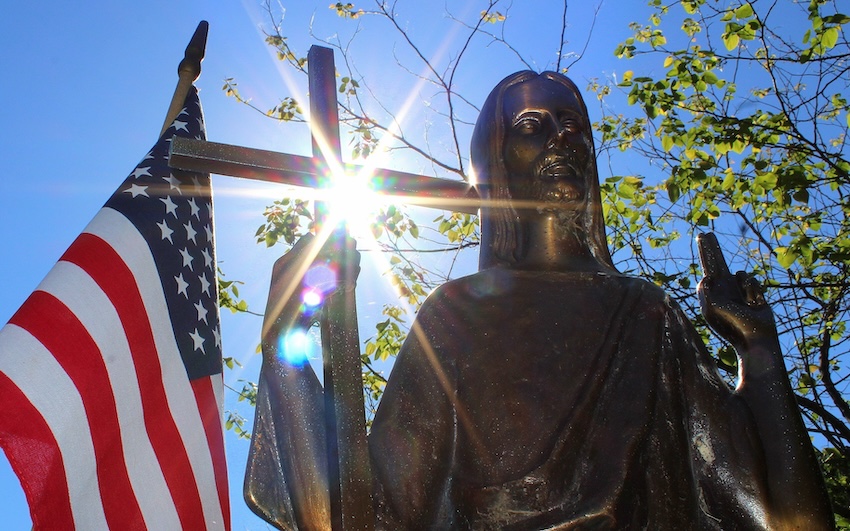
The nation’s attention was riveted on one thing on Nov. 3, as though it was the most important day of the year. Nov. 22, on the other hand, will likely pass unnoticed by the vast majority of Americans, as though it’s just another day to watch football.
These reactions demonstrate that, paradoxically, we both take politics too seriously and not seriously enough. And that goes for many of us Catholics.
Political seasons
For many of us, the outcomes of elections are framed as the most important events of our lives. These elections function something like liturgical seasons. Local and state elections are memorials. Midterm federal elections are feasts. The quadrennial presidential elections are solemnities.
We turn our attention to these liturgies as though they define who we are, both individually and collectively. Whether riveted in our homes to CNN or Fox News, or together in watch parties, we are gathered in to witness public acclamations of the results. We order our attention to them, and they, in turn, give order and rhythm to our lives, for good or ill.
Nor does a low turnout in the memorials and feasts nullify this observation. Even if we don’t regularly attend, the outcome of these events are the highest ordering principles of our moral and social lives. We may either celebrate or bemoan their outcomes. But whether our side wins or loses, nothing is more determinative of our private and public formation. There are winners and losers in a zero-sum game.
There is nothing transcendent about these faux liturgies. They do not point us to anything higher than who wins and who loses. And our religious commitments are secondary to these outcomes. This is because we take politics too seriously.
Feast of Christ the King
The last Sunday of the actual liturgical year, on the other hand, largely goes without celebration, or even notice. Celebrated on Nov. 22 in 2026, this is, of course, the solemnity of Our Lord Jesus Christ, King of the Universe.
Yes, at Mass (if we go to Mass) we may (or may not) notice the references to Christ the King in the readings and prayers. The homily may (or may not) make mention of implications of the day. But few of us will anticipate it, and for few of us will it make any difference in our Sunday.
Still less will the implications of this solemnity have any purchase on the ordering of our lives.
When he inaugurated the solemnity of Christ the King in his 1925 encyclical, “Quas Primas,” Pope Pius XI declared that it is “grave error … to say that Christ has no authority whatever in civil affairs, because … all things are in his power.”
“Nor,” the pope explained, “is there any difference in this matter between the individual and the family or the State.” All people “are under the dominion of Christ. In him is the salvation of the individual, in him is the salvation of society.”
As such, he continued, our Lord “invests the human authority of … rulers with a religious significance.” This includes care for “the common good and also the human dignity of their” citizens.
This tells us that, properly speaking, politics is neither simply about the distribution of power nor the ultimate normative principle of our lives. Politics is ordered not toward zero-sum distributions of power but rather to the good of the human soul. But this is only possible, of course, if we recognize that Christ is king of the universe, transcending any particular political structure or outcome.
And because all earthly political authority is delegated by Christ the King, Pius XI explains, the Church “has a natural and inalienable right to perfect freedom and immunity from the power of the state.” The Church does not run civil affairs, the pope explains. But it grants authority to civil powers on the Church’s own terms, to be administered according to its principles.
The feast of Christ the King is a reminder that the authority of political authorities is delegated and, thus, limited. The authority of earthly politics is measured by its relative concern for the care of souls. Statecraft is soulcraft. If we fail to see this, it is because we do not take politics seriously enough.
Kenneth Craycraft is a professor of moral theology at Mount St. Mary’s Seminary and School of Theology in Cincinnati and author of “Citizens Yet Strangers: Living Authentically Catholic in a Divided America” (OSV Books).
