


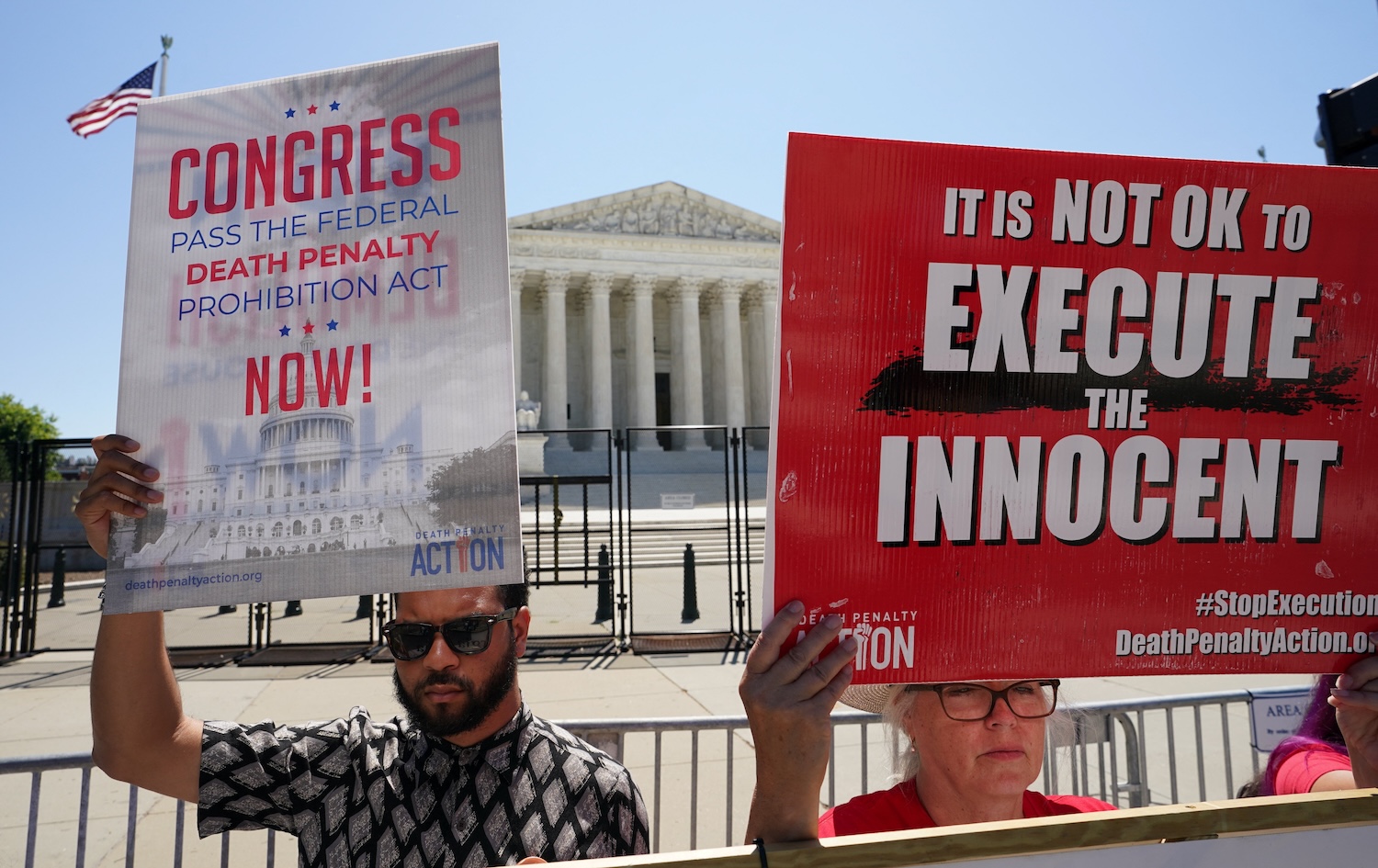
In late September, the state of Tennessee attempted and failed to execute Christa Pike, after 31 years in prison.
The news description of the botched execution is gruesome. Multiple attempts to inject Pike with a lethal dose of phenobarbital were “unsuccessful.” It has resulted in Pike being placed on life support (as I write this column) alive but unable to breathe on her own.
Having failed to kill her, Tennessee is now trying to keep her alive, presumably for another opportunity to kill her. Far and wide, this horrifying incident has been cited as a reason to eliminate capital punishment. It is not.
The incompetence of some officials to carry out a law is not necessarily a sound basis for opposing the law.
Proponents of capital punishment highlight the extreme sadistic violence of the murder of which Christa Pike was convicted. Then 18 years old, along with two accomplices, Pike tortured 19-year-old Colleen Slemmer with a box cutter, meat cleaver and large chunk of asphalt, before killing her by crushing her skull. Pike removed a fragment of Slemmer’s skull, keeping it as a souvenir. The monstrous brutality of this crime has been cited as a reason to maintain capital punishment. It is not.
Visceral reaction to certain actions is not a sound basis for legislating against them. Catholic theologians must wrestle with the issue of capital punishment both on moral grounds and in the context of the development of doctrine. Neither the moral status nor the history of the Church’s position is as clear as proponents and opponents of capital punishment would have us believe.
Advocates and supporters both make compelling arguments, but neither, in my judgment, make convincing ones. But this is not a concession to either side.
Even the Catechism of the Catholic Church is not as clear as we might like it to be. In 2018, Section 2267 of the catechism was revised to provide three rationales for why it concludes that “the death penalty is inadmissible,” and why “she works with determination for its abolition worldwide.”
First, the catechism explains that “the dignity of the person is not lost even after the commission of very serious crimes.” Certainly, this is true of what theologians call “ontological dignity.” Ontological dignity is based on the very nature of the human person as made in the image and likeness of God. As such, this dignity is not alienable, any more than any other aspect of human nature can be repudiated.
But theologians also cite “moral dignity.” This describes the relative exercise of moral agency. It can be impaired or even lost when a person makes moral choices against the good of the person and society.
This is why we can morally deprive a person of property or liberty when that person commits offenses against society. But, again, no such commission, regardless of the severity, can compromise ontological dignity. I wish Section 2267 of the catechism had made this distinction between ontological and moral dignity. It did not.
The second reason to oppose capital punishment, the catechism explains, is the emergence of “a new understanding … of the significance of penal sanctions imposed by the state.” It is not clear what this means, but I have interpreted it as a warning against giving the state the power to kill in cold blood. And whether one opposes or favors capital punishment, there’s no denial that it is dispassionate, cold-blooded, killing.
Finally, the catechism cites “more effective systems of detention, … which ensure the due protection of citizens,” but which do not “definitively deprive the guilty of the possibility of redemption.” Of the three reasons for its conclusion that capital punishment is inadmissible, this is the most contentious. It seems to imply that the admissibility of capital punishment is contingent upon such “effective systems of detention.”
But what about societies where such systems do not exist? Some read this provision as implying that the prohibition of the death penalty is conditional, not absolute. It is not an unreasonable interpretation. I wish the Catechism were clearer on this point. It is not.
I believe that Pope Francis, who implemented the revised language of Section 2267 of the catechism, was categorically opposed to capital punishment. And I think he intended Section 2267 to teach that capital punishment is morally prohibited, without exception. It does not.
My opposition to capital punishment is much closer to absolute than many colleagues and other faithful Catholics. If limited to the United States and similarly advanced countries, my opposition is, in fact, absolute. But I acknowledge that the ambiguity of the language of Section 2267 does not require every Catholic to agree. I wish it did. It does not.
Kenneth Craycraft is a professor of moral theology at Mount St. Mary’s Seminary and School of Theology in Cincinnati and author of “Citizens Yet Strangers: Living Authentically Catholic in a Divided America” (OSV Books).
