


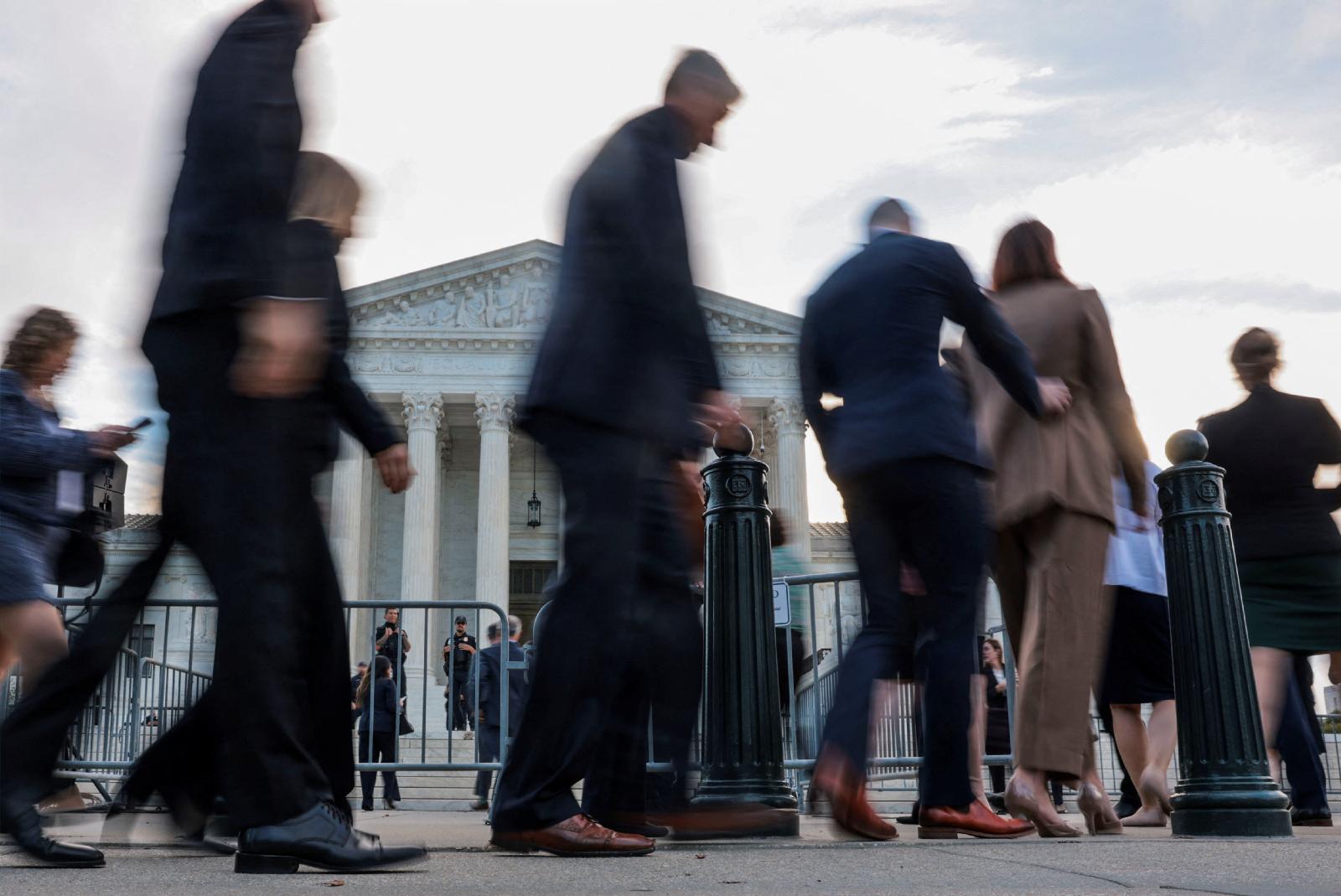
WASHINGTON (OSV News) — The U.S. Supreme Court began its new term Oct. 5, with cases on its schedule involving religious liberty, guns, immigration and the environment.
Among the noteworthy cases the high court will hear this term is St. Mary Catholic Parish v. Roy, a clash between Catholic preschools and the state of Colorado over whether those schools can participate in the state’s universal preschool program.
Mark Rienzi, president and CEO of Becket, a religious liberty law firm representing the preschools in the case, told OSV News that their clients in the case and the Catholic Church in Colorado liked the idea of “a universal pre-K law designed to give every parent in the state the chance to send their kid to any pre-K program they want.” But he said the problem arose because “Colorado’s definition of universal excludes all the Catholic schools.”
“If your school operates according to teachings on sex and marriage that the state of Colorado does not like, Colorado says you can’t be in this program,” he said.
The program provides funds — up to about $6,000 — to parents to send their child to the preschool of their choice, public or private, including faith-based schools. However, Colorado has argued the Catholic preschools ran afoul of a nondiscrimination rule in the program that prohibits participating schools from refusing admission to any child on the basis of the sexual orientation and gender identity of the child or the child’s family.
‘I suspect the court will have some déjà vu’
Rienzi pointed to previous Supreme Court rulings that he said were relevant precedent in the case, including Trinity Lutheran Church of Columbia, Inc. v. Comer, Espinoza v. Montana Department of Revenue, and Carson v. Makin. Each of those cases involved the Equal Protection Clause of the U.S. Constitution.
“I suspect the court will have some déjà vu and think that they’ve been here before,” he said.
The Supreme Court is scheduled to hear St. Mary Catholic Parish v. Roy on Nov. 3., which is also Election Day for the 2026 midterms.
Proposed grotto mired in zoning dispute
In another religious liberty case, the court will also consider Missionaries of St. John the Baptist, Inc. v. Frederic, a dispute that began in 2021 over a local zoning ordinance in Kentucky that prevented a religious organization from building a Marian shrine on its own property, which includes a church, because it was zoned as residential.
First Liberty Institute is representing the Missionaries of St. John the Baptist, a group of priests whose status as a public association of the faithful was suppressed in 2024 by Bishop John C. Iffert of Covington. While members of the Missionarities of St. John the Baptist no longer minister at the parish, the organization’s nonprofit corporation owns Our Lady of Lourdes’ church building and property in Park Hills, Kentucky, where the shrine was prohibited. Neither the Diocese of Covington nor Our Lady of Lourdes Parish are parties to the case.
“Telling a church it can’t build a modest place for prayer and reflection on its own property is outrageous,” Kelly Shackelford, First Liberty Institute president, CEO and chief counsel, said in an Oct. 2 statement. “Federal law provides clear protections for how faith-based organizations can use their property to support their mission. This is an important case for religious freedom.”
Religious liberty protections
Asked how he expects the high court to approach religious liberty cases more broadly this term, Rienzi said, “I think the court’s been doing a good job taking religious liberty cases and making clear that religious liberty really protects the right of people to have different beliefs from what the government has, and to live those out, and to be treated fairly and equally in our society while living those out.”
Other cases the court will consider include a challenge to the Trump administration policy of carrying out third-country deportations, or removals to a country where a person who had migrated to the United States has no ties, and its policy of mandatory detention during deportation proceedings.
In Viramontes v. Cook County, scheduled for Dec. 2, the court will hear a dispute over whether local ordinances banning AR-15s and similar semiautomatic rifles, commonly called “assault weapons,” violate the Second Amendment.
The U.S. Conference of Catholic Bishops, in an amicus brief that did not take a side on the constitutional question, urged the court to decide the case “in a manner that preserves the traditional authority of political communities to regulate weapons capable of exceptional violence and that threaten the public peace.”
It stated, “Three principles embedded in our constitutional tradition, and independently affirmed in Catholic teaching, bear on this case: the right of self-defense, which is genuine but not unlimited; the government’’s authority to promote the common good and public safety; and the autonomy of local communities — federalism, which the Church knows as subsidiarity — to calibrate regulation to local conditions.”
Previous term’s rulings
During its 2025-2026 term, the high court issued major rulings striking down President Donald Trump’s executive order limiting birthright citizenship, rejecting Trump’s sweeping tariff policy, but also permitting the Trump administration to reimplement a policy of turning away asylum-seekers along the U.S.-Mexico border before they enter the country, known as “metering,” and to end a temporary designation that shielded eligible Haitian and Syrian immigrants living in the U.S. from deportation. The court also upheld state laws requiring student athletes to compete on sports teams that correspond to their biological sex rather than their self-identified gender, among other key rulings.
The new term also begins as Trump has criticized the justices for ruling against his position in some of those cases. In an interview with Time published Oct. 1, Trump lashed out about the cases he saw as losses, and said he regretted selecting the three justices he nominated to the high court during his first term.
The justices’ role
Rick Garnett, a professor of law at the University of Notre Dame in Indiana, told OSV News that while Justices Amy Coney Barrett, Brett Kavanaugh and Neil Gorsuch do not always agree with each other, “It was never the job of these justices — or of any justice — to somehow pay back the president who nominated them.”
“All three of President Trump’s nominees were and are talented and conscientious lawyers, who take seriously their oaths to the Constitution,” he said. “They do not regard their task as voting for, or against, the president; their task is to decide legal questions that are presented in legal disputes.”
Meanwhile, a recent Marquette Law School Poll national survey found approval of the Supreme Court dipped to 43% in September, down from 47% in July, closer to the conclusion of its previous term. The same poll found 60% of adults said the Supreme Court has ruled in favor of the Trump administration often or fairly often, while 40% said it has done so rarely or never.
On Oct. 5, the Supreme Court hears two cases: a lawsuit from officials in Boulder, Colorado, seeking to hold oil companies liable for driving climate change, and another case regarding a law limiting disability benefits for some incarcerated veterans.
Kate Scanlon is a national reporter for OSV News covering Washington. Follow her on X @kgscanlon.
