


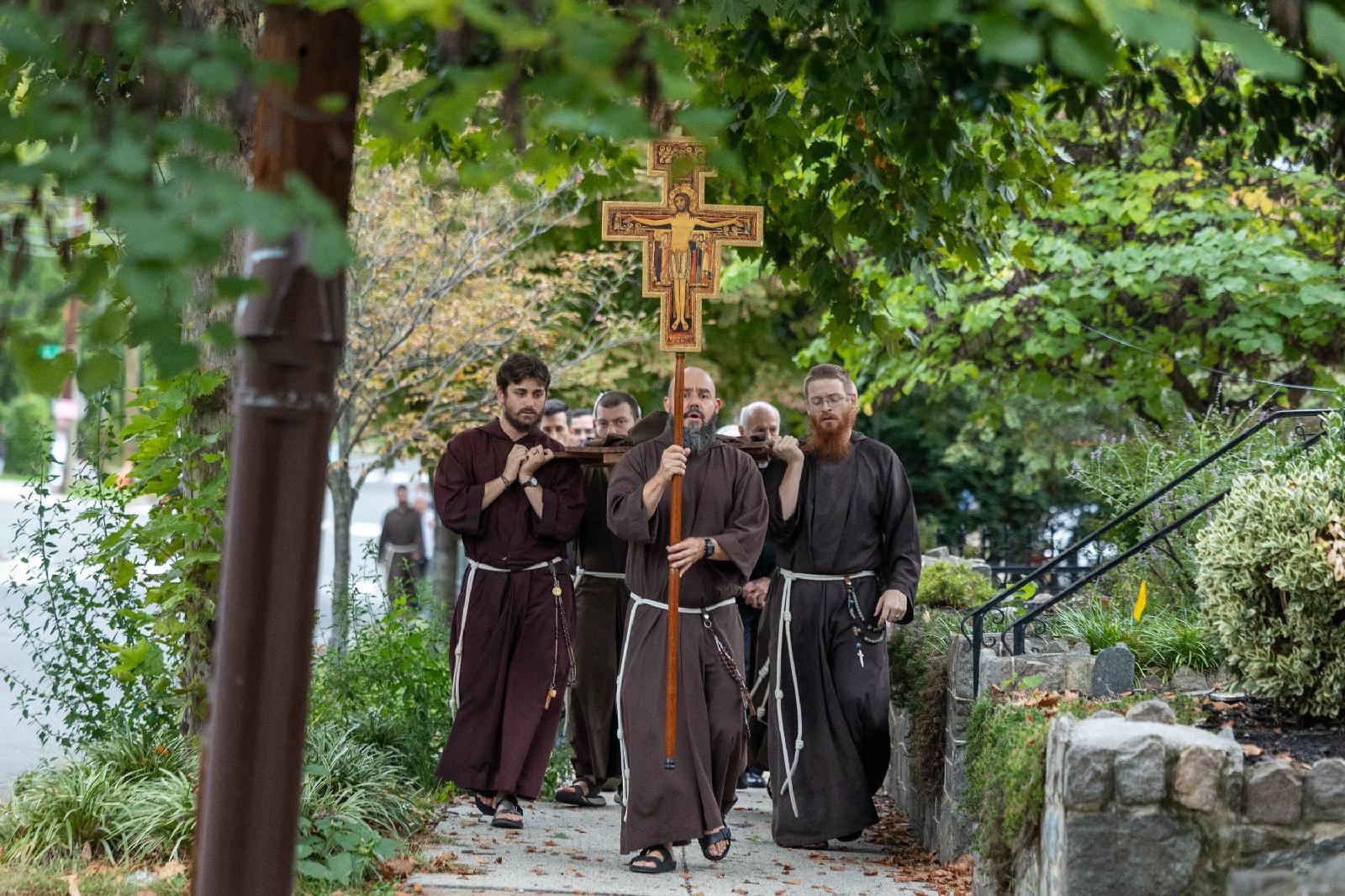
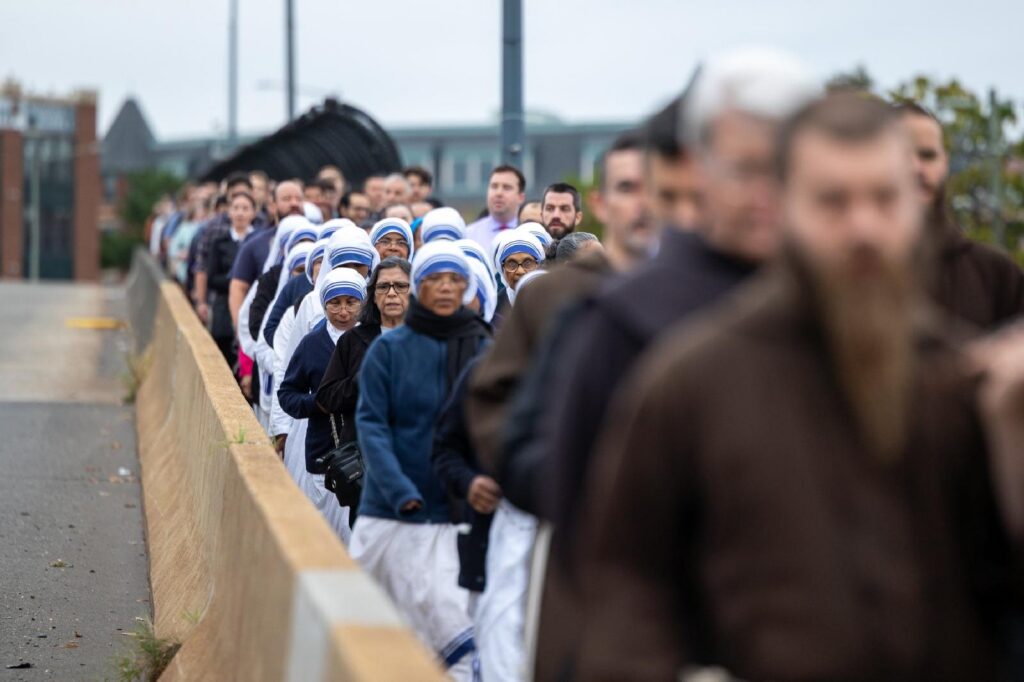
WASHINGTON (OSV News) — When a winding procession of friars, priests, nuns, and laypeople approached the Franciscan Monastery of the Holy Land in America in northwest Washington, on the seasonably fall-like evening of Oct. 3, it had already traversed a mile-and-a-half of city streets from its starting point on the lawn of the Basilica of the National Shrine of the Immaculate Conception.
Despite passing through the city’s Brookland neighborhood — referred to as “Little Rome” owing to its numerous Catholic institutions — those who trekked to the monastery were visibly giving witness to an occasion unfamiliar to some passersby: The 800th anniversary of the death of St. Francis of Assisi (1181-1226), commonly known by its Latin name as the “Transitus.”
Each year on Oct. 3, followers of St. Francis mark the globally popular saint’s journey from life to death through special community commemorations of the Transitus.
The Franciscan friars who ultimately led the crowd through the gate of the monastery — with its impressive gardens, Holy Land replicas, and resident friars who support that region, its people and its sacred sites — held aloft two emblems of St. Francis in the approaching twilight.
First came the Byzantine-style cross of San Damiano, from which Jesus Christ reportedly spoke in a vision to the saint in 1206, commissioning him to reform his Church. The crucifix was followed by a simple wooden funeral bier transporting an empty brown Franciscan habit and white cord cincture, which — reaching its final destination — was reposed in front of the monastery church’s altar.
Before the Transitus began, Franciscan Father Ramzi Sidawi, guardian of the monastery, spoke with OSV News.
Living the phases of St. Francis of Assisi’s life
Father Sidawi traced the continuity between three distinct phases of St. Francis’ short, 45-year life — his introduction of the world’s first living Nativity scene on a bitterly cold winter night in Greccio, Italy; his reception of the painful and transforming wounds of Jesus, known as stigmata, at La Verna, Italy; and his simple and humble death at a small church dubbed the Portiuncula (“Little Portion”), on the plain below Assisi.
“Francis, during his life, lived all the phases of the life of Jesus,” said Father Sidawi. “He lived the nativity in Greccio; he lived the crucifixion in La Verna; and then at the end, he lived his final ‘transitus,’ passing away from this life to eternal life. So he was always united with Jesus.”
Father Sidawi noted that St. Francis found peace in his heart, which was mirrored in his joyous and compassionate relationship with all creatures — both human and animal.
“Francis is a perfect example of how we human beings today — and every day — can really go back to this original harmony with all creation,” Father Sidawi suggested.
‘Transitus’ aglow in candlelight
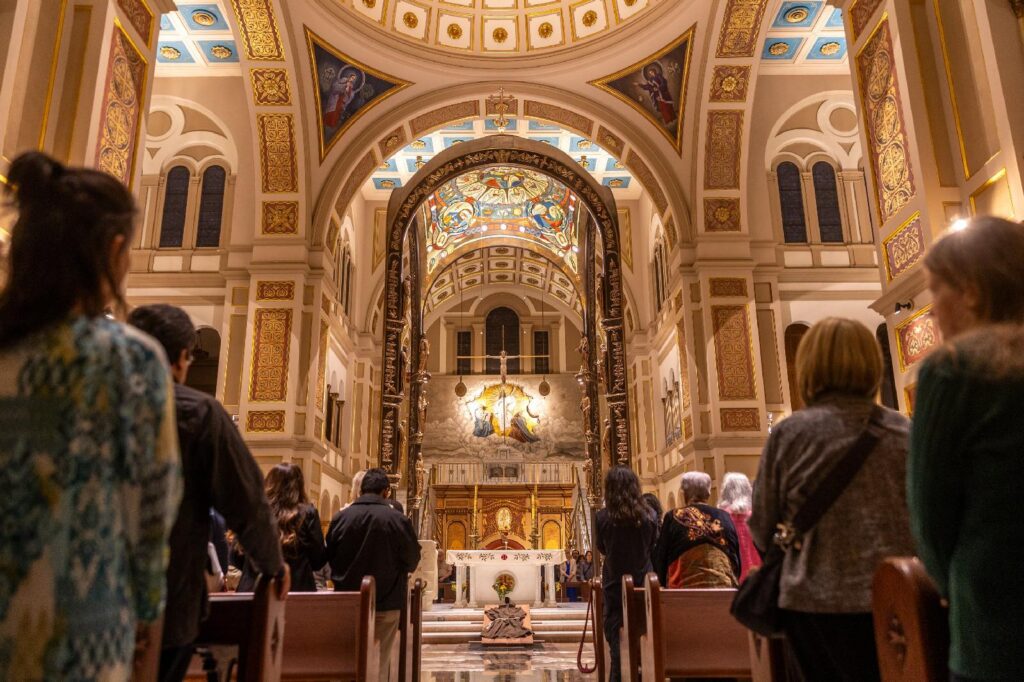
Built beginning in 1898 and meticulously preserved, the stately parchment, rose and moss-colored neoclassical interior of the monastery church — aglow with candlelight reflected by its gilded ornamentation — welcomed a standing-room-only crowd of worshippers. They eagerly seated themselves in every available pew and sat on stairs leading to life-size, three-dimensional polychrome sculptures of the Crucifixion and the Resurrection.
Father Sidawi presided over the Transitus vespers service, which included a hymn depicting St. Francis’ death; the chanted recitation of three psalms, including Psalm 142, which St. Francis prayed as he lay dying; and readings from both Scripture and early histories of St. Francis’ life.
Vespers’ reflection: Do not be ‘sleepwalkers’
At the evening’s core was a reflection by Capuchin Franciscan Brother Thomas Piolata, assistant professor of systematic theology at Catholic University.
Brother Piolata’s reflection was a ringing call to wake up; to realize we’re surrounded by “sleepwalkers,” and to avoid becoming one ourselves.
That’s not easy, he admitted, citing a “whole constellation of forces” encouraging a retreat from society: our computer, phone and iPad screens; political ideologies; idolatry of money; and media content.
In his own era, St. Francis was once a kind of sleepwalker, too, said Brother Piolata — until a spiritual vision jolted him wide awake, after which he fiercely conformed himself to Christ through the radical openness of literally living the Gospel.
St. Francis’ conformity to Christ
St. Francis’ conformity, Brother Piolata said, reveals the fullness of being truly awake.
“And so in a world, then, that seems to almost privilege sleepwalking, Francis shakes us. And,” he added, “we would do well — as we commemorate the eve of the anniversary of his death — to be shook by him.”
“Wake up! Wake up to the living God!,” urged Brother Piolata. “Do not settle for mediocrity; do not settle for an existence that sleepwalks. Wake up! Brothers and sisters — wake up, and praise!”
Brother Piolata’s reflection was followed by recitation of the Magnificat; intercessions; praying the Lord’s Prayer; and a concluding prayer asking God the Father to help the faithful “follow your Son by walking in the footsteps of Francis of Assisi and by imitating his joyful love.”
Nuncio reflects on the faithful’s ‘little portion’
Archbishop Gabriele Caccia, apostolic nuncio to the United States, remarked upon St. Francis’ own Portiuncula and the modern faithful’s invitation to cultivate their own “little portion” in the world.
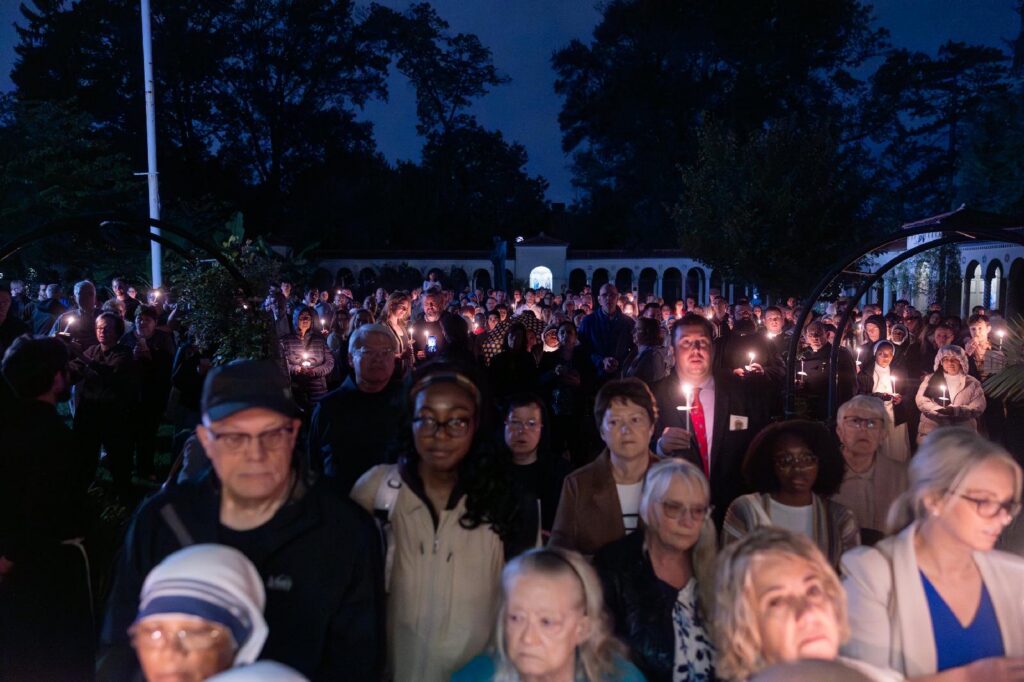
As a light rain fell, Archbishop Caccia then led worshippers — who repeatedly chanted “Jesus, remember me, when you come into your kingdom” — in a candlelight procession through the dark and hushed gardens, to the monastery’s Portiuncula replica.
Arriving there, a special prayer of Pope Leo XIV — penned to open the 8th Centenary of the Transitus of St. Francis — was recited from commemorative prayer cards given to all, as the crowd was blessed with a first class relic of St. Francis.
A light reception in the monastery conference center concluded the celebration, with visitors munching on cookies and warming up with coffee.
Heather Sullivan, a recent fundraising and special events hire at the monastery, told OSV News Brother Piolata’s words resonated with her.
“I think the homily tonight being about ‘wake up,'” said Sullivan, “and the impact of social media on our lives, and the need to unplug from that — I feel like Franciscans do that so well. I worked in an environmental think tank before I came here, so there’s a beautiful connection,” she added. “God’s threading the needle.”
Kimberley Heatherington is an OSV News correspondent. She writes from Virginia.
