


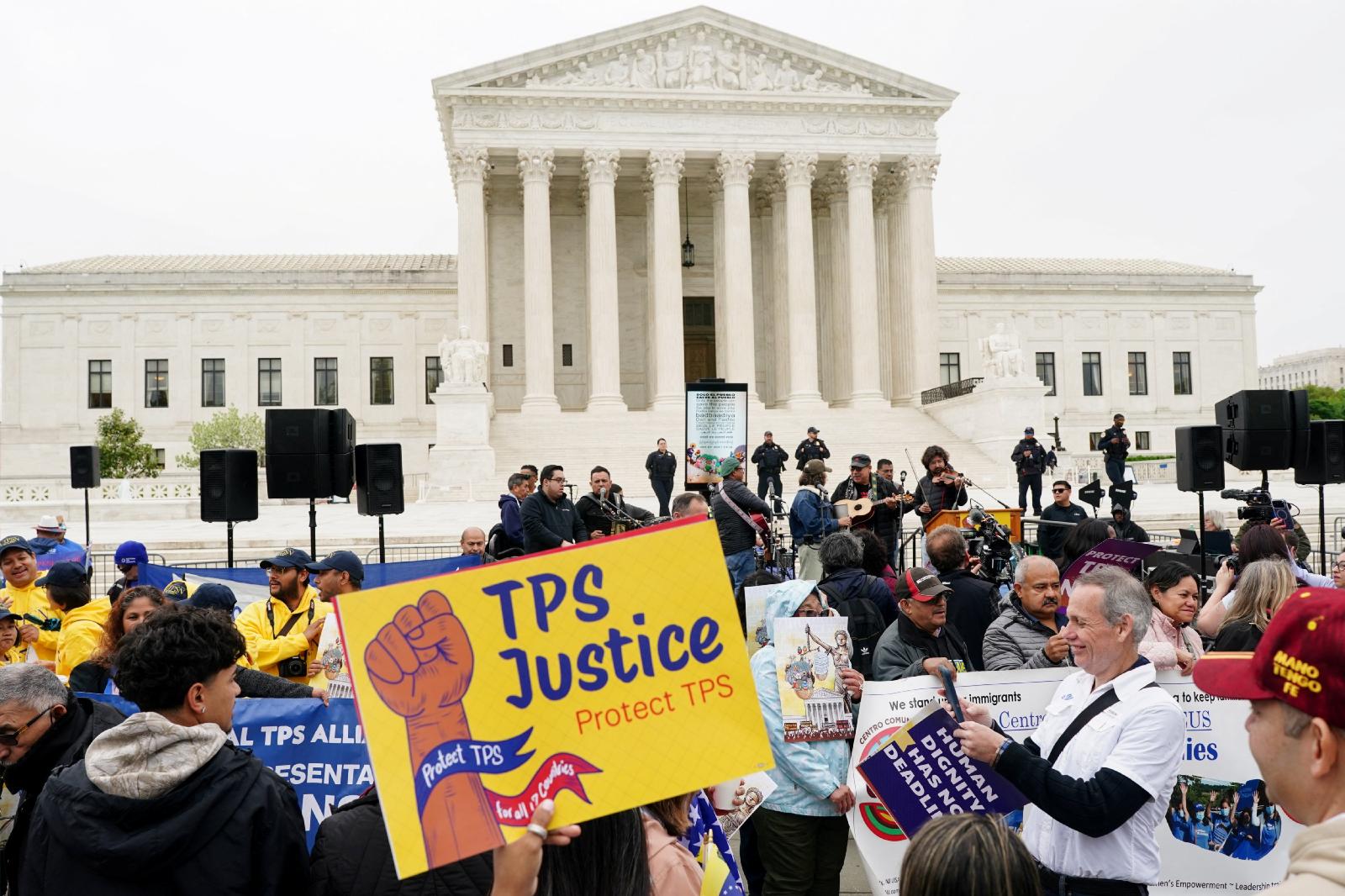
WASHINGTON (OSV News) — The U.S. Supreme Court on June 25 found the Trump administration can end a program temporarily shielding eligible Haitian and Syrian immigrants living in the U.S. from deportation.
The Trump administration previously asked the high court to pause rulings by federal judges that barred the government from ending Temporary Protected Status designation for Haitian and Syrian nationals. At the time, the U.S. bishops and other advocates urged that TPS for eligible Haitians remain in place due to ongoing unsafe conditions in that country.
A TPS designation grants the U.S. government the power to give protection from deportation to eligible migrants from countries experiencing dangerous conditions such as war, disaster, or other unrest. The ruling could have far-reaching implications for those who hold TPS status, including 350,000 Haitians, a population with many Catholics, who are currently living and working in the U.S. legally under the program. About 1.3 million people from 17 countries in total hold TPS status.
6-3 majority on TPS ruling
Writing for a 6-3 majority, Justice Samuel Alito said that in the cases TPS designation for Haiti and Syria, the court was asked whether they “are entitled to orders postponing the terminations during litigation. We hold that they are not.”
Alito argued that lower courts improperly overrode the federal government in blocking the removal of TPS designation for those countries.
During April oral arguments in the combined cases, U.S. Solicitor General D. John Sauer argued the court should end “judicial micromanagement” of what he cast as foreign policy decisions that should properly be made by “the political branches” of government.
But Geoffrey M. Pipoly, who represented the Haitian migrants with TPS status, pointed to comments made by former Secretary of Homeland Security Kristi Noem in which she argued people from Haiti and other “non-white countries” were “killers, leeches, entitlement junkies,” and that “we don’t want them, not one.” He argued that those comments, especially when contrasted with other actions specifically prioritizing White South Africans for refugee status, showed discrimination by the government.
Rejects claim decision to end TPS ‘racially motivated’
But Alito rejected the argument that the decision was racially motivated, which he called “the sole constitutional claim” in the case, finding that “the current administration, which has terminated every TPS designation that has come up for renewal, simply opposes the TPS program, at least as it has been implemented in the past.”
In a dissenting opinion, Justice Elena Kagan argued that “the majority claims to see no evidence that race played any role in the Haiti decision. But the evidence is there, plain to see, in the President’s statements, which the majority (and for that matter, his own lawyers) cannot even bear to repeat.”
The State Department currently warns Americans against traveling to either country, designating both as “Level 4 – Do not travel,” citing risks of violence.
Kevin Appleby, senior fellow for policy and communications at the Center for Migration Studies of New York and the former director of migration policy for the U.S. Conference of Catholic Bishops, told OSV News, “The decisions affirm policies which will send human beings back to unstable and dangerous situations.”
“The Statue of Liberty is shedding a tear today,” he said.
Dylan Corbett, executive director of the Hope Border Institute, a group that works to apply the perspective of Catholic social teaching in policy and practice to the U.S.-Mexico border region, told OSV News that the ruling and another permitting a policy of turning away asylum-seekers along the U.S.-Mexico border before they enter the country give carte blanche to the administration to continue its assault on legal migration.”
“Asylum protections at the border and TPS are legal instruments that afford protection to the most vulnerable,” Corbett said. “Returning people to danger fails the moral tests of compassion and justice and does nothing to address the need to fix our immigration laws. The human, economic and moral toll of expansive deportation policies is immediate and will have far-reaching consequences. Meaningful, humane immigration reform is essential — and the measured, principled voice of the Catholic Church must remain central to that national conversation.”
Catholic social teaching on immigration balances three interrelated principles — the right of persons to migrate in order to sustain their lives and those of their families; the right of a country to regulate its borders and control immigration; and a nation’s duty to regulate its borders with justice and mercy.
Kate Scanlon is a national reporter for OSV News covering Washington. Follow her on X @kgscanlon.
Updated June 25 at 1:51 p.m. ET
