


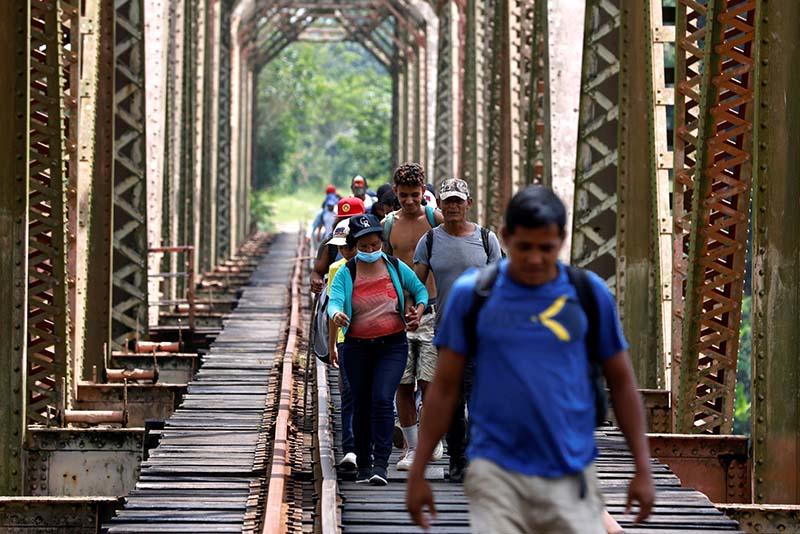
WASHINGTON (OSV News) — The U.S. Supreme Court on June 25 ruled that the Trump administration can reimplement a policy of turning away asylum-seekers along the U.S.-Mexico border before they enter the country, known as “metering.”
The central question in the case was whether noncitizen asylum-seekers must literally cross the border in order to apply for asylum, or if those who appear at the border and seek entry must also be allowed to apply.
In a 6-3 ruling, Justice Samuel Alito said, “This case presents a straightforward question: whether an alien who seeks to enter the United States from Mexico ‘arrives in the United States’ when he or she is still in Mexico.”
Alito said that the U.S. Court of Appeals for the Ninth Circuit “answered ‘yes.'” That is wrong.”
Context of ‘arrives in the United States’
“In ordinary speech, no one would say that a person ‘arrives in’ a place — for example, a house, a city, or a country — before the person enters that place,” he said. “The context in which the phrase ‘arrives in the United States’ is used in the immigration statutes at issue here supports an ordinary-meaning reading.”
In a lengthy dissent, Justice Sonia Sotomayor argued the majority’s “illogical interpretation is driven almost entirely by a fixation on a single word: ‘in.'”
“Words, however, must be read in context and with attention to how they fit into the statute as a whole,” she wrote.
Citing the ill-fated 1939 transatlantic voyage of the St. Louis — which carried Jewish refugees fleeing Nazi Germany who had applied for U.S. visas and planned to wait for approval in Havana, only to be denied entry and sent back to Europe — Sotomayor wrote that “the U. S. Government also turned them away in part because the immigration laws at the time had strict country quotas and the relevant quota was already filled for that year.”
“Tragically, over 500 of the refugees that had attempted to flee were trapped in Western Europe under German control, and over 250 of them died during the Holocaust,” she wrote, adding that the U.S. later “negotiated international treaties with other nations to prevent future incidents like the voyage of the M. S. St. Louis.”
U.S. Refugee Act of 1980
“Congress passed the Refugee Act in 1980 because it did not want this country to repeat the mistakes of its past,” Sotomayor wrote. “Yet if the refugees on the M. S. St. Louis were to walk up to a port of entry on our southern border today, the majority’s interpretation would allow immigration officers to refuse even to consider their asylum applications by physically blocking them from stepping foot onto U. S. soil.”
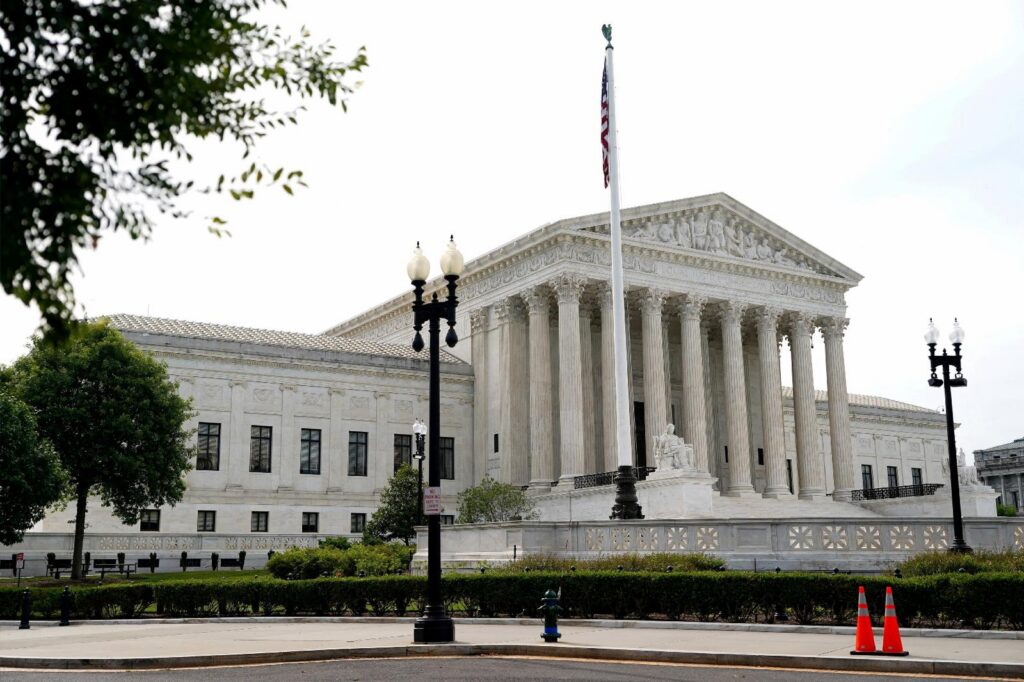
Sometimes called “metering” or the “turn back policy,” the practice of sending back some asylum-seekers who presented at the southern border was first sometimes used under President Barack Obama’s administration, and later expanded during the first Trump administration. It was rescinded in 2021 by President Joe Biden’s administration, but the second Trump administration sought to reinstate the policy.
Ashley Feasley, the legal expert in residence at the Immigration Law and Policy Initiative at The Catholic University of America Columbus School of Law, told OSV News, “The decision today gives the government the right to regulate the processing of asylum-seekers at U.S. ports of entry through metering.”
“This may appear a straightforward right of sovereign nations to control their borders,” she said. “The reality is that the policy implications of this decision are very large and may have very real and dire human consequences.”
‘Could result in blanket restrictions’
“Depending on how this policy is implemented in the future, it could result in blanket restrictions to asylum-seekers at (ports of entry) without effectively giving any tangible justification for such delays,” she continued. “This could lead to some real human suffering, impacting already vulnerable people unable to access protection and asylum at (ports of entry) and instead being sent back to dangerous conditions in Mexico.”
In effect, it “could lead to more people crossing in between the (ports of entry) out of desperation, which is dangerous, inefficient and not in the national interest,” she said.
The court’s ruling will allow the policy to go into effect, which would block asylum-seekers from setting foot on U.S. soil, where federal law would then allow them to seek asylum. If asylum were granted, it would provide protection from persecution in their country of origin. Other efforts made by the second Trump administration to curtail asylum are facing separate legal challenges.

Catholic social teaching on immigration balances three interrelated principles — the right of persons to migrate in order to sustain their lives and those of their families; the right of a country to regulate its borders and control immigration; and a nation’s duty to regulate its borders with justice and mercy.
Rulings ‘devastating for our clients’
In reference to the ruling, as well as another the same day allowing the Trump administration to remove Temporary Protected Status designation for Haiti and Syria, Anna Gallagher, executive director of the Catholic Legal Immigration Network, also known as CLINIC, said in a statement that the pair of rulings “are devastating for our clients, and for those of us who accompany vulnerable immigrants through the legal system.”
“As Catholics, we believe in a God who weeps for our suffering, who is concerned for the fall of the sparrow, for the least of these,” she said. “And so we, too, weep for our clients whose asylum rights are restricted or who fear return to immediate life-threatening conditions because of this court decision. We walk with them as legal advocates, seeing the injustice of our laws play out firsthand. We know that today is a dark day for many people we have come to know and care for — including legal residents of this country, beloved members of our community.”
An amicus brief filed in February by the USCCB in support of the migrants challenging the policy said, “The policy violates the obligation to care for refugees — a fundamental legal and moral principle that runs through nearly two millennia of Catholic faith, an international humanitarian consensus, and this Nation’s history.”
Kate Scanlon is a national reporter for OSV News covering Washington. Follow her on X @kgscanlon.
