


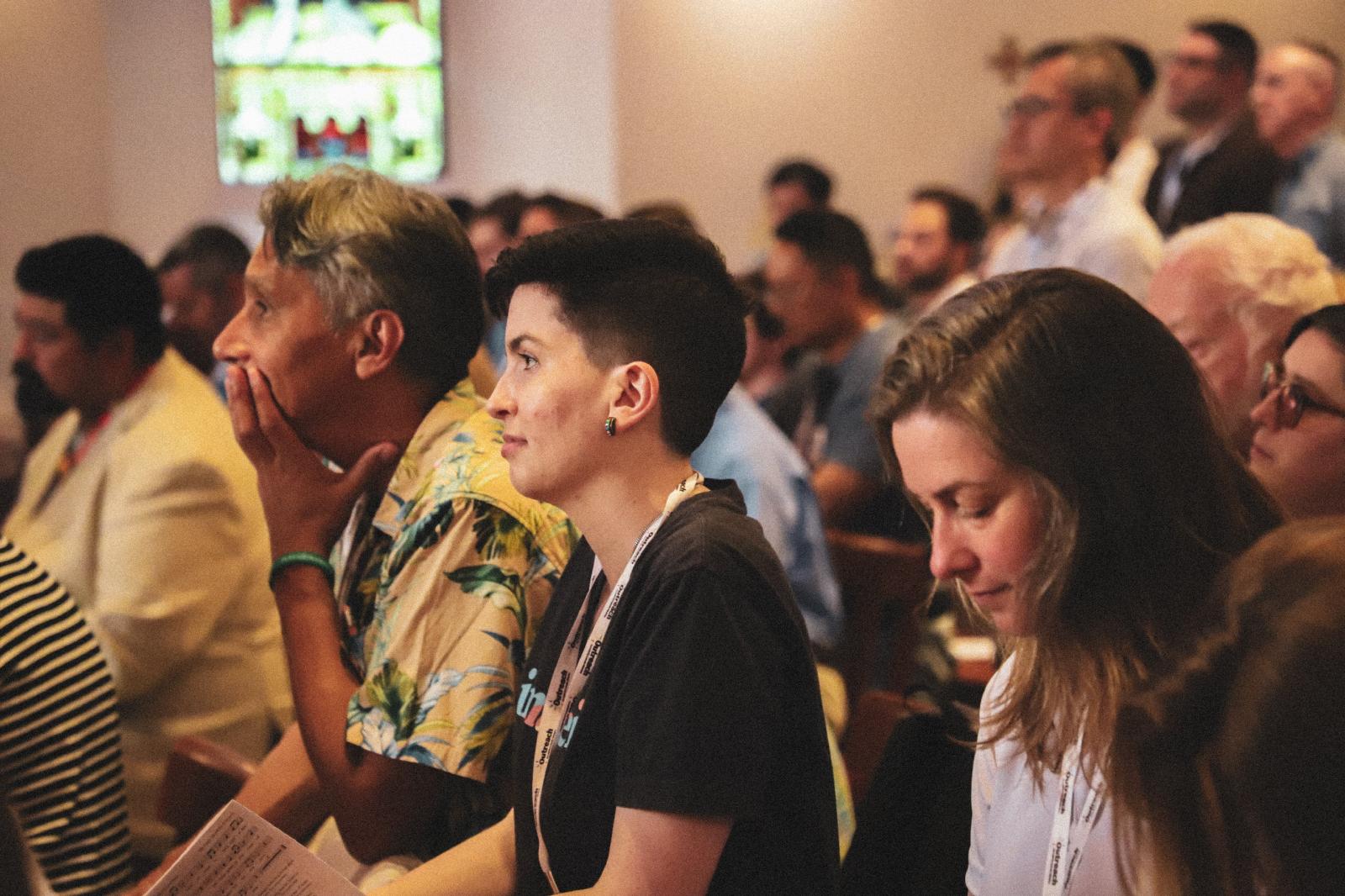
(OSV News) — Conor J. Reidy, the executive director of Outreach, a ministry for Catholics who identify as LGBTQ that seeks “to foster a Church where all people know they belong,” had a simple message for June 19-21 attendees of the Outreach 2026 Conference at Georgetown University: “Do not be afraid.”
More than 450 laypeople, clergy, scholars, artists, educators, students and family members gathered for the ministry’s fourth conference. The event marked the fifth anniversary of the Outreach ministry itself, which is a part of the Jesuits’ America Media apostolate.
The core of the conference took place June 20 with panel discussions on topics related to same-sex attraction and gender identity, including lived experiences, theology, prayer, parish ministry, care, the Bible and women. Kerry Alys Robinson, president and CEO of Catholic Charities USA, gave a keynote address, and Washington Cardinal Robert W. McElroy celebrated a vigil Mass that evening for Outreach participants.
LGBTQ Catholics and chastity
Greg Krajewski, a filmmaker and incoming pastoral ministries student at Chicago’s Catholic Theological Union, Pope Leo XIV’s alma mater, opened the panel “LGBTQ Catholics and Chastity: Diverse Lived Experiences” with a reference to two paragraphs, No. 2337 and No. 2394, from the Catechism of the Catholic Church.
He noted the Catechism defines chastity as “the successful integration of sexuality within the person and thus the inner unity of man in his bodily and spiritual being” the virtue of which “involves the integrity of the person and the integrality of the gift” and that “Christ is the model of chastity. Every baptized person is called to lead a chaste life, each according to his particular state of life.”
“The question is,” Krajewski said, “if we are called to fully integrate our sexualities with our spiritual and physical selves, what does that look like?”
Eve Tushnet, co-founder of Building Catholic Futures — a discipleship ministry offering “tools and insights to serve and share the Gospel with LGBT+ and same-sex attracted people” — offered what she dubbed “three potentially controversial claims” about chastity.
First, she said, Catholics who identify as gay are interested in and drawn to chastity by many paths and for many different reasons; second, starting a conversation with “Do you like chastity?” or “What do you think of chastity?” is rarely the best question for helping people discern a next step in discipleship; and finally, current parish ministry models are often not well equipped to help people discern that next step in their discipleship.
“In order to understand people’s relationship to any virtue — to justice, to chastity, to charity — you do have to understand their journey,” Tushnet said. “You have to hear what they want out of life, what they believe contributes to their happiness — and what they have tried already and found does not lead to that happiness.”
Meant to serve
In her keynote speech, Catholic Charities’ Robinson emphasized serving others.
“For all of my deep love and dedication to the Church, at times, it has truly, utterly broken my heart,” she reflected. “My heart is broken when the Church fails to live up to the very values it espouses, when it has caused pain and left its members feeling excluded, forsaken and abandoned.”
“When you have moments of doubt, discouragement or disappointment in our Church, I hope that you will find and focus on your own sources of inspiration and encouragement, your own examples of moral heroism,” Robinson continued. “It is never too late to become the people we are meant to be — and it is never too late to be generous, to serve, to cultivate a disposition of other-centeredness and to work for the common good.”
In the afternoon, the panel “Parish Ministry: Sustaining and Evaluating a Ministry” examined various models and strategies for successful ministry for Catholics who experience same-sex attraction or otherwise identify as LGBTQ.
Among the advice offered was to start small and be realistic about what a potentially small ministry can and can not do — what Joseph Schneider, leader of Affirmed Community at St. Clement Parish in Chicago, called its “say-do” ratio. Bill Chapman of Catholic Ministry with Lesbian and Gay Persons in the Archdiocese of Los Angeles suggested that if one’s parish does not welcome a LGBTQ ministry, not to be afraid to take it elsewhere. Angelina Rossi, co-director of AGLOChicago in the Archdiocese of Chicago, counseled holding ministry members accountable by asking, “Where have we been? Where are we? Where do we want to be?” and make an annual working retreat.
Call to holiness
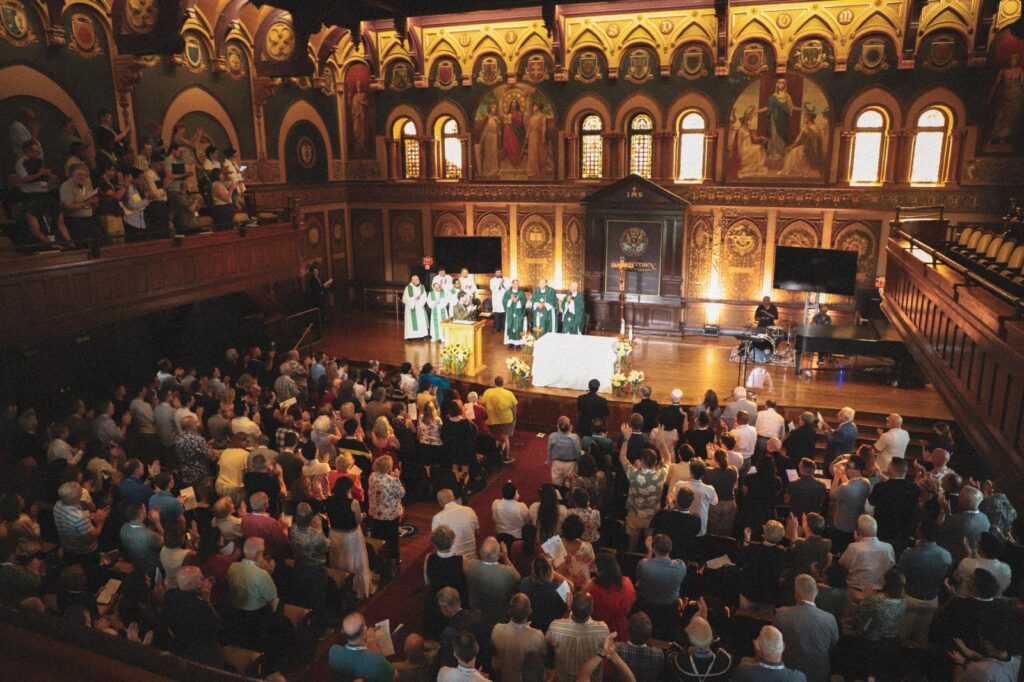
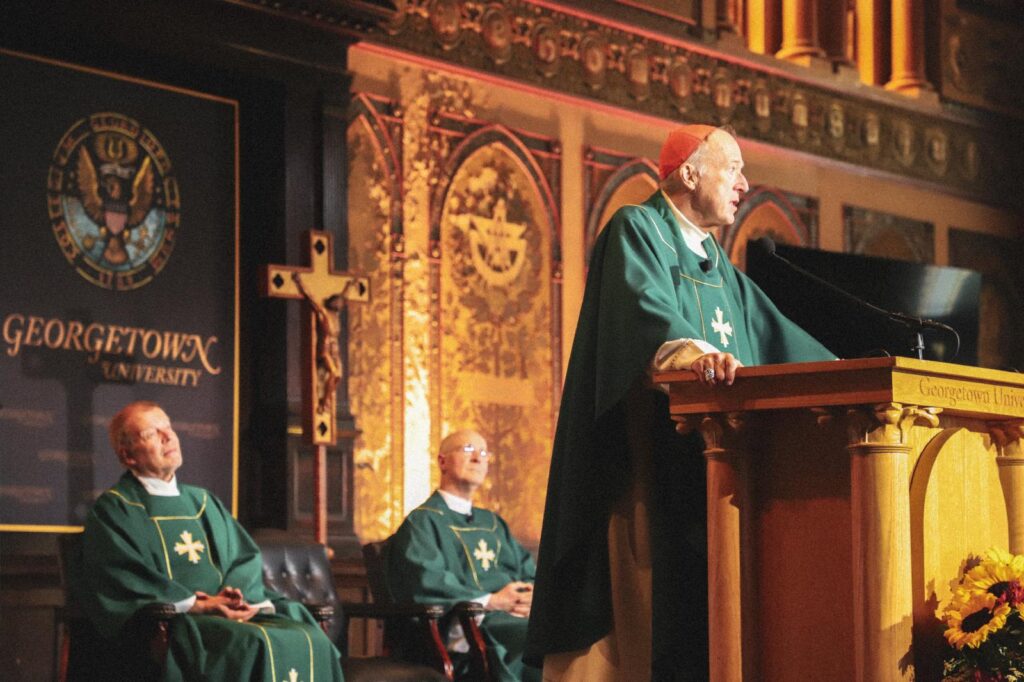
Almost 500 attendees worshipped at the vigil Mass held in Georgetown’s Gaston Hall with Cardinal McElroy, Outreach founder Jesuit Father James Martin and other concelebrating clergy.
As principal celebrant, Cardinal McElroy said he was honored at the invitation. “In a Church which has so frequently wounded the LGBT community through judgmentalism and exclusion, we should find great hope in two important developments that have taken place during the pontificate of Pope Leo which constitute rich seeds for the unfolding of the Gospel in the years to come,” he said in his homily.
“Interestingly, neither of these developments focus specifically on LGBT issues or persons,” he noted. “They focus on the call to holiness for every believer and how it can be lived out in the concrete realities of our modern world.”
Cardinal McElroy shared a reflection from Pope Leo XIV during his April 2026 apostolic journey to Africa, in which Leo told reporters on the papal plane that “the unity or division in the Church should not revolve around sexual matters.”
“This simple declaration puts in context the call to chastity as a component of the Christian moral life,” Cardinal McElroy said. “Too often, both in magisterial statements and on the popular level, sexual sins have been condemned with an ardor that effectively places them in the eyes of many believers as the core moral obligation of Christians. This is utterly false to the Gospel of Jesus Christ.”
“When Pope Leo points to the comparative importance of economic justice, war and peace, immigration and racism as key elements of the Christian moral life,” the cardinal continued, “he is rejecting this false reductionism that concentrates moral obligations within the sexual realm.”
Controversial synod report
The second development Cardinal McElroy cited is the report issued May 5, 2026, by Study Group 9 from the Vatican’s 2021-2024 Synod of Bishops, frequently referred to as the “Synod on Synodality.” Ten study groups were created under Pope Francis to do research and formulate practical guidelines for the Church’s consideration on complex topics.
Synod Group 9 was intended to help address “controversial doctrinal, pastoral and ethical issues,” and some groups involved in LGBTQ+ ministry welcomed its reflections and effort to include those who felt marginalized by the Church’s teaching.
But the group’s final report also drew criticism for deficiencies in synodal consultation, with various objectors saying the report, which included two testimonies from persons in same-sex civil marriages, lacked representative testimonies from Catholics who identify as being same-sex attracted or LGBTQ+ while trying to live out the call to holiness within the Church’s teaching.
Courage International strongly objected that the working group had singled out its apostolate to persons who experience same-sex attraction for negative criticism without consulting its leaders or members, or giving Courage members the opportunity to share their own personal experience.
“This Study Group had the great task of applying the pastoral theology of Pope Francis in an integrated way with Catholic teaching and practice,” Cardinal McElroy said, pointing to its final report, which stated that “the Church’s mission is not a matter of abstractly proclaiming and deductively applying principles that are set out in an immutable and rigid manner, but of fostering a living encounter with the person of the risen Lord Jesus, by engaging with the lived experience of faith of the People of God … in relation to the diverse situations of life and the many cultural contexts.”
The outcome of that path, Cardinal McElroy said, is that “pastoral practice is not the understanding of how to apply an already formed and often reified set of principles to concrete situations. It proceeds from the conviction that the concrete situations in which people find themselves are constitutive dimensions of how doctrine should be formed in the light of the kerygma.”
The day’s activities concluded with a “sending forth” to the tune of the hymn “How Can We Be Silent?” followed by a group photo of those gathered in Gaston Hall to mark the occasion.
Kimberley Heatherington is an OSV News correspondent based in Virginia.
This story was updated July 17, 2026, at 12 p.m. EDT.
