


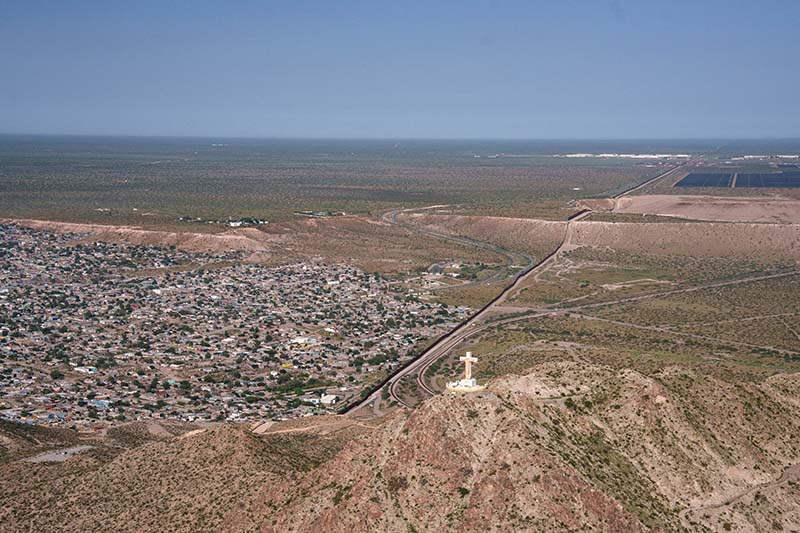
(OSV News) — As the Trump administration moves to seize a diocesan pilgrimage site for the border wall, bishops from New Mexico and Texas are calling on the faithful to join them for Mass on the mountain.
In a June 23 message, Bishop Peter Baldacchino of Las Cruces, New Mexico, announced that he and Bishop Mark J. Seitz of El Paso, Texas, invited “all the priests and faithful of our Dioceses and the region to join in prayer and pilgrimage” June 28 at Mount Cristo Rey, located in Sunland Park, New Mexico.
The 4,675 foot peak, capped by a 29-foot limestone statue of Jesus Christ the King, has served as a shrine for Catholic faithful coming there to pray for close to a century.
Each year, thousands trek up the rugged path to the image, which depicts a robed Christ with arms stretched out against the cross, overlooking the El Paso and southern New Mexico landscapes.
Bishop Baldacchino said pilgrims will begin their ascent at 4:30 p.m., with the climb ending in a Mass that he and Auxiliary Bishop Anthony C. Celino of El Paso will celebrate under the statue at 6 p.m.
Latest development in diocese’s ongoing court battle
The gathering marks the latest development in the Diocese of Las Cruces’ ongoing battle, now playing out in court, to prevent the Trump administration from claiming the site for construction of a portion of a border wall — part of Trump’s hardline crackdown on immigration.
“Our government is within its rights to secure its border, however, our Diocese is defending itself against the means by which the government now seeks to do so,” said Bishop Baldacchino in his June 23 message.
Referencing the intended border wall segment, he said that “the erection of a symbol of division in the shadow of Christ runs contrary to the very person of Christ, who gathers people of all backgrounds and walks in unity and love to himself.”
“This is not a matter of politics, but a matter of preserving and defending a sanctuary and devotion which has brought many people in our community to God,” stressed Bishop Baldacchino. “The spiritual value of this site cannot be compromised by politics or financial gain.”
The diocese cited religious freedom violations in its June 19 opposition response filed in U.S. District Court for the District of New Mexico.
An ‘affront to religious liberty’
“This affront to religious liberty cannot stand,” said the diocese, which noted the federal government’s purpose for the intended seizure was “offensive to Catholic values and teachings,” since the wall was “a physical symbol of the Government’s dehumanizing treatment of migrants writ large.”
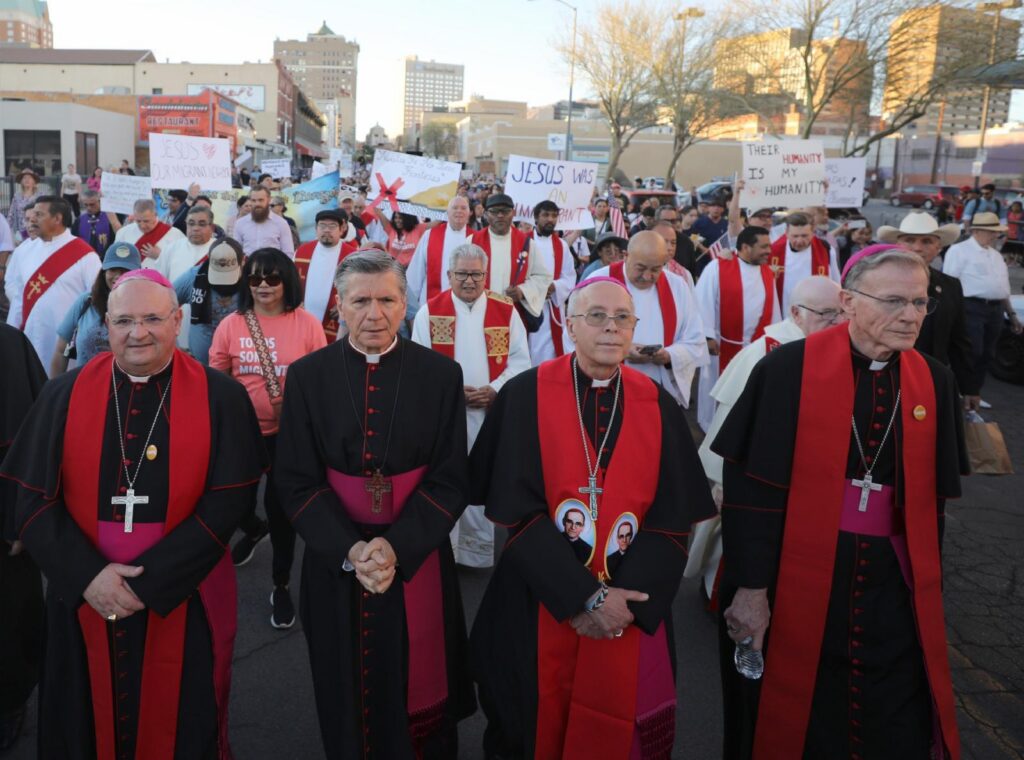
Along with the opposition response, Bishop Baldacchino, Bishop Seitz and Bishop Michael Buerkel Hunn of the Albuquerque, New Mexico-based Episcopal Diocese of the Rio Grande, filed declarations in support of the Las Cruces Diocese’s challenge.
Those documents were the latest submissions in a May 7 federal government lawsuit claiming eminent domain — or government power to seize private property for public use, with “just compensation” as required by the Fifth Amendment — over some 14 acres that include Mount Cristo Rey.
On June 15, U.S. District Judge Kenneth J. Gonzales ruled that the legally required just compensation — determined by the fair market value of the property, and calculated as $183,071 — should be deposited into the court registry’s bank account. The move is standard in eminent domain legal proceedings.
At the same time, Gonzales stressed in his ruling that “allowing the deposit and subsequent transfer of title will not interfere with, alter, or nullify” the diocese’s right to challenge the Trump administration.
Invoking rights under First Amendment, RFRA
But in its latest response, the Diocese of Las Cruces invoked its rights under the First Amendment and the Religious Freedom Restoration Act, the latter of which expands protections for religious exercise beyond those covered under the former.
RFRA prohibits the government from placing a substantial burden on a person’s exercise of religion without compelling government interest, and even in those circumstances, requires that they do so by the least restrictive means.
The federal government’s plans for taking possession of the land are hardly that, said the diocese, stating, “Nothing could be less Catholic.”
Specifically, said the diocese, the federal government’s plan would “deface” Mount Cristo Rey, and “profane” the site with the presence of a border wall segment that would in turn likely “damage or restrict access to this sacred space.”
Deprives diocese of ‘stewardship responsibilities’
In addition, said the diocese’s response, the Trump administration’s move to condemn the land and take immediate possession would “deprive” the diocese of its stewardship responsibilities, which ensure that “successor landowners do not use Diocesan property in ways that are inconsistent with Catholic values and teachings.”
The diocese also noted that former Secretary of Homeland Security Kristi Noem — under whom the land seizure effort was initiated — “waived compliance with a host of statutes and regulations that safeguard culturally, historically, and environmentally sensitive sites in connection with border-wall construction.”
The federal government “has shown little respect for Mount Cristo Rey in the preliminary phases of its work in the area,” the diocese said, citing an X video posted by El Paso Sector Border Patrol Feb. 4 “depicting a large explosion” and bragging that sections of the mountain “will undergo a face lift.'”
The diocese observed that “the only face on Mount Cristo Rey is that of Christ the King.”
‘Greenlighting work even before ‘securing title’
The diocese also pointed to the government’s admission of contracting companies and greenlighting work “before even securing title to the property in question.”
Another site sacred to the O’odham tribes has already been “irreparably damaged” by the federal government amid the border wall construction, said the diocese.
Along with fears of the “desecration” of Mount Cristo Rey, Bishop Baldacchino also noted that the federal government’s move to condemn the land further violated his religious freedom by placing him, as steward of diocesan property, at odds with canon law, the Catholic Church’s administrative code.
He explained that any sale of the land would first need a sign-off from the Vatican, “consultative affirmation” from diocesan officials and the “inclusion of legal restrictions” to prevent the land from being used contrary to Catholic teaching — all of which would be precluded by the government seizure.
Judge Gonzales gave the federal government a July 3 deadline to respond. A hearing on the case is scheduled for July 23.
“At this juncture, whether our Diocese will prevail rests in the hands of our courts and civil leaders,” said Bishop Baldacchino in his June 23 message, noting that he and pilgrimage participants would “pray for Dioceses of Las Cruces and El Paso, and for our government and its leaders.”
Gina Christian is a multimedia reporter for OSV News. Follow her on X @GinaJesseReina.
