


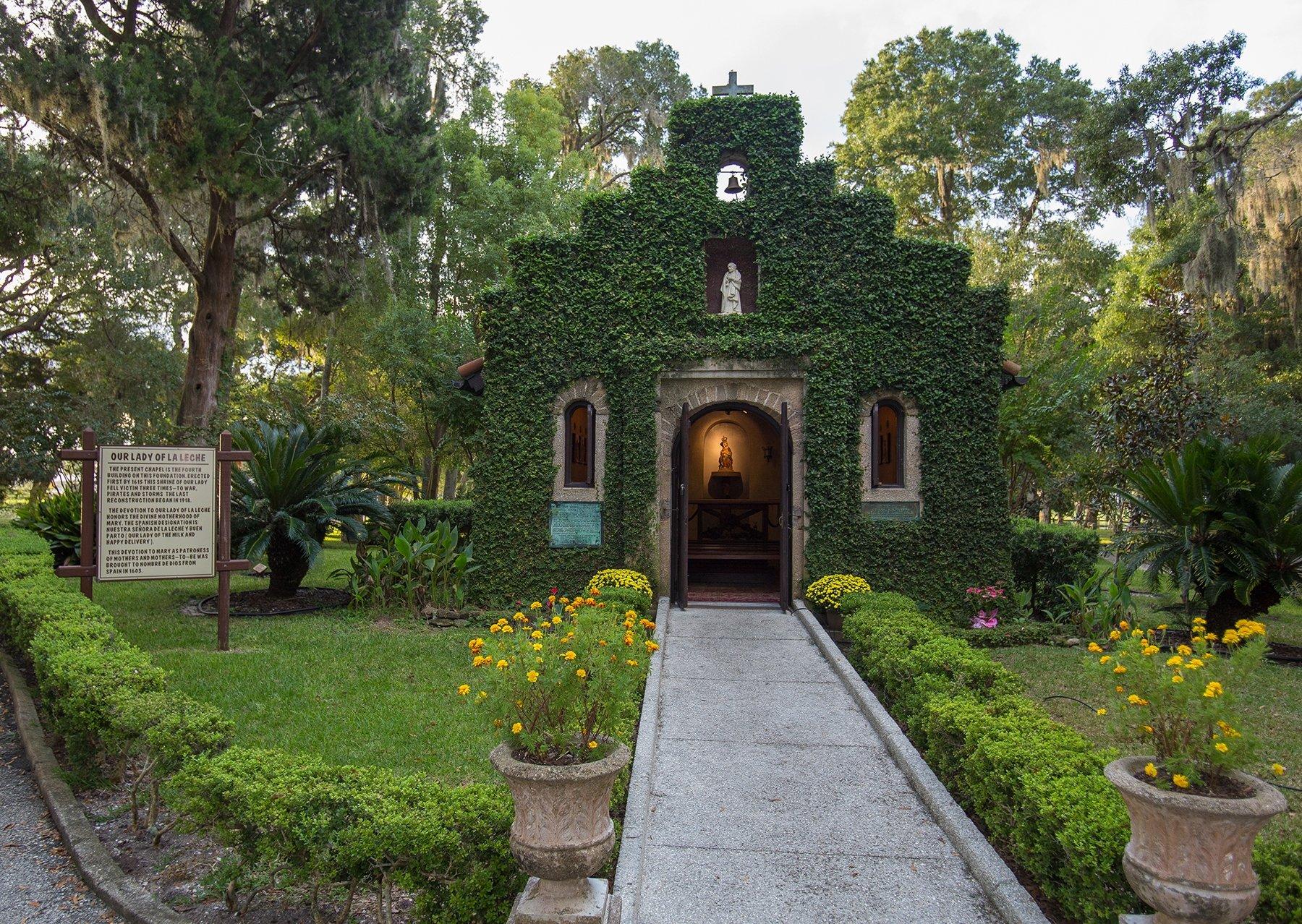
In this continuing series on the origins of Catholicism in the 50 states, the story now turns to the lower South and the states of Florida, Georgia, Alabama and Mississippi. What began as a fragile missionary presence with the Spanish and French would only gradually develop into a more established Church.
Catholic roots in Georgia reach back well before the English colonies, to the era of Spanish mission activity along the southeastern coast.
Nearly two decades before the pilgrims landed at Plymouth, Franciscan missionaries left Spain to evangelize and minister to the Indigenous peoples of the region. Living among the Guale along the Georgia coast, they preached the Gospel and celebrated the sacraments, while insisting on Christian norms of marriage in contrast to the practice of polygamy.
Their faithfulness brought them into conflict with local leaders, and in September 1597, five friars were killed, in part for upholding Church teaching against polygamy. Recognized now as the Georgia Martyrs, these brave missionaries are set for beatification on October 31 of this year, and their witness stands as the earliest chapter in the Catholic story of Georgia.
The creation of the Diocese of Charleston in 1820, encompassing the Carolinas and Georgia, underscored how limited Catholic life remained in the region. In Georgia, the first parish, Most Holy Trinity in Augusta, had been founded only a decade earlier.
Florida
Moving down the coast to Florida, the Catholic story begins earlier than anywhere else in what would become the United States. Spanish expeditions in the first half of the sixteenth century sought to establish colonies, but a lasting presence only came in 1565 with the founding of St. Augustine, the first permanent European settlement in what is now the United States.
There, the mission of Nombre de Dios was established with a secular priest as its first pastor. The missionary impulse quickly expanded, leading to the founding of the first Catholic hospital in 1598 and a Franciscan seminary in 1605. In 1606, Bishop Juan de las Cabezas de Altamirano of Cuba became the first bishop to set foot in territory that would one day be part of the United States.
As was true in most other places in the Americas, missionary life was often difficult in what would become the state of Florida. At times, Mass could not be celebrated for months due to the lack of bread or wine. Yet the work continued.
A Franciscan missionary who arrived in 1595 labored among the coastal Timucua and produced a grammar and dictionary of their language, aiding the spread of the faith.
Over the centuries, as colonial control shifted, the Church in Florida was administered in various ways, often under bishops in Cuba and elsewhere, until 1870, when the Diocese of St. Augustine was established to encompass the entire state. Today, with its rapid growth in the twentieth century, Florida is home to seven dioceses serving a diverse Catholic population of over 1.9 million.
Alabama
Moving west along the Gulf Coast, the Catholic story in Alabama began to take shape in the early eighteenth century, when much of the Mississippi Valley, including present-day Alabama, formed part of the French Empire.
The first parish was established in Mobile in 1703, with Father Henri Roulleaux de La Vente, a priest from the Diocese of Bayeux in France, serving as its first pastor after arriving by way of Canada.
In these early years, Mass and other sacraments were celebrated in the chapel of Fort Louis until a parish church was built outside the fortifications in 1708.
For much of the next century and a half, Catholic life remained largely confined to the Gulf Coast, with limited expansion inland. A more stable institutional footing came in 1829 with the establishment of the Diocese (today Archdiocese) of Mobile.
For much of the nineteenth and twentieth centuries, Alabama remained overwhelmingly Protestant, and Catholic growth was slow. Parishes gradually spread inland, with foundations in Tuscaloosa in 1844 and Birmingham in 1872 marking that expansion. In recent decades, however, the rise of the Sun Belt and immigration from outside the United States have strengthened the Church’s presence, and today about 6.8 percent of Alabamians are Catholic.
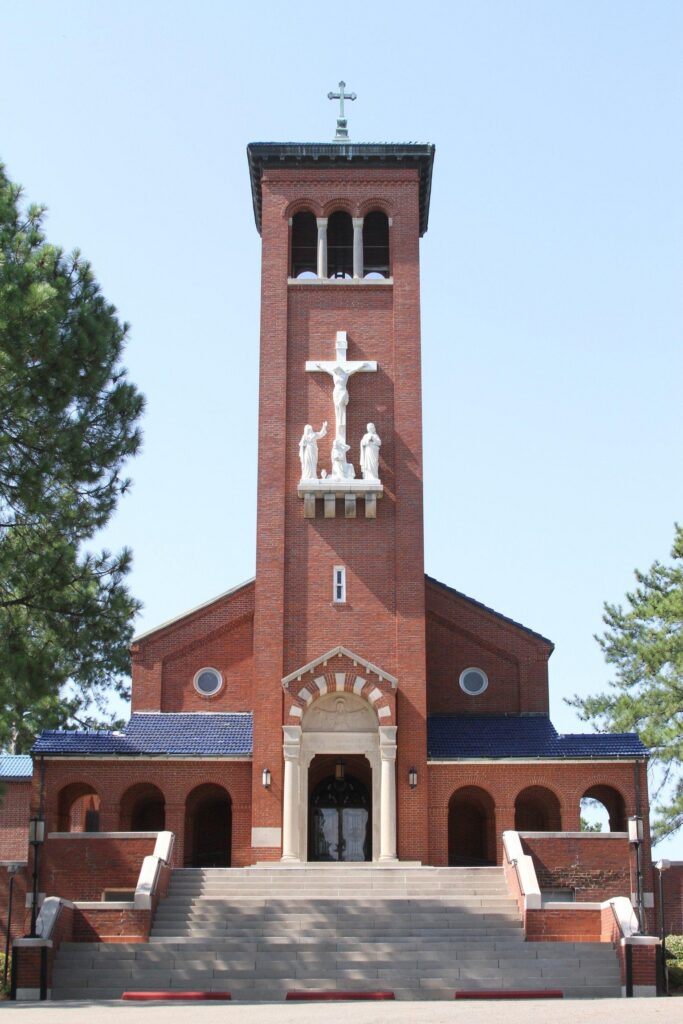
Mississippi
Just to the west, Mississippi presents a closely related but distinct chapter in the Catholic story of the Gulf South. Catholic beginnings in Mississippi date to 1682, when French explorers descended the river to its mouth and claimed the region for France, accompanied by Father Zenobius Membré, an Augustinian Recollect, who celebrated what is likely the first recorded Mass in what would become the nation’s twentieth state.
French settlement followed in 1699 at Old Biloxi, where priests ministered to the first European colonists. Missionary work quickly extended to Native peoples, where a chapel was built among the Houma, and Father Jacques Gravier performed what is likely the first recorded baptism in Mississippi.
In 1779, control of the region passed to Spain, and in 1788, a church dedicated to the Holy Savior was built in Natchez, on the site where St. Mary Basilica stands today. Despite this early foundation, Catholic life remained fragile. By the time Pope Gregory XVI established the Diocese of Natchez (today Jackson) in 1837, encompassing the entire state, there was not a single Catholic church or resident priest, and the first bishop named to the see declined the appointment.
Stability came only in 1841, when John Joseph Chanche of Baltimore accepted the role, becoming the first bishop to establish a lasting Catholic presence in Mississippi.
Like neighboring Alabama, Mississippi has seen significant Catholic growth in recent decades, and today about 110,000 Catholics are served by the Dioceses of Jackson and Biloxi.
The Catholic story of the lower South reflects a long journey from mission to a mature presence. Early efforts by Spanish and French missionaries laid foundations that would only slowly develop into a stable Church. Today’s growing Catholic communities stand as a testament to that enduring, if often overlooked, history.
Father Anthony D. Andreassi, a priest of the Brooklyn Oratory of St. Philip Neri, holds a doctorate in history from Georgetown University. His research and writing have focused on the American Catholic community. After spending many years in Catholic secondary education, he is on the staff of the Oratory parishes of Assumption and St. Boniface in Brooklyn, New York.
