


Written by R. Jared Staudt, PhD
(OSV News) — How many hours, how much money and effort pour into the illusive preservation of our fleeting youth? Legend has it that the conquistador, Ponce de Léon, sought the Fountain of Youth along the Atlantic coast of Florida, making landfall in the northern part of the state in 1513.
Today, just outside the historic center of St. Augustine, you can visit the alleged site of his fountain. Instead of youth, however, the Spaniard found death, pierced by a poisoned arrow on another voyage in Southwest Florida, near present-day Fort Myers. But even the name he bestowed on his discovery, La Florida, honoring the festival of Paschal flowers, points to a deeper source of youthfulness, one that does not fade.
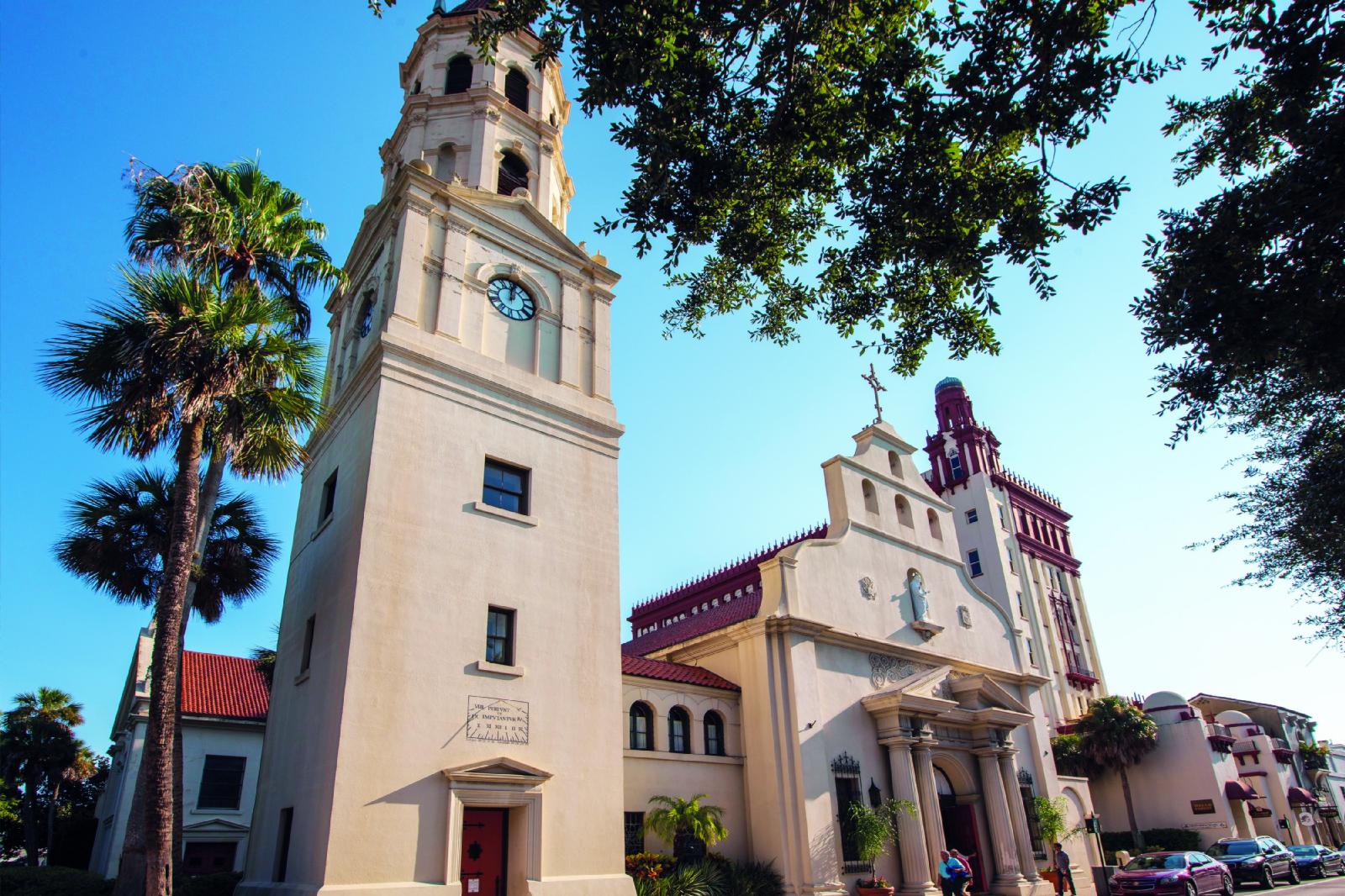
The Spanish brought the true fountain of youth with them, establishing America’s oldest city in St. Augustine decades after Ponce de Léon’s visit in 1565. The waters of baptism began flowing in North America from the spot that President John F. Kennedy dubbed our “sacred acre” adjacent to Ponce de Leon’s previous landfall.
‘Cradle of Catholic martyrdom’ in U.S.
The founder, Pedro Menéndez de Avilés, declared that he would found the colony “in the name of God,” trumping the Spanish king in honor of the Creator. This apt move pointed to a source of unity that could bring people together, and even overcome the insatiable lust for gold the Spanish brought like a plague. God, the eternal one, neither young nor old, pours out his life into us, drawing us into an undying youth through rebirth in “water and Spirit” (Jn 3:5).
St. Augustine, the city that rose up adjacent to the Nombre de Dios (Name of God) mission, offers an alternative foundation narrative for our country. A later shepherd of this first foothold of faith, Bishop John Mark Gannon, called us to rediscover our lost heritage rooted in this foundation: “Not wishing to detract in the least from the worth and importance of the English contribution to American culture, we are now awakening to the fact that the dignity and sublime greatness of American civilization flows, not so much from the dry rock of Plymouth, as from the cradle of Catholic martyrdom, which antedated the Pilgrim arrival by nearly a century.”
This youthful branch of the Church took root and its shoots blossomed across the entire region, with over 30 missions stretching all the way north to Virginia.
National Eucharistic Pilgrimage launch
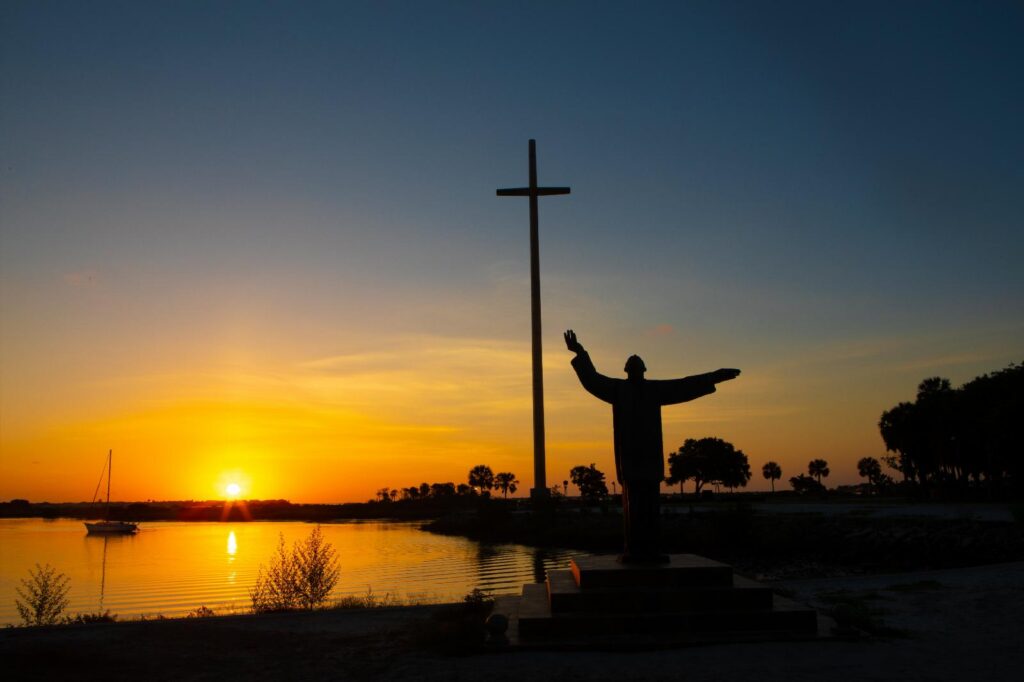
St. Augustine — and its “sacred acre” — is the site of the May 24 launch of the 2026 National Eucharistic Pilgrimage, which also commemorates the spread of the Catholic faith in the fledgling U.S., as the nation celebrates its 250th anniversary.
La Florida’s greatest fruits stemmed from its martyrs — laymen and priests, Spaniards and natives — who died defending the missions from the encroachment of settlers from the English colonies to the north. These raiding colonists would wipe out the memory of these missions for a time, gobbling up the vision and story of the first founding and subordinating it to Jamestown and Plymouth.
Yet, any great story contains both its heroes and villains. Selfless Franciscan friars sowed the faith throughout the American Southeast, though occasionally Spanish governors fell into oppressing the people. Then, in the early 18th century, during Queen Anne’s War, English raids from Carolina, led by Colonel James Moore, destroyed Florida’s missions. Europeans brought savagery with them, it seems, annihilating peaceful settlements dedicated to the Christian faith.
The Florida martyrs
Yet, out of the ashes of this tragedy, American Catholics will discover long-lost heroes of faith, coming down to us as the true fruit and treasure of St. Augustine. Soon Antonio Cuipa may become a household name, a native layman who has given his name to the canonization cause of 86 Florida martyrs. The group, martyred between 1549 and 1715, includes religious, such as Dominican Father Luis Cáncer and many laymen.
Cuipa, an educated layman, carpenter and musician, assisted both in the governance of his native village and assisted the friars in their missionary work, giving his life when the mission of San Luis near present-day Tallahassee was attacked. The Diocese of Pensacola-Tallahassee is erecting a beautiful shrine to the martyrs that will serve as an important place of pilgrimage alongside historic St. Augustine.
Spanish Florida left us a spiritual legacy, which we must take up and renew. And it is a timely one. Even after the destruction of the missions, the area became a refuge both for oppressed Indians from the English colonies, who coalesced as the Seminoles, and for escaped slaves fleeing oppression in the English colonies who established America’s first free Black settlement at Fort Mose, just north of St. Augustine.
Building unity through faith
This is the Catholic way, building unity through faith. To be Catholic means to embrace the rich diversity of human life and culture, ordering all things together to the glory of God
Despite the sins of colonists, Catholic and Protestant both, we can say that God wanted the Christian faith to come to the New World to share the redemption of his Son with all nations. We did our best to ruin his plan, but Our Lady of Guadalupe appeared in 1531 to show her particular love for the American people, reassuring them of their place in God’s family, the Church.
St. Augustine, as a place of pilgrimage, has much to offer Catholics today, bestowing a richness of martyrs, unity across cultures and devotion to Our Lady. Mary’s love became apparent here as well, with the oldest shrine in the United States forming in 1609 at the Nombre de Dios mission dedicated to Our Lady of La Leche (Milk).
Here again, we find ourselves as youths coming to be nourished by Our Mother. She is the mother of all Christian peoples, who teaches us how to preserve a childlike attitude before the Lord. In a way, her shrine presents us with a choice. Will we come to God as docile children, or will we turn away rebelliously to seek our own way?
It is up to us to continue spreading the faith on this continent, bringing the true kingdom to this melting pot of a nation. We can continue to overcome division through the grace of God and to teach the lost the true meaning of freedom. Our Lady awaits to nourish us at her shrine on the grounds of America’s first mission. Let us return to our true Alma Mater.
R. Jared Staudt, PhD, serves as director of content for Exodus 90 and has authored many books, including “How the Eucharist Can Save Civilization.” He and his wife, Anne, have six children, and he is a Benedictine oblate.
