


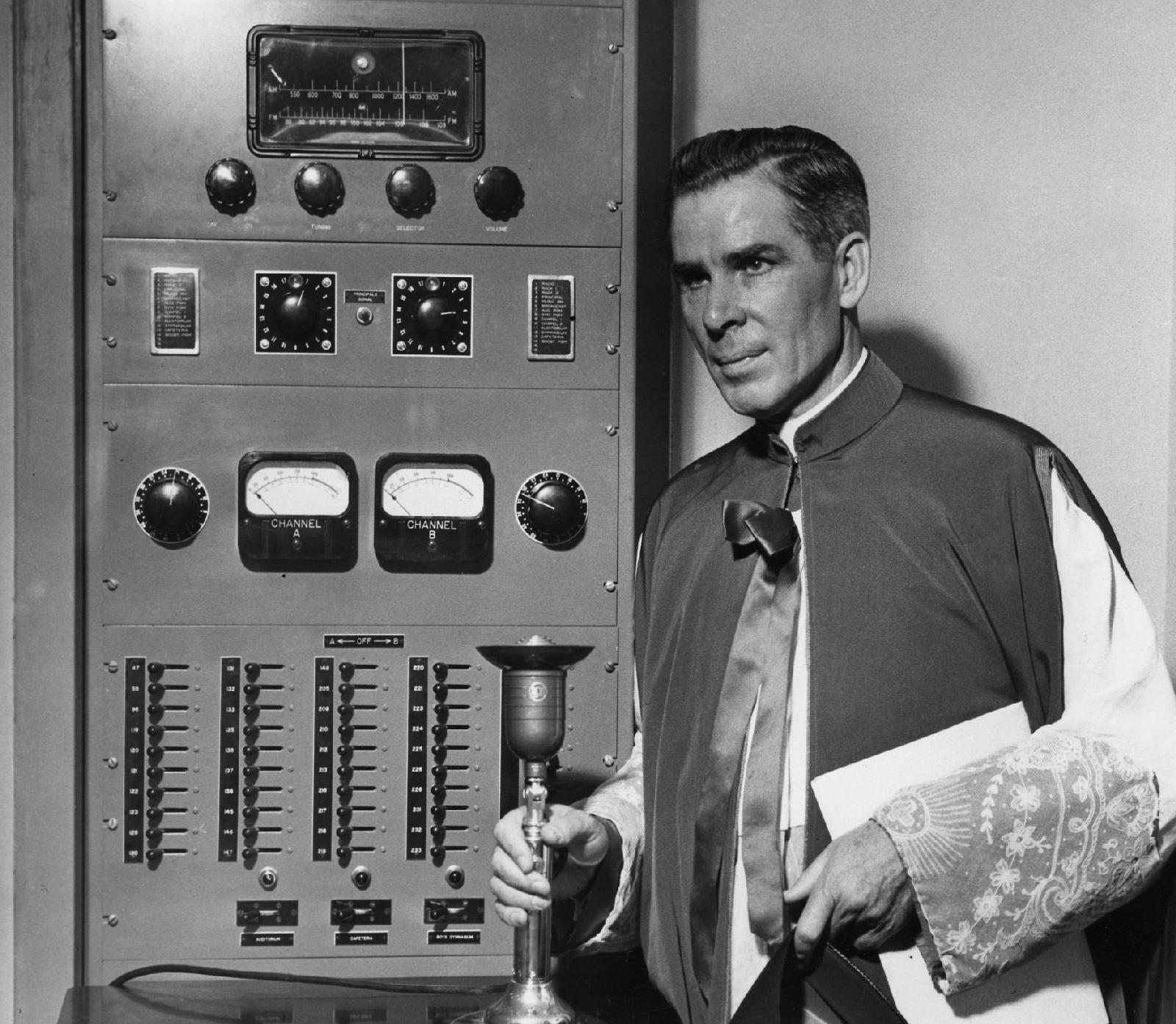
(OSV News) — It was while a professor at The Catholic University of America in Washington that Archbishop Fulton J. Sheen began to use radio as a powerful tool for evangelization. It was a medium that soon garnered him a national audience and reputation.
After completing his doctoral studies at the University of Louvain in Belgium, then-Father Sheen was awarded the highly prestigious agrégé honor after further postdoctoral work, including the publication of a book. In 1926, he returned to CUA, where he had previously begun his graduate studies in philosophy.
Now a faculty member, Archbishop Sheen took on a demanding teaching load and began writing prolifically, leading to the publication of his book “Religion without God” in 1928, a sequel of sorts to his dissertation, “God and Intelligence.” The young priest-scholar also became well-known and popular on campus for his frequent lectures to clubs and groups, as well as his involvement in the newly-founded American Catholic Philosophical Association.
His reputation soon extended beyond CUA’s campus as invitations to speak poured in from around the country. From 1926, Archbishop Sheen began delivering the Lenten sermons at St. Paul the Apostle Church in Manhattan, one of the city’s largest parishes. His first radio appearance came in 1928, after which he was quickly flooded with invitations to speak on radio programs nationwide.
Amid this busy schedule, he also became a sought-after retreat leader for religious women, forming a particular friendship with the Sisters of the Holy Child Jesus, thanks to his bond with a nun at their new Rosemont College near Philadelphia. His presence in New York City’s Catholic pulpits expanded further when he was invited to preach at St. Patrick’s Cathedral on the four Sundays of Advent in 1929.
Writing and preaching
Despite his growing fame, Archbishop Sheen was acutely aware of the need to ground himself spiritually, especially in the virtue of humility. He faithfully dedicated himself to a daily Holy Hour before the Blessed Sacrament each morning and often retreated to monasteries for longer periods of prayer and meditation. During this period of rising prominence, he became close to a convent of Carmelite nuns in New Albany, Indiana, often writing to the superior to request the nuns’ prayers and supporting the convent financially through regular, generous contributions.
In 1934, Archbishop Sheen published his third book, “Philosophy of Science,” in which he aimed to demonstrate the harmony between recent advancements in mathematics and physics with Thomistic philosophy. He researched and wrote this book while managing a demanding teaching schedule, and spending increasing amounts of time lecturing and preaching around the country.
Recognized for his academic accomplishments, Archbishop Sheen was granted tenure and promoted to associate professor at CUA in 1935. During the mid-1930s, he typically spent two days each week teaching on campus, while traveling to New York City on weekends to preach at St. Patrick’s Cathedral and teach classes for converts — an apostolate for which he would become especially renowned.
Distinctive public speaking style
His rigorous schedule was well-documented: a 1940 article in Time magazine noted that Archbishop Sheen maintained around 150 speaking engagements annually on top of his teaching commitments at the university. By 1947, Archbishop Sheen had been promoted to full professor, and his resume boasted 33 books, 13 pamphlets and 34 volumes of radio addresses.
It was during this time that Archbishop Sheen fully developed his distinctive public speaking style, captivating audiences in person, on the radio and eventually on television. While he devoted hours to preparation, he always spoke without notes and often opened with a self-deprecating anecdote to establish a sense of connection with his audience. This approach proved especially effective as he increasingly addressed radio audiences.
As mentioned, Archbishop Sheen’s first radio appearance was in 1926, but his radio career truly began in 1930, when he embarked on a 20-year tenure hosting “The Catholic Hour” on NBC radio, which eventually reached an audience of 4 million listeners per broadcast. In 1940, Archbishop Sheen made his first television appearance on Easter Sunday, in what is regarded as the world’s first Catholic television broadcast.
From radio to TV
After 22 years on the radio, Archbishop Sheen — who had been consecrated a bishop in June 1951 — began hosting the television series “Life is Worth Living” in 1952. Initially aired for five seasons on two of the nation’s major networks (DuMont and ABC) and later by other distributors until 1968, “Life is Worth Living” reached an audience of 30 million at its peak, sometimes even outpacing Milton Berle’s show on NBC, which aired at the same time.
Having refined his presentation style — including his famous use of a chalkboard — Archbishop Sheen captivated audiences with his talks on faith, the meaning of life and moral living, resonating with listeners beyond just American Catholics. The Jesuit weekly America magazine eventually dubbed him: “the greatest evangelizer in the history of the Catholic Church in the United States” for his groundbreaking use of media to spread the Gospel.
Father Anthony D. Andreassi, a priest of the Brooklyn Oratory of St. Philip Neri, holds a doctorate in history from Georgetown University. A version of this story first appeared in MISSION magazine, the publication of the Pontifical Mission Societies, and is distributed through a partnership with OSV News.
