


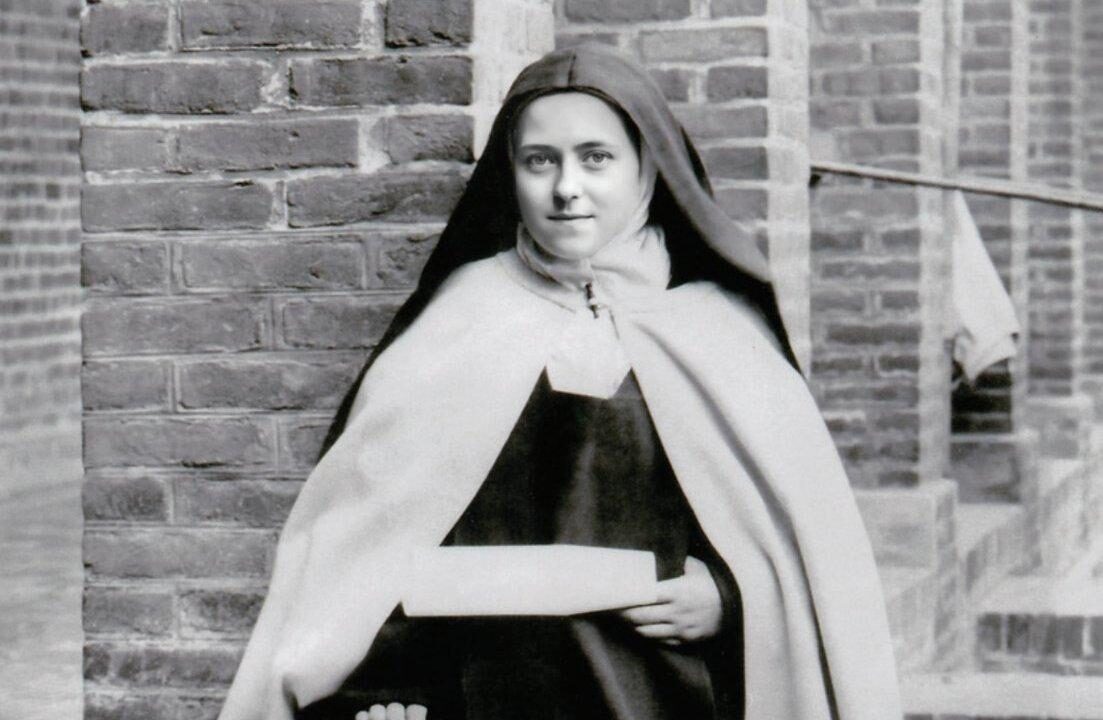
(OSV News) — There is an apparent contradiction, at first glance, between the fact that St. Thérèse of Lisieux never left her Carmelite monastery and yet is patroness of missionary activity.
As she related in her spiritual autobiography “Story of a Soul,” St. Thérèse noted that charity was the “key” to her vocation. “I understood … that the Church has a heart, and a heart on fire with love,” she wrote.
It was this heart ablaze that she desired to share with the world.
“Like the Prophets and Doctors, I would be a light unto souls, I would travel to every land to preach Thy name, O my Beloved, and raise on heathen soil the glorious standard of Thy Cross,” she wrote. “One mission alone would not satisfy my longings. I would spread the Gospel to the ends of the earth, even to the most distant isles. I would be a Missionary, not for a few years only, but, were it possible, from the beginning of the world till the consummation of time.”
‘Love makes one a missionary’
Blessed Fulton J. Sheen, longtime promoter of the missions as national director for the Society of the Propagation of the Faith, summarized this desire in his book “Archbishop Fulton Sheen’s St. Thérèse: A Treasured Love Story,” saying: “This woman was in love, and she wanted her Beloved known all over the world. That’s why she loved the missions! … Love makes one a missionary. When we cease to love, we cease to be a missionary.”
With the approach of the 100th anniversary of World Mission Sunday Oct. 18, it is worth getting to know better this patroness of the missions.
Before becoming a Discalced Carmelite nun as a teenager, Marie Françoise-Thérèse Martin was simply Thérèse — the youngest daughter of two future saints. Her family was the context in which St. Thérèse of Lisieux began to discover her “Little Way” of holiness for which she’s so well known. From an early age, Thérèse learned to accept all as grace and providence, and to rely solely on God’s will to find her peace. St. Thérèse teaches us that holiness is found in doing little things consistently and with great love.
Insistent upon doing God’s will
Thérèse was born the ninth child of Sts. Louis and Zélie Martin on Jan. 2, 1873, in Alençon, France. Louis would lose his wife to breast cancer four years later, and his brother-in-law helped arrange for the widower’s family to move north to Lisieux.
During her childhood, Thérèse was considered weak and unusual. At the age of 9, she became so sick that it appeared the end was near. Her father even requested Masses at Our Lady of Victories Church in Paris, and her family kept vigil at her bedside. As three sisters were leading prayers of intercession to the Blessed Mother in front of the family’s statue of her, Thérèse experienced a miracle: The statue began to smile at her. She was healed.
Thérèse and her four older sisters (her other four siblings did not survive infancy), discovered God’s call to the religious life. And Thérèse was quite insistent upon doing God’s will as soon as possible, despite the many difficulties she encountered on that path.
Refused entry to the Carmelite convent in Lisieux because of her young age, Thérèse seemingly could not contain the zeal with which her soul desired total union with Christ. She even used a meeting with Pope Leo XIII during a pilgrimage to Rome as an opportunity to seek his assistance. The pope replied, “Well, my child, do what the superiors decide. … You will enter if it is God’s will.” The local bishop later gave his consent for her to enter the Lisieux Carmel when she was 15.
Developing her ‘Little Way’
Life in the Carmel of Lisieux was taxing for Thérèse. Living with the other nuns was not always easy. She was maligned and mistreated. But it was there that Thérèse found her “Little Way.” Entering the convent with a desire for spiritual greatness, her attitude slowly changed, writing in her diary: “I applied myself especially to practice little virtues, not having the facility to perform great ones.”
In “Story of a Soul,” published in 1898 about a year after her death, Thérèse explained the “Little Way” more: “But how shall I show my love, since love proves itself by deeds? … The only way I have of proving my love is to strew flowers before Thee — that is to say, I will let no tiny sacrifice pass, no look, no word. I wish to profit by the smallest actions, and to do them for Love.” Among the names she’s known by today is “the Little Flower.”
‘Sweet’ suffering
Finding blood in her handkerchief, she experienced “joy,” and awaited death as the final act in her complete union with Christ. Dying from tuberculosis, she taught of suffering’s purpose: “I have reached a point where I can no longer suffer, because all suffering is become so sweet.”
Thérèse experienced intense physical suffering and offered it all to the Lord, in union with his to the end — uttering as she breathed her last, “My God, I love you!” She died on Sept. 30, 1897. She was 24.
The simplicity and practical approach to the spiritual life of St. Thérèse of Lisieux make her among the most popular saints in the Church, and the universality of her message reached a pinnacle in 1997 when Pope St. John Paul II declared her a doctor of the Church.
Two years after St. Thérèse became the first saint he canonized — and one year after he established World Mission Sunday — Pope Pius XI in 1927 formally declared “the Little Flower” the Patroness of the Missions. Her feast day is Oct. 1.
Michael R. Heinlein is author of “Glorifying Christ: The Life of Cardinal Francis E. George, O.M.I.” and a promised member of the Association of Pauline Cooperators.
