


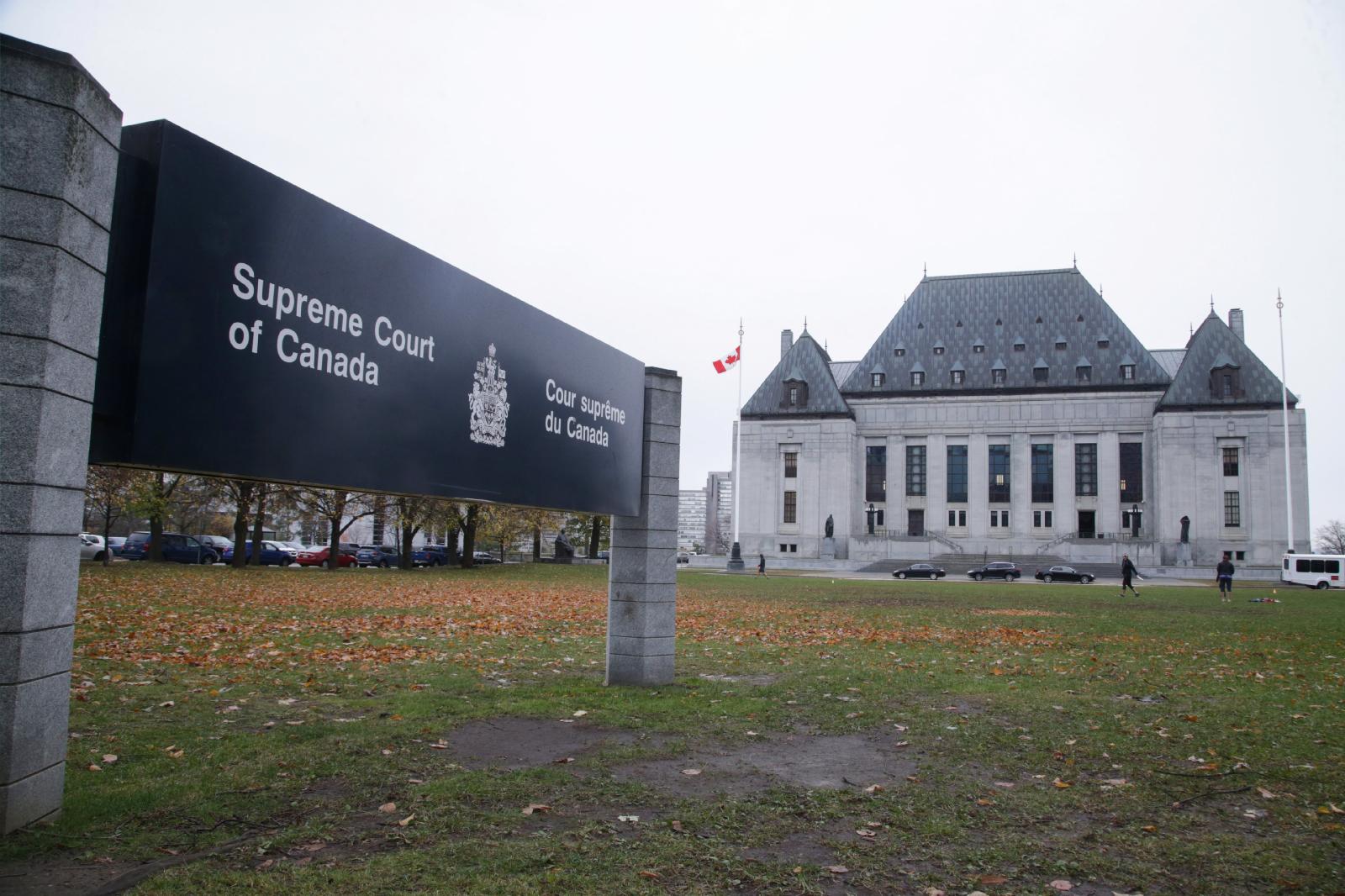
(OSV News) — Two Canadian high courts issued rulings Nov. 27 on cases that have religious liberty implications for Catholic individuals and organizations in the country.
Canada’s Supreme Court upheld most of a Québec law banning certain public servants from wearing religious symbols at work, while British Columbia’s Supreme Court ruled that faith-based hospitals can refuse to provide Medical Assistance in Dying, or MAID, Canada’s state-sanctioned assisted suicide and euthanasia program.
Both courts’ rulings referenced the Canadian Charter of Rights and Freedoms, Canada’s constitutional counterpart to the U.S. Bill of Rights.
Quebec ban on public servants wearing of religious symbols mostly upheld by Canada’s Supreme Court
Canada’s Supreme Court mostly upheld a Quebec law that prohibits the wearing of religious symbols by public servants in a 6-1 ruling Nov. 27.
The much-debated Bill 21, officially known as “An Act Respecting the Laicity of the State,” prohibits public servants in positions of authority — such as teachers, police officers, and government lawyers and judges — from wearing religious symbols at work. The law also extended the ban to certain staff at subsidized daycares, private schools and professional development centers.
Passed by the Québec National Assembly June 16, 2019, it asserts that Québec is a secular state and that it aims to separate religion from state affairs.
However, Bill 21 faced a Supreme Court of Canada challenge in March regarding its impact on religious freedom and equality.
In “English Montreal School Board v. Quebec,” the Court ultimately ruled in favor of Québec’s use of the so-called “notwithstanding clause” in section 33 of the Canadian Charter of Rights and Freedoms and a similar clause in section 52 of Québec’s Charter of Human Rights and Freedoms. The Canadian Charter’s clause allows Parliament or a province’s legislature to expressly declare that an act temporarily overrides certain rights and freedoms listed in the country’s Charter for a period of five years, after which the overriding legislation could be renewed by the governmental body.
The Court also said that exercising that override power in a piece of legislation does not prevent courts from declaring it violates constitutional rights due to the separation of powers, allowing the possibility of legal challenges to legislation utilizing an override while permitting the legislation to stand.The Court also maintained an exception for members of Québec’s legislature to wear head or face coverings while performing their duties.

The Canadian Conference of Catholic Bishops had submitted a strongly worded intervener factum, a legal statement of facts similar to an amicus brief in U.S. courts, declaring its interest to Canada’s Supreme Court in the case. The conference was one of over 50 interveners in the case.
In a Nov. 27 statement, the bishops’ conference expressed deep concern about the future of religious freedom and the full participation of persons of faith in public life, both in Québec and across Canada.
“The Catholic Church recognizes the legitimate autonomy of civil authority and the distinction between religious and political institutions (cf. Gaudium et Spes, 76). However, the religious neutrality of the State should not entail the exclusion of religious expression from public life,” the statement read. “No person should be required to choose between the faithful expression of his or her religious convictions and the opportunity to serve society.”
While a parliamentary majority can restrict certain fundamental rights, elected representatives have a moral responsibility to “safeguard those rights, protect minorities, and engage in genuine dialogue with those affected by such restrictions,” the bishops said. “The protection of religious freedom is not a matter of privilege for religious communities; it is a shared responsibility and an essential foundation of a free, just, and democratic society.”
Religious and civil rights groups voice concerns over Bill 21 ruling
Phil Horgan, a Toronto Catholic lawyer serving as president and general counsel of the Catholic Civil Rights League, presented the bishops’ oral arguments during the Bill 21 Supreme Court hearing. He shared that the CCRL “share the concern of the CCCB,” as reported by The Catholic Register, based in Toronto.
The Christian Legal Fellowship, Canada’s national association of Christian lawyers and law students, also intervened in the case. Derek Ross, CLF’s executive director, acknowledged that many are fixating on how the top court interpreted usage of the notwithstanding clause. But, he said, “it is important not to lose sight of who is most directly impacted by the law at the centre of the case: religious minorities who are excluded from public service simply because they openly identify as religious.”
He expressed concern about what this ruling will lead to in the future.
“Once a law embraces the idea that people of faith are not welcome to participate in government unless they hide their religious identity, where does it end? We’ve already seen that laicity’s restrictions have not been limited to government workers but extended to religious expressions by private citizens in schools, colleges, public parks, and sidewalks. What was proposed as state neutrality is increasingly being imposed as societal irreligion.”
The Canadian Civil Liberties Association is also “deeply disappointed” by the decision, The Catholic Register reported. The organization’s Executive Director Howard Sapers wrote that “since 2019, we have witnessed how Bill 21 has treated religious minorities, particularly Muslim women, as second-class citizens. This judgment does not restore the rights, opportunities and careers that have been taken away.”
Federal and provincial Québec politicians largely celebrated the ruling.
Yves-François Blanchet, the leader of the Bloc Québécois, declared that “we are now more than ever in a position to move forward with the preservation of the very elements that profoundly define the distinct nature of Quebec society.”
François Legault, the former Québec premier and leader of the Coalition Avenir Québec, wrote in French on social media that he is “very proud of this legacy.”
Current Québec Premier Paul St-Pierre Plamondon’s reaction was more mixed. While acknowledging the ruling as a victory for secularism, he warned that the decision allowing declaratory relief — or judicial declarations when a law infringes on Charter rights — represents “a setback for the provinces” in terms of wielding the notwithstanding clause.
The English Montreal School Board chair Joe Ortona noted that while the ruling marks the “end of the legal road,” the political fight is still ongoing, The Catholic Register reported, as “we have a minority government in Quebec and the notwithstanding clause needs to be renewed every five years, and that’s going to come again in 2029 (for Bill 21).”
Catholic hospital’s refusal to offer medical assistance in dying doesn’t violate rights, B.C. Supreme Court rules
In a decision supporting the right of Vancouver’s St. Paul’s Hospital to refuse MAID, or Medical Assistance in Dying, on site, the British Columbia Supreme Court ruled Nov. 27 that government policies allowing faith-based hospitals to decline to provide MAID do not violate the Canadian Charter of Rights and Freedoms.
In an 86-page decision released Nov. 27, Chief Justice Ronald A. Skolrood dismissed the constitutional challenge to the province’s policy, Canadian Catholic News reported.
The government’s policy allowing faith-based organizations to operate in a way that is consistent with their beliefs “does not amount to state sponsorship of those beliefs or make the practice of those beliefs mandatory,” Skolrood wrote, referring to the B.C. Health Ministry’s policy.

The lawsuit arose from the death of Sam O’Neill, a Vancouver woman with advanced cervical cancer who received MAID after being transferred from St. Paul’s Hospital, operated by the Catholic health care organization Providence Health Care, to another facility in April 2023.
Her mother, Gaye O’Neill, along with Dying with Dignity Canada and MAID provider Dr. Jyothi Jayaraman, challenged the B.C. government’s policy allowing faith-based hospitals to opt out of providing MAID. They argued that requiring patients to transfer to another facility violated patients’ Charter rights and caused unnecessary physical and psychological suffering, and that the policies violated the freedom of conscience rights of physicians who choose to provide MAID.
During the trial, Gaye O’Neill testified that the doctors and nurses at St. Paul’s had been “wonderful” to her daughter, but described the transfer as “very, very quick,” leaving family members little time to say goodbye.
The defendants were Providence Health Care, the B.C. government, and Vancouver Coastal Health Authority.
Skolrood concluded that the plaintiffs had failed to establish violations of physicians’ freedom of conscience or patients’ rights to freedom of conscience and religion, life, liberty and security of the person.
“In my respectful view, the plaintiffs have not established any basis for the Court to interfere in that Policy,” he wrote.
Kimberley Heatherington, Megan Marley and Quinton Amundson contributed to this report. Versions of this story were published by The Catholic Register and Canadian Catholic News, and are distributed in partnership with OSV News.
