


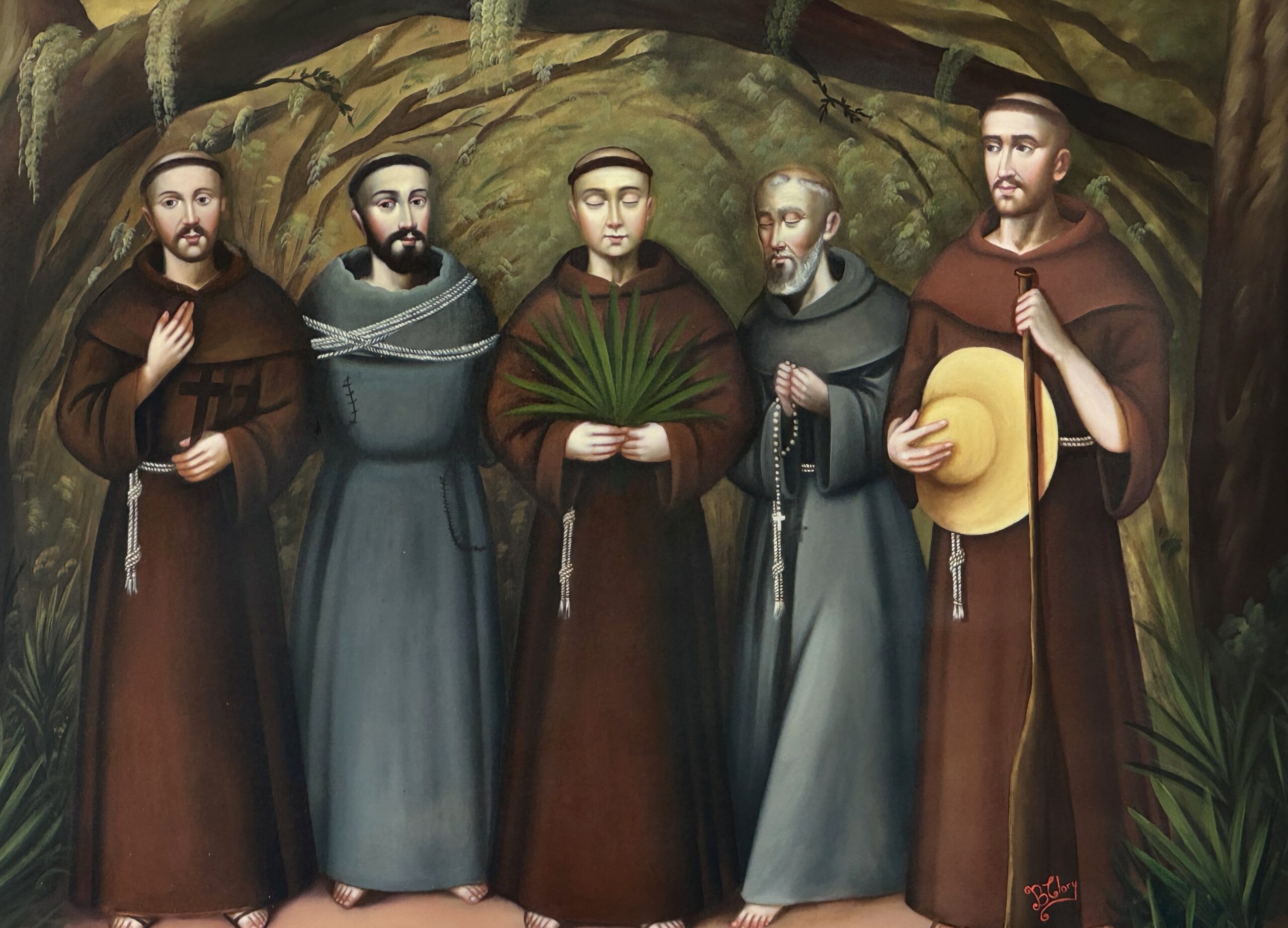
Earlier this month on Oct. 3, Catholics around the world marked the 800th anniversary of the death of St. Francis of Assisi. Not long after his death in 1226, his spiritual sons would carry the Gospel far beyond Italy to Africa, Asia and, eventually, to the Americas. And on Oct. 31, the Church will beatify five Franciscan missionaries from Spain who were martyred in 1597 in what is now the state of Georgia.
The beatification comes at an especially fitting moment, just days after Catholics around the world mark World Mission Sunday on Oct. 18. This annual observance celebrates the Church’s enduring call to bring the Gospel to the ends of the earth and the role every Catholic plays in that mission through prayer, sacrifice and generous giving.
Missionary spirit
The story of the Georgia Martyrs offers a powerful early example of that missionary spirit on American soil. More than two decades before the pilgrims landed at Plymouth, Franciscan missionaries had already left Spain to evangelize the Indigenous peoples along what is now the Georgia coast. They established missions among the Guale people, learning their language and customs, preaching the Gospel and celebrating the sacraments.
Guale society was organized around a network of villages, with leadership mostly passing through matrilineal lines. Upon the death of the cacique (chief), the chiefdom transferred to the son or daughter of the cacique’s eldest sister. Because this structure was built upon a system of inheritance through the female, it was common for chiefs to take more than one wife.
The Franciscans, however, taught that those who had accepted baptism were also called to embrace the Christian understanding of marriage, which excludes any kind of plural marriage. That teaching brought one of these Franciscans, Father Pedro de Corpa, into conflict with Juanillo, a young Guale man who was heir to an important chiefdom. When Juanillo sought to take a second wife, de Corpa reminded him that, as a Christian, he could not do this. In response to this admonition, Juanillo and several followers reacted violently and de Corpa was killed on Sept. 14, 1597, as he was preparing for Sunday Mass.
Now on the war path, the group then moved from mission to mission along the coast, killing the friars Blas Rodríguez, Miguel de Añon, Antonio de Badajóz and Francisco de Veráscola. When in early 2025 Pope Francis authorized their canonization, he called them true martyrs, killed in “odium fidei” (hatred of the faith).
There is a danger in telling their story simply as a clash between Christianity and Indigenous culture. The encounter between Europeans and the native peoples of the Americas was enormously complicated, and its history includes exploitation, violence and profound cultural loss. But acknowledging that larger history should not obscure the particular witness of these five men who lost their lives in service of Christ and his Gospel. They had left their homes and familiar surroundings to live among people whose language and way of life were vastly different from their own.
The Dicastery for the Causes of Saints has pointed to that decision itself as the first evidence of their willingness to give their lives for Christ, leave Spain, and go to a land and peoples still largely unknown to them. Their martyrdom, in other words, did not begin on the days in September 1597 when they were killed. It began much earlier when they allowed themselves to be sent.
These five Franciscans probably could not have imagined that the missions where they labored would one day become part of the United States, much less the vibrant Catholic Church that would eventually take root here. But that is often the way the Gospel grows. The seed is planted by people who never live to see the harvest.
American missionaries
Nor were they the last missionaries to make the ultimate sacrifice on this continent. On Oct. 19, the Church celebrates the feast of the North American Martyrs (St. Isaac Jogues, St. Jean de Brébeuf and their companions). Only a few decades after the deaths of the Georgia Martyrs, these French Jesuit missionaries crossed the Atlantic to bring the Gospel to the Indigenous peoples of New France, in what is now Canada and upstate New York.
Their stories bear striking similarities to those of the Spanish Franciscans. They too left behind the familiarity and security of Europe, learned new languages and cultures, endured enormous hardships and sought to plant the Gospel in a land far from home. And they, too, ultimately gave their lives for the mission they had embraced.
Centuries later, the direction of that missionary movement would begin to change. The Church in the United States, once itself a mission territory, would increasingly send its own priests, religious and lay people to bring the Gospel to other parts of the world. And some of them, too, would pay the ultimate price.
Among them were four American women — Maryknoll Sisters Ita Ford, Maura Clarke, Ursuline Sister Dorothy Kazel and lay missionary Jean Donovan — who were murdered in El Salvador in December 1980 while serving the poor there.
Less than a year later, another American missionary would give his life. Stanley Rother, a priest of the Archdiocese of Oklahoma City serving in Guatemala, had remained with his people amid growing violence, insisting that “the shepherd cannot run,” and on July 28, 1981, he was murdered in his rectory. Beatified in 2017, he became the first U.S.-born martyr formally recognized by the Church.
When the five Georgia Martyrs are beatified on Oct. 31, we will remember not only the sacrifice of these brave Franciscans, but also the missionary story they represent. Their witness reminds us that the call to mission belongs to every Christian: To carry the Gospel beyond ourselves and trust that God will bring to harvest the seeds we may never see grow.
Father Anthony D. Andreassi, a priest of the Brooklyn Oratory of St. Philip Neri, holds a doctorate in history from Georgetown University. His research and writing have focused on the American Catholic community. He is associate national director of The Pontifical Mission Societies USA. After spending many years in Catholic secondary education, he is on the staff of the Oratory parishes of Assumption and St. Boniface in Brooklyn, New York.
