


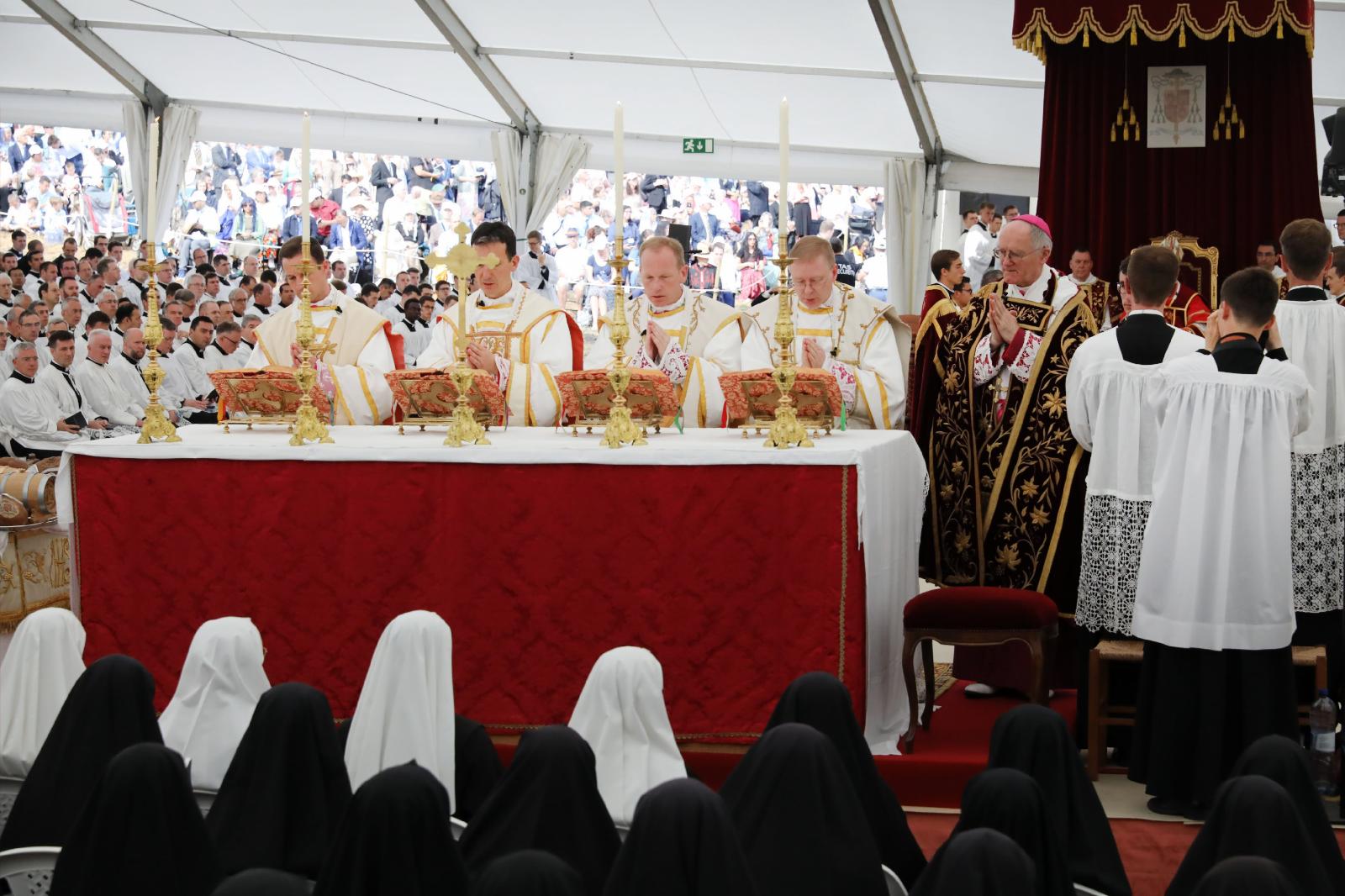
The Lefebvrites are once again in full schism with the Catholic Church.
Backed into a corner by the Society of St. Pius X’s decision to ordain four bishops July 1, Pope Leo XIV took the steps necessary to foster the Church’s unity when the Dicastery for the Doctrine of the Faith issued the next day a decree of excommunication of the newly ordained. Included in that excommunication are laypeople who persist in consistently attending SSPX Masses.
For Pope Leo, whose desire for unity within the Church is so deep that his very motto is “In Illo uno unum,” or “In the One, we are one,” this separation is about as painful as it gets.
A plea for unity
The day before the planned ordinations, he issued a letter to Father Davide Pagliarani, superior general of the SSPX, in which he begged for the ordinations to not go forward and for communion to be sustained. “I plead with you and ask you with all my heart: please turn back! I urge you to consider carefully the spiritual good of the faithful, because the schismatic act you are about to undertake would deprive them of the licit and, in some cases, even valid reception of the Sacraments, which they love and seek for their sanctification,” the pope wrote.
This is indeed the case. As of July 2, the sacraments of marriage and reconciliation, if conducted within the SSPX, are invalid. It was a bold but necessary move by the Vatican — one that is strengthened by its call to the faithful associated with the SSPX to “remain steadfast in communion” with the Church.
Pope Leo’s cries for a united Church have been consistent since his first moments in office. He spoke perhaps most eloquently during his homily during the Week of Prayer for Christian Unity this past January, when he said, quoting the homily he gave at the start of his pontificate: “It is the shared task of all Christians to say humbly and joyfully to the world: ‘Look to Christ! Come closer to him! Welcome his word that enlightens and consoles!'” He added: “My dear friends, every year the Week of Prayer for Christian Unity invites us to renew our commitment to this great mission, bearing in mind that the divisions among us — while they do not prevent the light of Christ from shining — nonetheless make the face which must reflect it to the world less radiant.”
SSPX history
For decades, and across pontificates, the Church has been trying to solve the problem of the SSPX. The back-and-forth has been happening for so long that one bishop who initially excommunicated himself in 1988 — a penalty that was lifted in 2009 by provisions created by Pope Benedict XVI — is now once again excommunicated.
One wonders how this situation might have been escalated by the promulgation of “Traditionis Custodes,” the 2021 document that, seemingly out of the blue and without the kind of synodal consultations appropriate to such a decision, Pope Francis levied heavy limitations on the use of the 1962 Missal.
Could the SSPX have seen such growth as a result of that decision that their audacity was strengthened to move ahead with the recent schismatic defiance? There has been no new ecumenical council or change in dogma. And considering that it took them almost 40 years to duplicate the 1988 illicit episcopal consecrations — in light of the widening support from Rome during that same timeframe for freer celebration of the preconciliar liturgy — one doesn’t have to wonder much.
Perhaps the time has come for Pope Leo to consider a more tactical approach? If it is the traditional liturgy that is attracting a number of the faithful away from the Church to the SSPX, why not cut the society off at the knees and restore widespread accommodations for use of the 1962 Missal?
Fruits of ‘Traditionis Custodes’
While “Traditionis Custodes” came about under the presumption that unity was increasingly at risk in the Church because the traditional Latin Mass was growing in popularity, is it fair to say in hindsight that the document instead effected division?
An increasing number of bishops have made similar arguments. By making the 1962 Missal into the enemy — rather than the misguided theology, morality and ecclesiology of only some of its proponents — the Church ended up scoring an own goal. Five years on from “Traditionis,” could restoring the Church’s practice to the one outlined in Pope Benedict’s “Summorum Pontificum” olive branch be worth considering anew in order to keep souls united to the Vicar of Christ and his Church?
If an additional positive fruit comes from the ongoing SSPX saga, let it be the much-needed concession by all in the Church that liturgy ought not be the battleground it has so readily become since the Second Vatican Council. Instead, let us celebrate the Church’s legitimate liturgical diversity and restore the principle of catholicity to our liturgical life, deepening our experience of the unity Christ wills for the Church.
Untangling the SSPX conundrum would likely benefit from a synodal solution, as Pope Leo has offered. As he continues to refine and define synodality in the Church’s life today, we might consider this issue — and the related “Traditionis Custodes” episode — as a key lesson of how a synodal approach to such significant decisions in ecclesial life, rather than brute force, has a better chance of restoring and maintaining communion within the Church.
Michael R. Heinlein is author of “Glorifying Christ: The Life of Cardinal Francis E. George, O.M.I.” and a promised member of the Association of Pauline Cooperators.
