


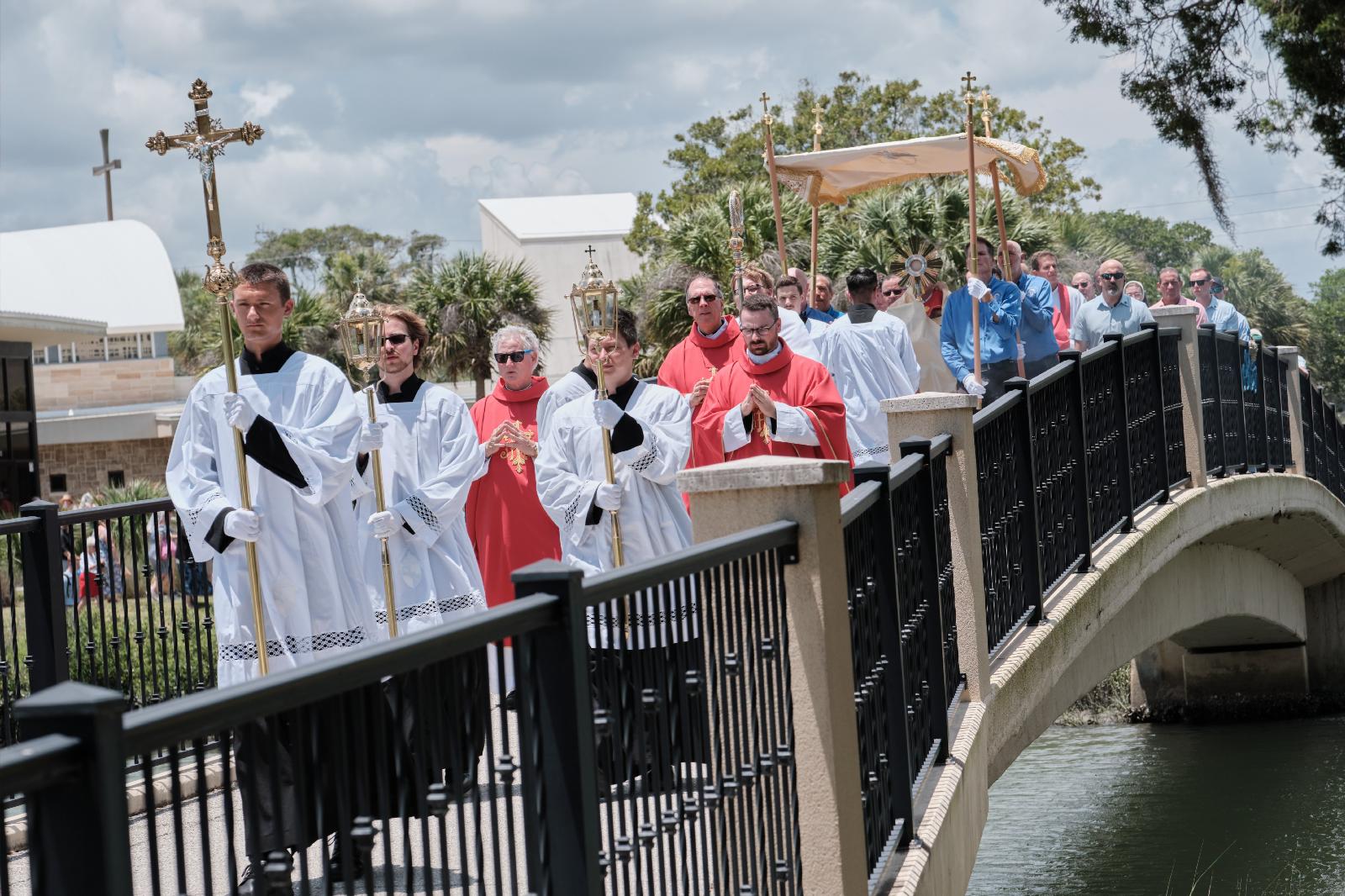
ST. AUGUSTINE, Fla. (OSV News) — A softening of hearts toward the Eucharist, a greater sense of unity in the Church, and a “fresh outpouring of the Holy Spirit” — these were the intentions held in the hearts of perpetual pilgrims as they set out on the third National Eucharistic Pilgrimage from St. Augustine May 24.
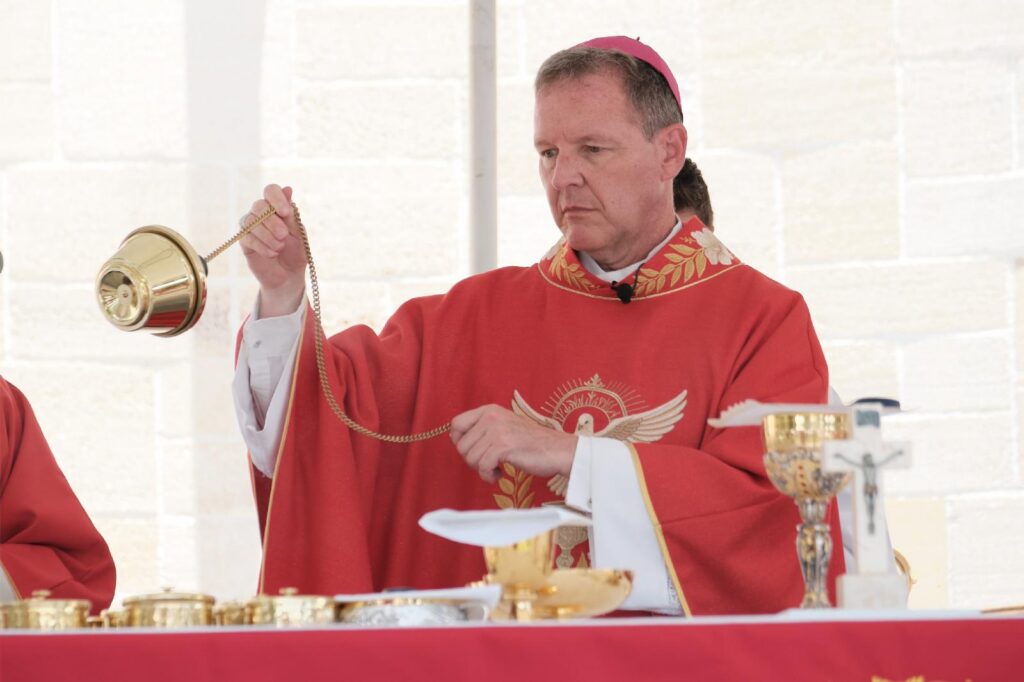
Under the bright Florida sun, on the grounds of the Mission Nombre de Dios and the National Shrine of Our Lady of La Leche, Bishop Erik T. Pohlmeier of St. Augustine celebrated Mass to kick off the 2026 pilgrimage on the feast of Pentecost — nearly 500 years after the first Mass of Thanksgiving there in 1565 in what is now “the oldest site of continuous Catholic presence in the United States.”
In attendance were the nine “perpetual pilgrims” of the National Eucharistic Pilgrimage who will be traveling with the Eucharist — which Catholics believe to be Jesus Christ truly present in his body, blood, soul and divinity — for six weeks on the “St. Frances Xavier Cabrini Route” up the East Coast, ending in Philadelphia over the July 4 holiday. Also present were officials connected to the National Eucharistic Pilgrimage and the Diocese of St. Augustine, and as many as 1,500 pilgrims gathered for the first leg of the 2026 pilgrimage.
“Today, on the feast of Pentecost, I’ve really just been praying for a fresh outpouring of the Holy Spirit: that we would be really filled with his gifts, and would experience peace and joy and freedom, and that that comes by living in an authentic relationship with Jesus,” said Mary Carmen Zakrajsek, a perpetual pilgrim from the Diocese of Fort Wayne-South Bend, at a press event at the start of the day. “And so that is my intention today, is that all of us here will allow Jesus to breathe new life into us through the Holy Spirit, and draw us into an even deeper relationship with him.”
A ‘surreal moment’ at Mass
Zakrajsek, 26, told OSV News that being at Mass at the Mission Nombre de Dios is a “very surreal moment.”
“To be in the place where the first Catholic Mass was celebrated centuries ago in this country is really historic and unique,” she said. “And I think we as pilgrims are on this pilgrimage, we as a country are also on a pilgrimage, right? And it’s a beautiful full-circle moment to see where we started, and where we are now, and where the Lord wants to take us in the future.”
During Mass, umbrellas blocked the sun in chairs near the altar, while worshippers — seated on beach and lawn chairs, or crowded on blankets — sought out any available shade under surrounding trees or tents. A steady breeze blew in from the nearby Matanzas River and, beyond that, the Atlantic Ocean. Participants ranged from families to the elderly, from Knights of Columbus to women religious.
Sister Mary Faithful Virgin, a member of the Servants of the Lord and the Virgin of Matara, a missionary order founded in Argentina, told OSV News she traveled from central Florida, where she is based, with 40 parishioners.
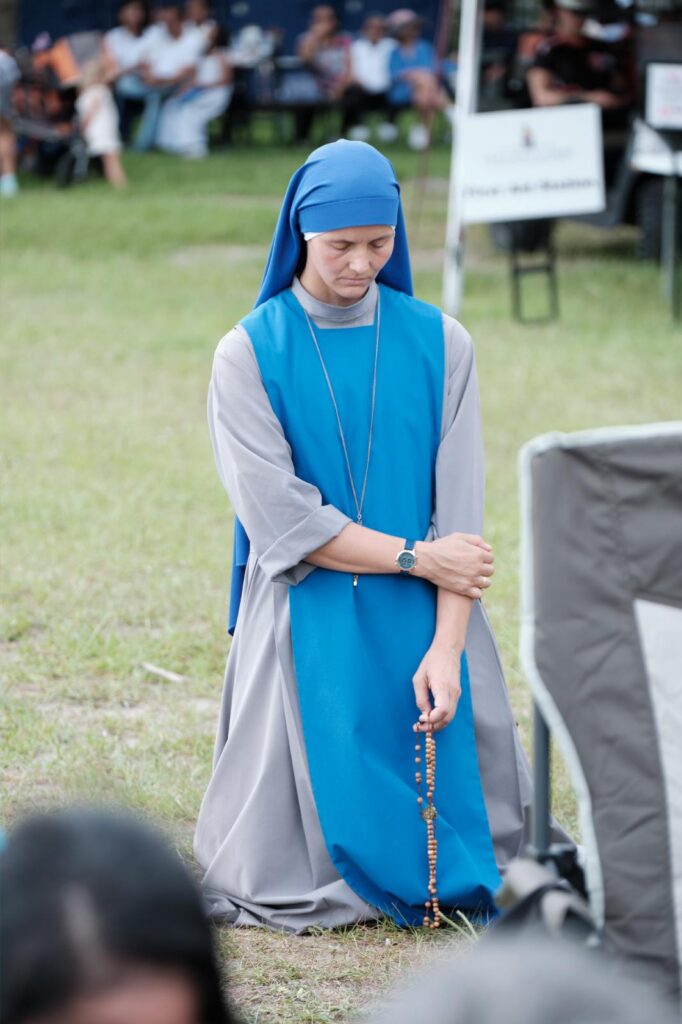
“It is a beautiful opportunity to be part of this moment of history and to pray for our country and our nation, that we can live truly ‘One Nation under God,'” she said, referring to the 2026 pilgrimage’s theme.
Coming together to give witness to Jesus
Buddy Odom and his wife, Gina, traveled from Ocean Springs, Mississippi, to St. Augustine for the launch of the pilgrimage. “We wanted to be part of the beginning of it,” Buddy told OSV News. “It’s really a wonderful thing to be a part of: to see everybody coming together for Christ and to demonstrate that to others.”
Maria Basilice attended the Mass with her husband and nine children. The family had participated in the National Eucharistic Pilgrimage when it went through Springfield, Illinois, in 2024.
“It’s a beautiful thing,” Basilice told OSV News about Jesus Christ being brought to the streets of the U.S. through the Eucharist. “Other people who may not ever encounter Jesus will get to.”
In his homily, Bishop Pohlmeier focused on two effects of Pentecost: the “missionary impulse because of the coming of the Holy Spirit” and “the divine power of the Church’s work because of the coming of the Holy Spirit.”
“From the beginning, we see that the Church is able to carry out the mission entrusted by God himself — able to carry it out because God provides,” he said. “And what God asks is that we faithfully receive the gifts that He gives. That in receiving those gifts, we step out in faith, allowing God to work in us.”
US Catholic ‘roots’ are in the Mass and missionary
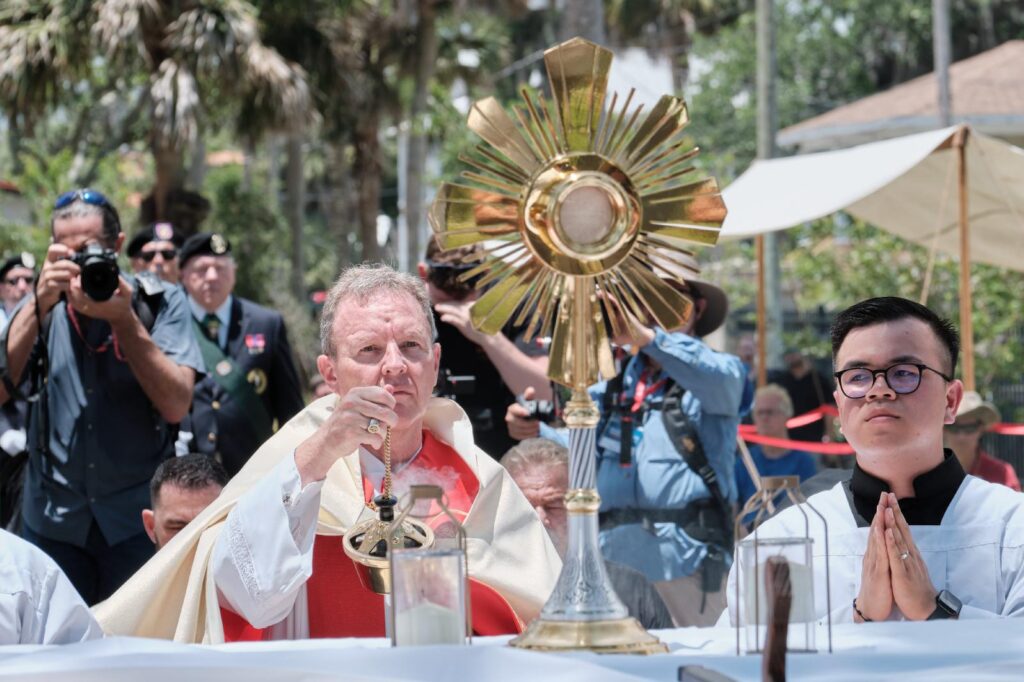
Following Mass, Bishop Pohlmeier processed throughout the grounds of the shrine with the Eucharist to the “Rustic Altar,” a memorial of where Father Francisco López de Mendoza Grajales celebrated St. Augustine’s first Mass Sept. 8, 1565. From there, Bishop Pohlmeier carried the Blessed Sacrament to the altar in the historic chapel of Our Lady of La Leche, where he placed Jesus at the foot of the iconic image of Our Lady holding the Child Jesus to her breast.
Jason Shanks, president of the National Eucharistic Congress organization, which operates the National Eucharistic Pilgrimage, said they wanted to begin the 2026 leg in St. Augustine to “highlight the Catholic contribution to this American experiment before there was even a Declaration of Independence” as the U.S. prepares to celebrate its 250th anniversary July 4.
“The Catholic contribution for us started with Mass,” he told OSV News. “I think with these times of polarization and ideology … it’s really important for us to go back to the roots. And for us as Catholics, it’s going back to the roots of Mass and the Eucharist.”
Shanks also wanted to “lean into the cultural diversity” of the Church. He said, “We felt it’s important to tell that the Catholic story in America has always been culturally diverse.
“It’s missionary — it started with missions there in Florida — and it’s bigger than any sort of region or ethnic group,” he added. “Through the Eucharist, there is unity in diversity in how our faith is expressed.”
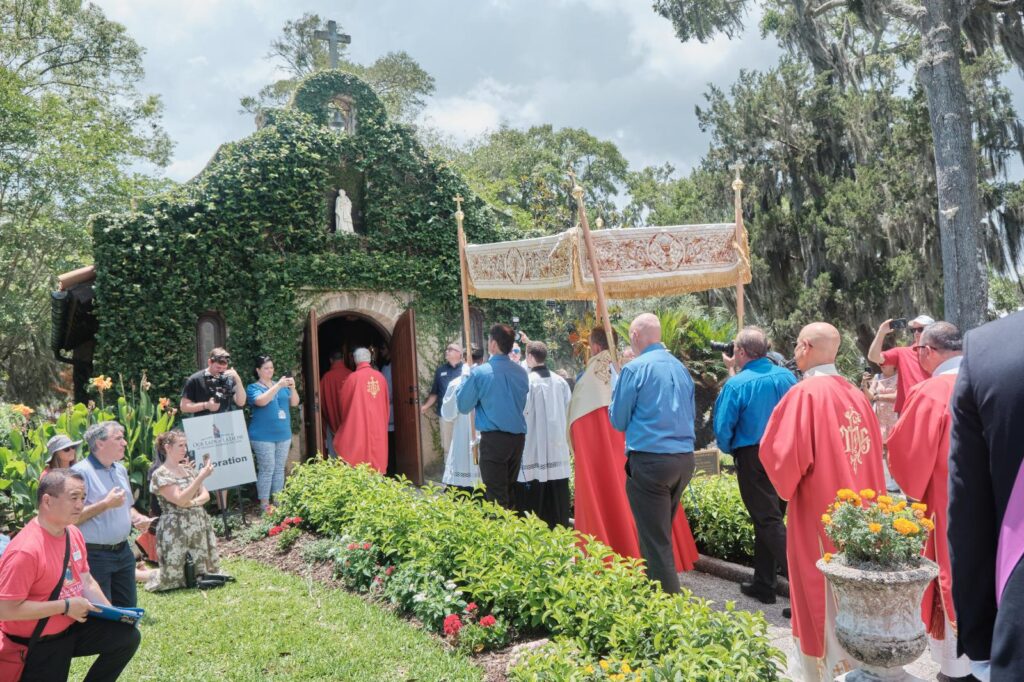
Eucharistic pilgrimage directs Church toward heaven
Pilgrim Zach Dotson, who drove the National Eucharistic Pilgrimage van outfitted with a monstrance from its resting place in Zionsville, Indiana, to St. Augustine earlier this week, told OSV News that it’s fitting the pilgrimage should begin in a place named for the saint who himself described the Church as being a people on pilgrimage.
Just like a pilgrimage, he said, with our earthly lives “we’re heading towards that end goal, which is hopefully to heaven, to full communion with God, to join the community of saints.”
Dotson told OSV News he hopes the witness of the National Eucharistic Pilgrimage will inspire all people, whether they are Catholics, other fellow Christians, those fallen-away from the faith or those with no faith.
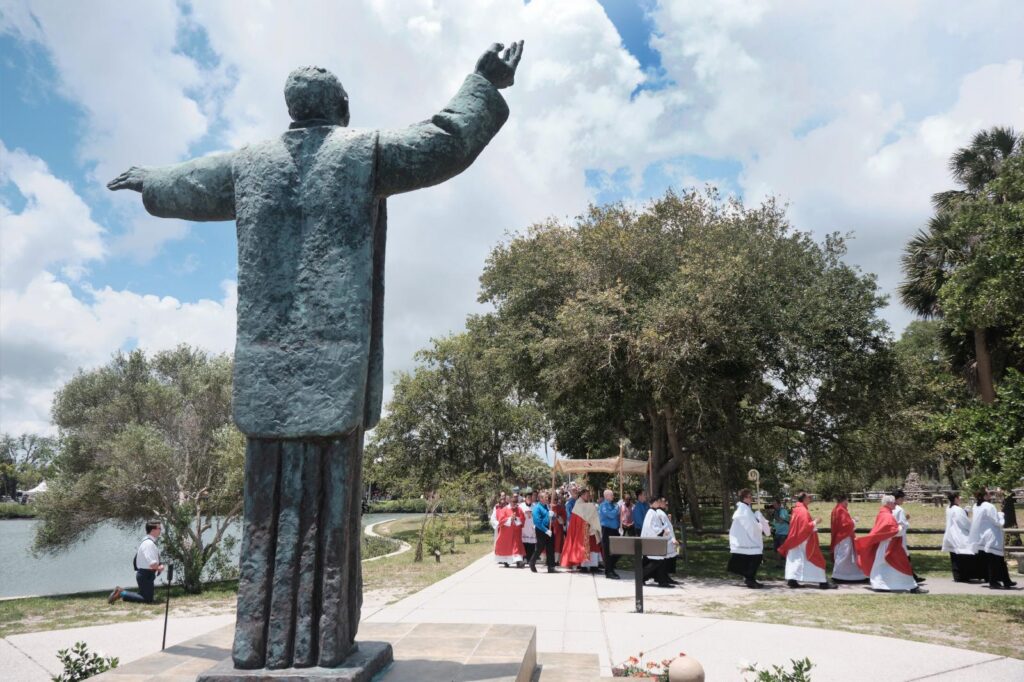
“You don’t celebrate, for nearly 500 years, the Mass for a symbol,” he said, referring to how long Catholics have celebrated the Eucharist in what is now the U.S. “You don’t follow behind in procession a symbol or a piece of bread. People don’t fall on their knees or lie prostrate for a symbol; but we do for our Lord and Savior, for the King of Kings. We follow after him. We lie prostrate for him. … So I hope that is the true witness: people seeing us live our faith authentically in our worship and in our adoration of our Lord, especially in the Blessed Sacrament.”
Following a period of Eucharistic adoration at the shrine, the pilgrimage continued with a one-mile procession down San Marco Avenue to the Cathedral Basilica of St. Augustine where Jesus Christ in the Eucharist would be adored by those keeping watch with him overnight.
Gretchen R. Crowe is editor in chief of OSV News.
