



WASHINGTON (OSV News) — The nomination of Acting U.S. Attorney General Todd Blanche appeared to be in limbo July 31 as the Senate Judiciary Committee lacked the votes to advance the nomination to the full Senate.
The same week in Washington, a Russia sanctions bill championed by the late Sen. Lindsey Graham, R-S.C., advanced in the Senate after a procedural vote, and lawmakers faced a looming Sept. 30 deadline to fund the government and avoid another shutdown.
Blanche nomination in limbo
The Senate Judiciary Committee delayed a vote previously scheduled for July 30 on whether to advance Blanche’s nomination to the full chamber after two Republican senators on the committee pushed for written commitments from Blanche and the Department of Justice that a controversial $1.8 billion “anti-weaponization fund” sought by Trump will not be revived. Trump sought the fund as part of a settlement from his lawsuit against the Internal Revenue Service.
In order for his nomination to advance, Blanche would need the support of both Sens. John Cornyn, R-Texas, and Thom Tillis, R-N.C., both members of the committee and among the Republicans who objected to the fund.
Neither Cornyn nor Tillis is returning to Congress next year. Trump had declined to endorse both incumbents, even backing Cornyn’s primary opponent, Texas Attorney General Ken Paxton.
In a post on his social media website, Truth Social, Trump suggested he would be willing to pull Blanche’s nomination until “after Cornyn and Tillis are out of office.”
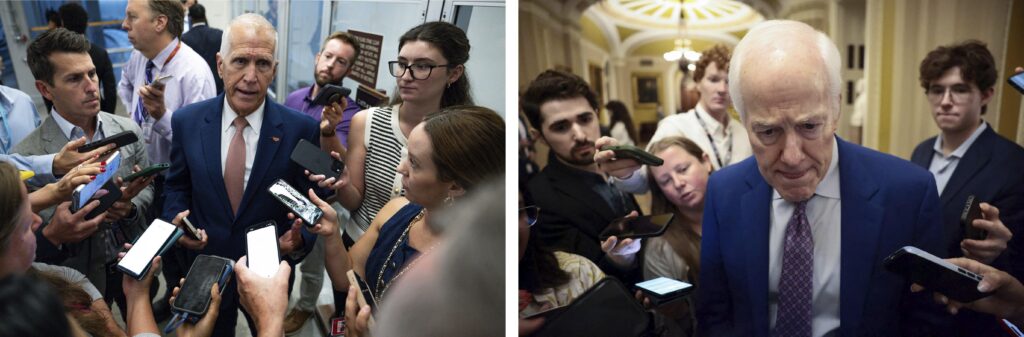
However, if Republicans lose control of the upper chamber in the midterm elections in November, the Senate may have a Democratic majority after Cornyn and Tillis end their current terms.
In response to Trump’s comments, Cornyn wrote on X that Trump “is mistaken if he believes concerns about the provisions in his tax lawsuit settlement are limited to me and Senator Tillis.”
During his hearing earlier in July, Blanche also took questions from senators on issues ranging from objections to the way the Department of Justice handled the release of the Epstein files to its approach to state challenges to a policy permitting distribution of mifepristone by mail.
Pro-life groups have pushed Blanche to stop the DOJ’s challenges to state lawsuits seeking to end that policy.
Russia sanctions bill advances
The Lindsey O. Graham Sanctioning Russia Act of 2026 advanced in the U.S. Senate July 28 after an 86-12 procedural vote. The bill would implement sanctions on purchasers of Russian oil and gas amid Russia’s war in Ukraine.
However, despite broad bipartisan support for the sanctions, the bill could face roadblocks over Trump’s request to include tariffs on buyers of Iranian oil.
The U.S. Supreme Court struck down Trump’s sweeping tariff policy earlier this year, and he is seeking new avenues to impose tariffs and ways to bring the conflict in Iran to a conclusion. Trump has argued the Iran war, launched by the U.S. and Israel, was necessary to prevent its regime from acquiring a nuclear weapon. But that conflict has become increasingly unpopular as it enters its sixth month.
The late Graham, who unexpectedly died on July 11, was a key supporter of the legislation, and lawmakers renamed it in his honor after his death.
Pope Leo XIV has called for peace in Ukraine and condemned the “brutality” of Russia’s invasion. He has also called for an end to the conflict in Iran.

Lawmakers still facing Sept. 30 deadline to fund the government
After the U.S. House began its August recess earlier in July, lawmakers in the U.S. Senate continued to seek a deal to avert a government shutdown when current funding expires Sept. 30, just weeks before the midterm elections.
Majority Leader John Thune, R-S.D., has indicated he wants to pass a stopgap funding bill that would push the deadline to Dec. 11. But the White House has pushed for a budget resolution, which could lead to a party-line spending bill.
During this Congress, previous record-setting shutdowns took place for most of the federal government, as well as a record-setting partial shutdown after a funding lapse at the Department of Homeland Security.
A government shutdown occurs when Congress fails to pass a budget or if that budget is not signed into law by the president. Some types of essential government services are exempt, including Social Security payments to older adults. But many other functions of government are suspended during shutdowns, such as paychecks for many government workers, including members of the armed services. Hundreds of thousands of federal workers are subject to furloughs during such shutdowns, meaning they must stop working and will not be paid until the federal government reopens.
The U.S. bishops and Catholic entities that advocate for, or work with, people who are poor and vulnerable in the U.S. have generally cautioned against government shutdowns.
Kate Scanlon is a national reporter for OSV News covering Washington. Follow her on X @kgscanlon.
