


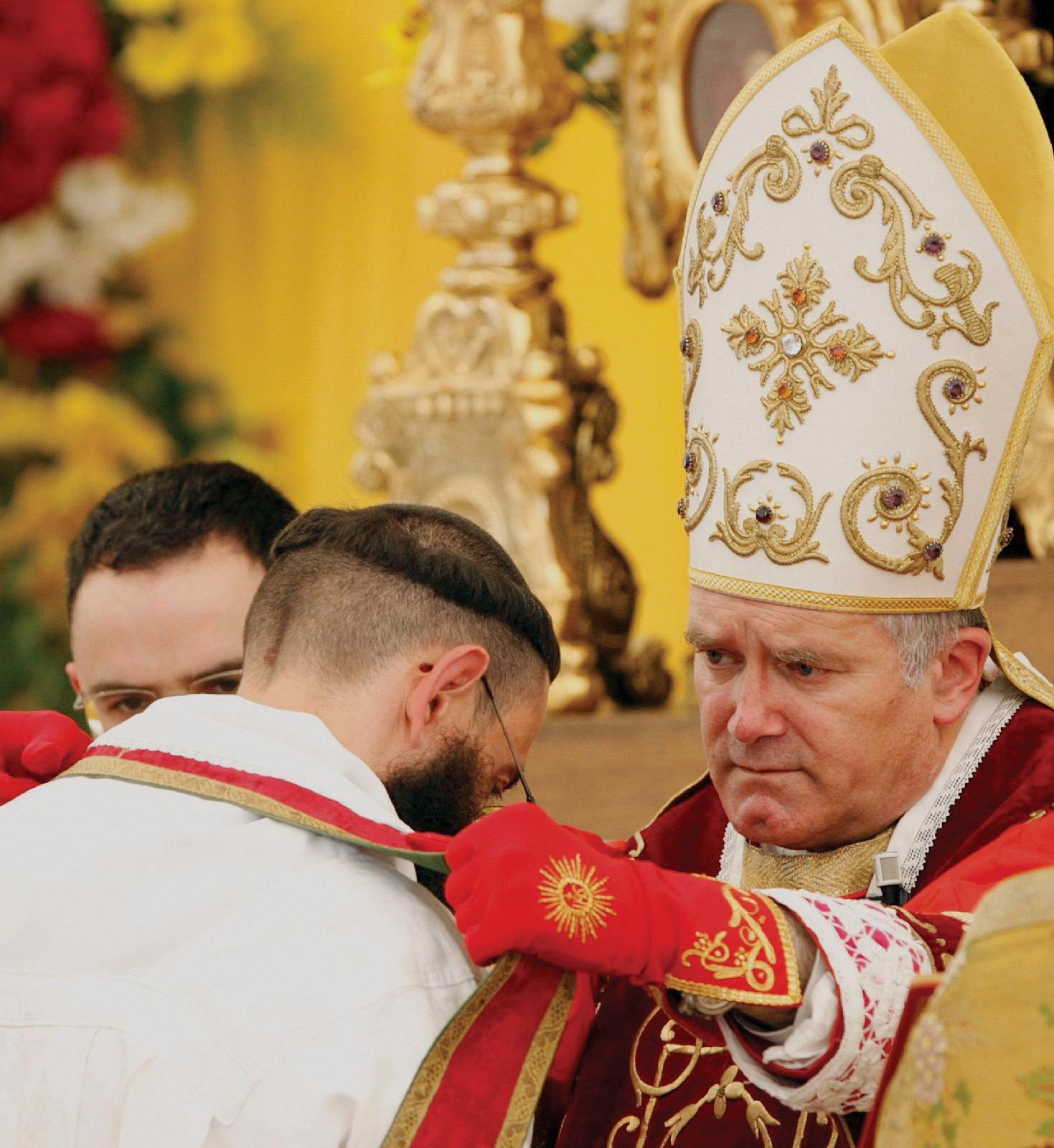
Q: I’ve read a lot recently about how the Society of St. Pius X (SSPX) is planning to ordain new bishops this summer, with or without the pope’s permission. Why is this such a problem, if the SSPX are all validly ordained anyways?
A: The quick, big-picture short answer is that the SSPX’s proposed episcopal ordinations are a problem because ordaining new bishops without the permission of the pope (technically called a “mandate”) is gravely injurious to Christian unity.
It is true that a truly ordained bishop has the power, by virtue of his ordination, to confer the sacrament of holy orders on other men. This includes the power to ordain lay men as deacons, deacons as priests and priests as bishops. So, if a bishop attempted to ordain a priest as a bishop without a pontifical mandate, the sacrament would still “work” and would result in a new and real bishop.
However, while such an ordination would be valid, it would be illicit — that is, against the law — and gravely so. In fact, canon law applies one of its most severe penalties for those directly involved with the ordination of a new bishop without a mandate from the pope.
As per Canon 1387 of the Code of Canon Law, both the ordaining bishop and the new bishop who received the illicit ordination from him “incur a latae sententiae excommunication reserved to the Apostolic See.” This means that both men are excommunicated automatically as soon as the mandate-less ordination takes place, and their excommunication can only be “lifted” or reversed by the authority of the pope.
The reason why canon law comes down so hard on this particular crime is because ordaining a bishop without the mandate of the pope, and especially if this happens against the pope’s express wishes, is strongly connected to the sin, and more foundational crime, of schism.
Canon 751 defines schism as “the withdrawal of submission to the Supreme Pontiff or from communion with the members of the Church subject to him.” A Catholic can be schismatic on an individual level, such as if a lay Catholic personally decides they will no longer obey the pope or follow the laws of the Catholic Church.
But the negative effects of schism are multiplied exponentially when a bishop ordains new bishops totally on his own initiative, since this has the potential to create a sort of “parallel church,” by which large numbers of the Catholic faithful might be drawn out of communion with the legitimate successor of St. Peter and the visible Church which Christ himself founded.
For background on this particular situation, the SSPX, or the Society of St. Pius X, was founded by Archbishop Marcel Lefebvre in 1970, in response to what he saw as the overly modernizing influence of the Second Vatican Council. Originally, the society was founded in the proper canonical way as a “pious union,” at the time the first step toward becoming a recognized religious community.
But then in 1988, frustrated by Rome’s lack of support for his work, Archbishop Lefebvre consecrated four new bishops against the explicit warnings of the Holy See. In his July 2, 1988, apostolic letter “Ecclesiae Dei,” Pope St. John Paul II recognized this as a “schismatic act” and formally declared that the bishops involved were excommunicated.
Over the years, popes since St. John Paul II have made efforts to reconcile the SSPX to full communion with the Church. For instance, in January 2009 Pope Benedict XVI lifted the automatic excommunication of the surviving affected bishops as an act of mercy and pastoral concern; and at various points in Pope Francis’ papacy the SSPX were granted the wider ability to celebrate the sacraments in some circumstances.
If the SSPX were to go forward with the ordination of new bishops without a papal mandate, this would likely re-set the state of their dialogue with Rome to where it was in 1988.
Jenna Marie Cooper, who holds a licentiate in canon law, is a consecrated virgin and a canonist whose column appears weekly at OSV News. Send your questions to CatholicQA@osv.com.
