


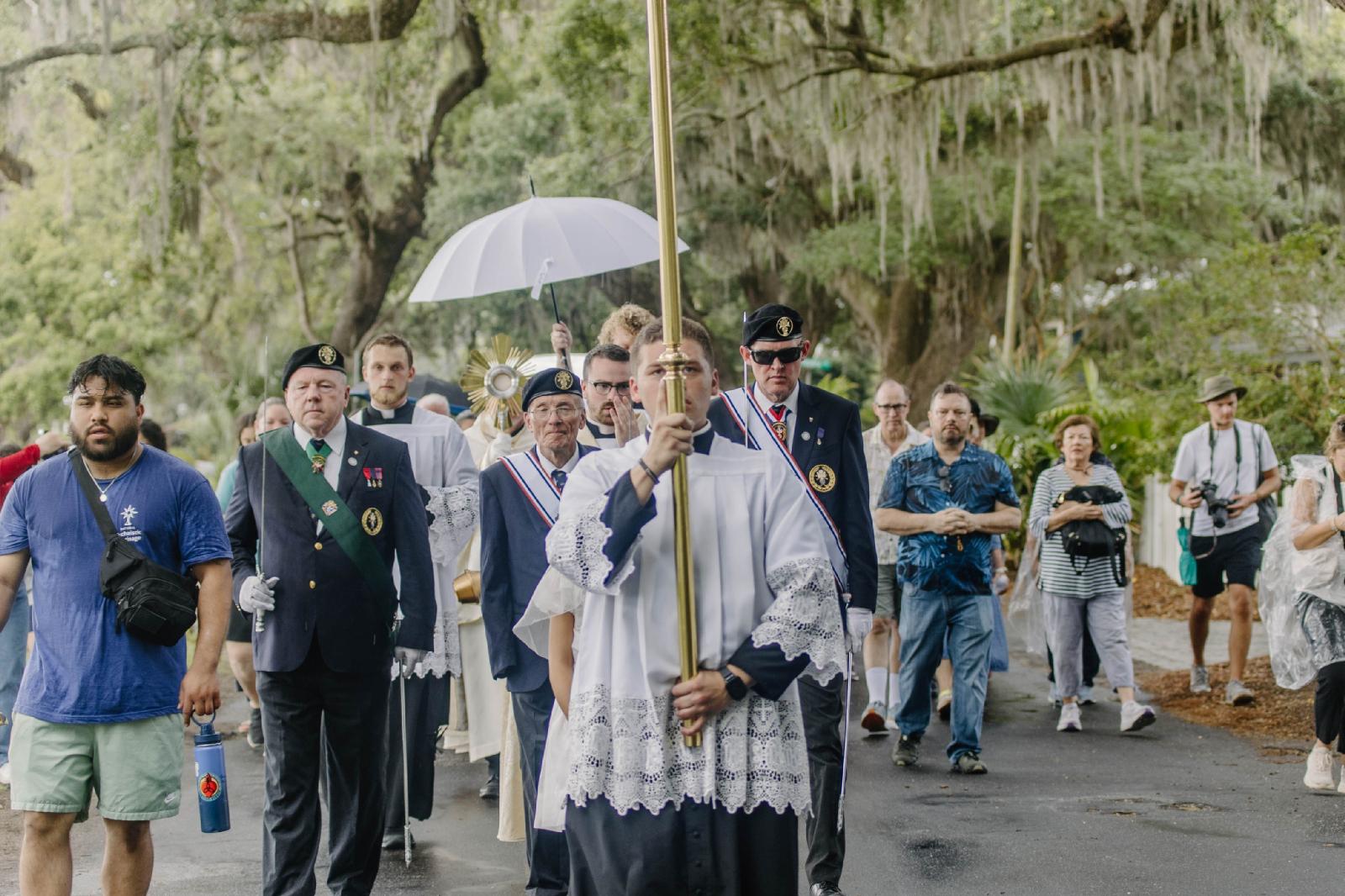
DARIEN, Ga. (OSV News) — In late October, a little more than a month after Archbishop Fulton Sheen is to become “blessed,” the sixth beatification on American soil will take place — this time of five Franciscan martyrs who died in 1597 in the Georgia seedbed of American Catholicism.
The pilgrims participating in the National Eucharistic Pilgrimage this summer spent some time walking in the footsteps of Friar Pedro de Corpa and his four companions — also known as the “Georgia Martyrs” — exploring, learning about and praying at sites that are sure to grow in popularity among Catholics as the martyrs’ story becomes more widely known.
Who are the Georgia Martyrs?
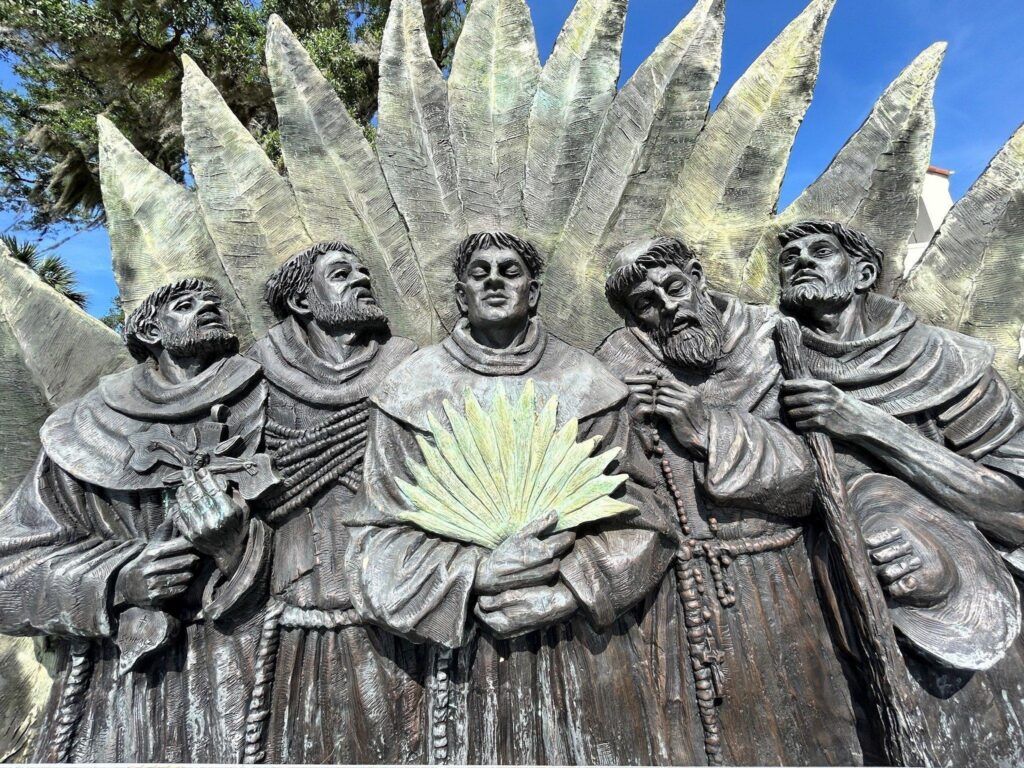
These Georgia Martyrs were missionaries in the Spanish missions along the Georgia coast north of the Spanish colonial capital of St. Augustine, Florida. They were killed in hatred of the faith when ministering among the indigenous Guale people. Friar Pedro de Corpa was the first to be killed in retaliation for not consenting to a converted chief’s demand for a second wife. The friars’ death was recognized formally as martyrdom by the Holy See in 2025.
Their story remains relevant today, Bishop Stephen D. Parkes of Savannah, in whose diocese the five friars ministered and were martyred, told OSV News in a recent interview.
“I think their lasting legacy is of great witness and also the effect that it can have on family life,” Bishop Parkes said, adding that he hopes that the friars will inspire new generations as intercessors who will intercede for marriage and family life.
Bishop Parkes encouraged the faithful to consider the martyrs as special patrons for family life, encouraging families “to ask for the intercession of Friar Pedro de Corpa and companions for family life in our homes, that Jesus is a welcome guest at our dinner table every night, and that he’s a part of our families, a part of marriage, and that the beauty of marriage between a man and a woman is something that we uphold, we believe in, we embrace and we live.”
Pilgrimage sites connected to the Georgia Martyrs
Pilgrims hoping to learn more about the Georgia Martyrs and walk in their footsteps are able to visit a handful of identified sites.
Unlike the Spanish missions in the southwest United States, which used building materials that have stood for centuries, those in the southeast were less permanent, and several fell to attacks by Spanish enemies. While excavations in the past half-century have located the sites of two of the missions associated with the martyrs — as well as unearthed a vast collection of artifacts — more work remains in identifying more sites and learning from what has been found.
Only one of the sites of martyrdom — St. Catherines Island — has been identified with certainty; Santo Domingo de Talaje, later referred to as Asao, is largely believed to be another.
St. Catherines Island preserves the only confirmed martyrdom site
The mission on St. Catherines, rediscovered in the 1980s, is located on the privately owned island, and it is closed to the general public. Archaeological discovery there has determined the location of the mission church, friary and a kitchen. Today, the site of the mission church, which houses the remains of hundreds of converted Guale, is marked by an outline of palm trees at the center of the island.
It is the sole confirmed location at which two martyrs — Friars Miguel de Añon and Antonio de Badajoz — shed their blood.
Despite the death of the missionaries more than four centuries ago, Catholics in Georgia and across the country remain inspired by their fortitude and zeal.
“This story of the friars and what happened in 1597 continues to be pertinent today as it was back then,” Father Pablo Migone, a priest of the Diocese of Savannah intimately connected to the friars’ cause for beatification, told OSV News. “There’s so much confusion and major redefinitions of what marriage is or isn’t in the world today that the story of these friars really highlights marriage.
“That gives us a platform to tell their story,” Father Migone continued, “and by telling their story to bring to the spotlight what the Church teaches on marriage.”
Other historic Georgia mission sites linked to the martyrs
Other sites yet to be discovered include the Tupiqui mission, which was the site of the martyrdom of Friar Blas Rodríguez de Cuacos. While its specific confines have not been located, archaeologists speculate that it was on the mainland across from the Sapelo island town, north of present-day Eulonia.
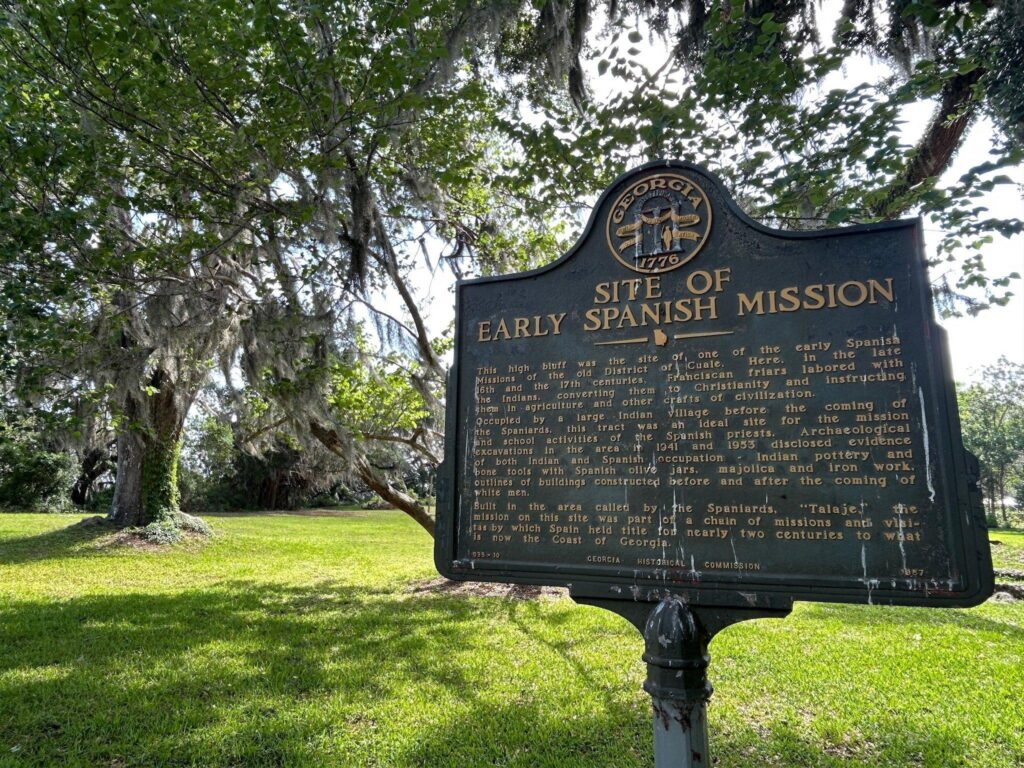
Near present-day Darien, Georgia, is Fort King George, a Georgia state historic site containing the site of an English fort built in 1721. Many experts believe this site had previously been the location of the Spanish mission Santo Domingo de Talaje, subsequently called Asao. The park includes a museum that contains many artifacts, including rosary beads, found during site excavations. It also showcases a reproduction of a Guale roundhouse. Some experts regard it as likely that present-day Fort King George is the place where Friar Francisco de Veráscola met his death as he came ashore after a canoe trip from St. Augustine.
The mission of Tolomato, understood as the headquarters of the Guale chiefdom, is where Friar Pedro de Corpa ministered and was killed. Although its location has been lost to time, it was likely also in the vicinity of Darien.
Shrines and sacred art honor the Georgia Martyrs across the state
Given Darien’s proximity to the locations of the martyrdoms, the Diocese of Savannah has chosen the small Nativity of Our Lady mission church there to be the most formal site of veneration commemorating the martyrs. On those church grounds, an informal, outdoor shrine was erected in 2021, containing a statue and altar designed by Canadian sculptor Timothy Schmalz. In addition to the Darien statue, other sacred images have been installed across Georgia to foster devotion among the faithful and remember their witness in defense of the Church’s teaching on the sanctity of marriage.
Commissioned artwork has been at Our Lady of the Mountains Church in Jasper, St. Michael Church in Gainesville, St. Francis of Assisi in Cartersville, Holy Spirit Church in Atlanta, St. Anthony Church in Blue Ridge, St. Luke Church in Dahlonega, the Purification Heritage Center in Sharon, and in the archdiocese’s chancery in Smyrna. A black-and-white drawing on vellum by Daniel Mitsui is at Mary Our Queen Church in Norcross.
The search for relics and the enduring witness of the Georgia Martyrs
Although the graves of some of the Georgia Martyrs were marked, and some of their remains were even moved for safekeeping by the Spanish colonists, it is not known today where any of their relics might be. A portion of a skull discovered at Fort King George during excavations — believed to have suffered from some blunt trauma — is currently being held in a university archive and could be subject to investigation to determine the person’s origins.
While not all the sites of their ministry and martyrdom have been identified, the search continues — a search that’s important to grasping what these friars arrived in Georgia to accomplish and how their legacy lives on.
“I think it’s a great experience to stand in the very same places where these missionaries were,” said Father Migone. “Coastal Georgia is not as developed as Florida or even South Carolina. You can step back in time by standing on the shoreline and it transports you to another time — to the time of these early missionaries.”
Those who get to know the friars will see them as models in the faith, Bishop Parkes said. “We may not be called to shed our blood, but we can be great witnesses, courageous witnesses and joyful witnesses for what the Church stands for.”
Michael R. Heinlein is author of “Glorifying Christ: The Life of Cardinal Francis E. George, O.M.I.” and a promised member of the Association of Pauline Cooperators. He writes from Indiana.
