


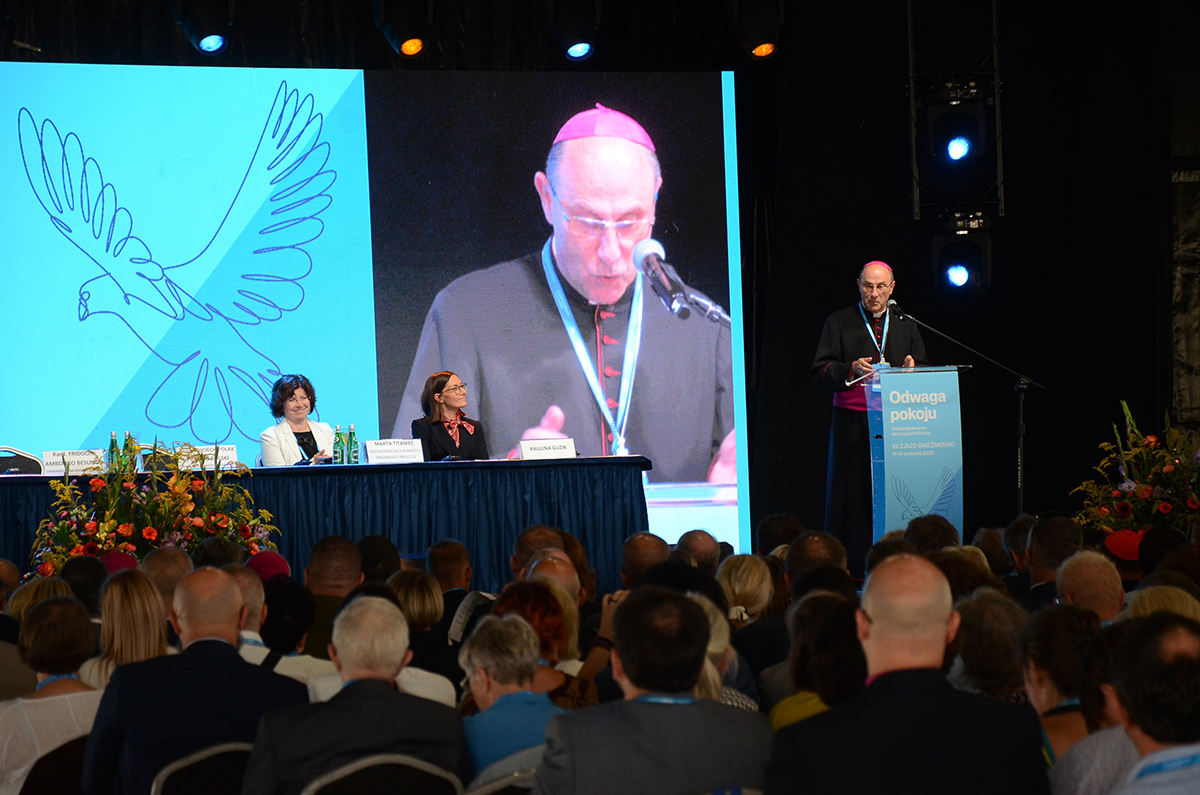
GNIEZNO, Poland (OSV News) — At a major peace summit in Poland, church leaders from around the globe urged Christians to be bold in building peace amid wars in Ukraine, the Holy Land, Africa and beyond.
Apologizing for his personal absence at the Sept. 11 event in Poland’s birthplace of Gniezno, Cardinal Pierbattista Pizzaballa, Latin Patriarch of Jerusalem, said that “the father has to be present … when the family is in danger.”
The cardinal recorded a video message underlining that people in the Holy Land live in “complicated situations that require my presence here,” adding that he would “also feel uncomfortable in case I would leave.”
He said that it is “not only what is happening in the territory — the violence, the deaths and destruction in the infrastructure and the life of the people,” that concern him, but also “the destruction” and “devastation” of the “relations among peoples,” and “the hatred that this war created,” along with the “language of contempt.”
‘Build a different narrative’
Cardinal Pizzaballa urged that religious institutions, Jewish, Christian and Muslim “have to avoid this” and “build a different narrative,” a language “full of respect for the others.”
“If we dehumanize the other in the language, then we also justify the violence against the other. So we need to build a narrative and language based on respect, based on the principle that we are all created in the image of God and the other,” Cardinal Pizzaballa said just weeks ahead of the second anniversary of the start of the Israel-Hamas war that started after the Oct. 7, 2023, attack of Hamas on Israeli southern communities and that took the lives of almost 65,000 Palestinians in the Gaza Strip.
The cardinal spoke to the Gniezno summit 1,025 years after the first Council of Gniezno was organized in the birthplace of Poland — the country established only years earlier.
In the year 1000, with his visit to the tomb of St. Adalbert, the German emperor Otto III wanted to welcome Poland peacefully on the map of Europe with dialogue and the Catholic faith at the center.
Re-established contemporarily by St. John Paul II in 1997, the modern councils center on the theme of peace. Every few years the council is organized on important anniversaries or around milestone events in the history of Europe and Poland.
How can Christians build peace?
Organized for the 12th time, the Sept. 11-14 Council of Gniezno brought together top prelates from all corners of the globe — including from places shattered by wars — to meet under the theme “The Courage of Peace. Christians together for the future of Europe.”
“We invited you to Gniezno … to boldly ask questions and seek answers together on how we, as Christians, can build peace in Europe and in the world,” said Marta Titaniec, head of the organizing board, opening the summit on Sept. 11. She said that peace cannot be understood as “the deadly silence after a conflict has ended, nor the result of domination, but a gift given to humanity, restoring life and dignity.”
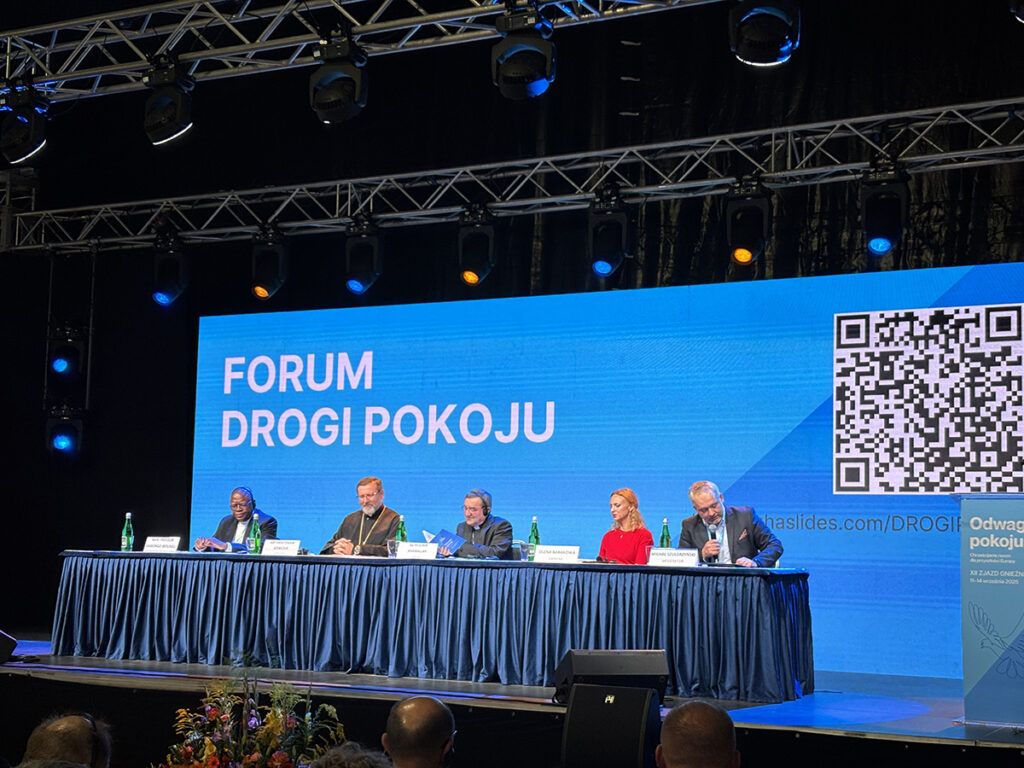
“Peace is possible, and because it is possible, peace is an obligation,” Polish President Karol Nawrocki said in a letter sent to the participants of the summit a day after Russian drones violated Polish airspace and were shot down by Polish pilots with cooperation of NATO allies.
Opening the summit under such circumstances, Archbishop Wojciech Polak of Gniezno, primate of Poland, said that “peace is not merely the absence of war, but a universal value and duty, rooted in God Himself.”
“Peace is built in the heart, starting with the heart, eradicating pride and entitlement, and weighing words carefully, because it is possible to hurt and kill not only with weapons, but also with language,” Archbishop Polak said opening the summit and before leading an ecumenical prayer for peace, during which he got visibly moved.
Process of forgiveness and reconciliation
In his message to the Council of Gniezno, signed by Cardinal Pietro Parolin, Vatican’s secretary of state, Pope Leo XIV said that, “Divisions, even those caused by past injustices, cannot be perpetuated or deepened, as this may lead to a repetition of the mistakes of our ancestors.”
On the contrary, the pontiff said: “They must be courageously overcome — in truth, justice, and evangelical love. By preserving historical memory and listening to one another through authentic dialogue, the process of forgiveness and reconciliation, even if long and painful, can be achieved.”
Present throughout the summit, Cardinal Fridolin Ambongo Besungu, archbishop of Kinshasa who started concrete initiatives for peace negotiations in his native Congo, said that faith is crucial for entering the path of peace.
The cardinal — who is president of the Symposium of Episcopal Conferences of Africa and Madagascar, or SECAM — started the peace roadmap titled “The Social Pact for Peace and Living Well Together” in Congo and the Great Lakes, inviting the people of the region to interact and hold dialogue to build lasting peace.
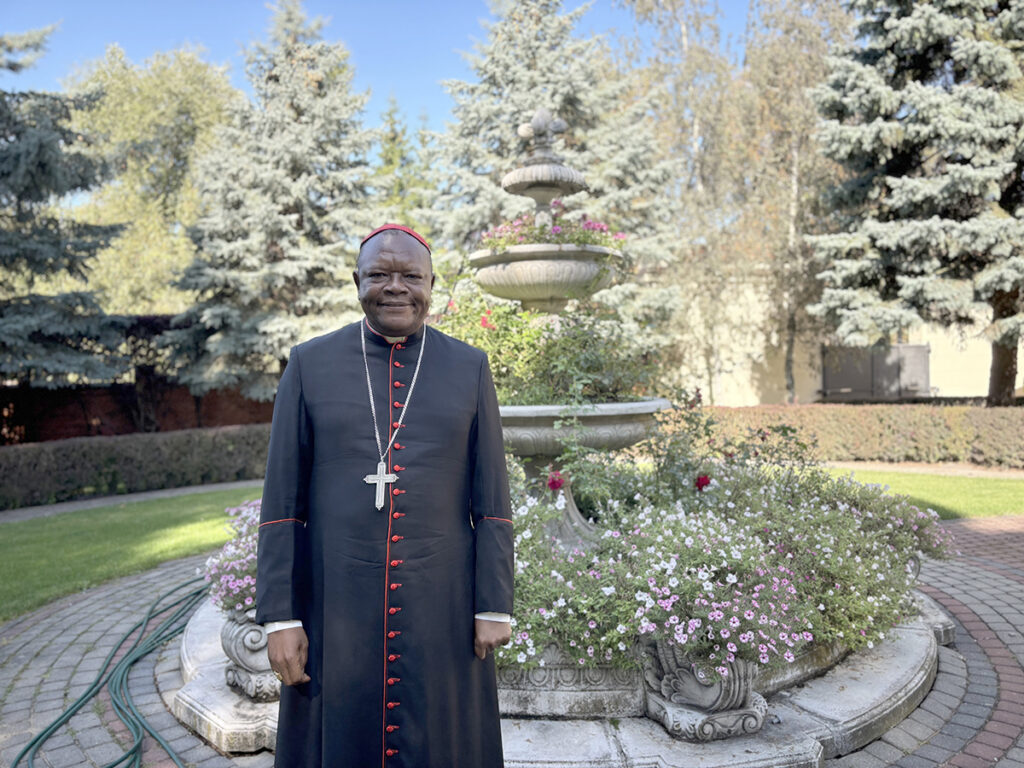
The cardinal said that even though, with warring parties, it can “feel like we’re preaching in the desert” as “we talk about peace, perhaps to people who don’t believe in peace at all,” the church cannot be “discouraged by that.”
“We say no, we are not discouraged,” Cardinal Ambongo said. “We will continue, and peace will ultimately prevail. Because God created us to live in peace, not to live in constant war. This is also where faith is important. When we have the courage of faith, we continue to believe, even if things don’t seem to be changing.”
‘Respect the rights of the weaker over the stronger’
Ukrainian Major Archbishop Sviatoslav Shevchuk of Kyiv-Halych reinforced that message by underlining in his Sept. 12 talk that “peace is the right to live that comes from the Creator,” adding that it is important to talk about peace in a Christian context.
He said that “true peace doesn’t have anything to do with pacifism,” but “peace is always connected to truth and justice.”
“To talk about peace we need courage to accept the truth and respect the rights of the weaker over the stronger,” he said.
Speaking to OSV News Sept. 12, Major Archbishop Shevchuk said that “we must all work together, at all levels and on all fronts, to put pressure on Russia.” The war in Ukraine “must stop,” he said.
“Of course, Ukraine is defending itself and will continue to do so” but Ukrainians “need help, we need solidarity, but we must work together, on a global scale, to ensure that the pressure on Russia increases in proportion to the escalation of this war. And it will surrender.”
For Major Archbishop Shevchuk, peace is “not about appeasing the aggressor and pacifying the victim. Peace is a space of dignity and life.”
The outspoken Ukrainian prelate underlined that true peace won’t come in Ukraine with ceding territory: “We are not a territory, but a nation, people who live in Ukraine. And we, as shepherds of the church, care about human dignity, human capabilities, and the ability to live in one’s own country, on one’s own land,” he told OSV News.
Delivering a pre-recorded message, Cardinal Pizzaballa concluded: “my wish, my prayer for you in Gniezno” is to be “one important brick in this building that we want to build, where people can gather, where relations are built based on mutual respect and desire of good.”
Paulina Guzik is international editor of OSV News. Follow her on X @Guzik_Paulina.
