


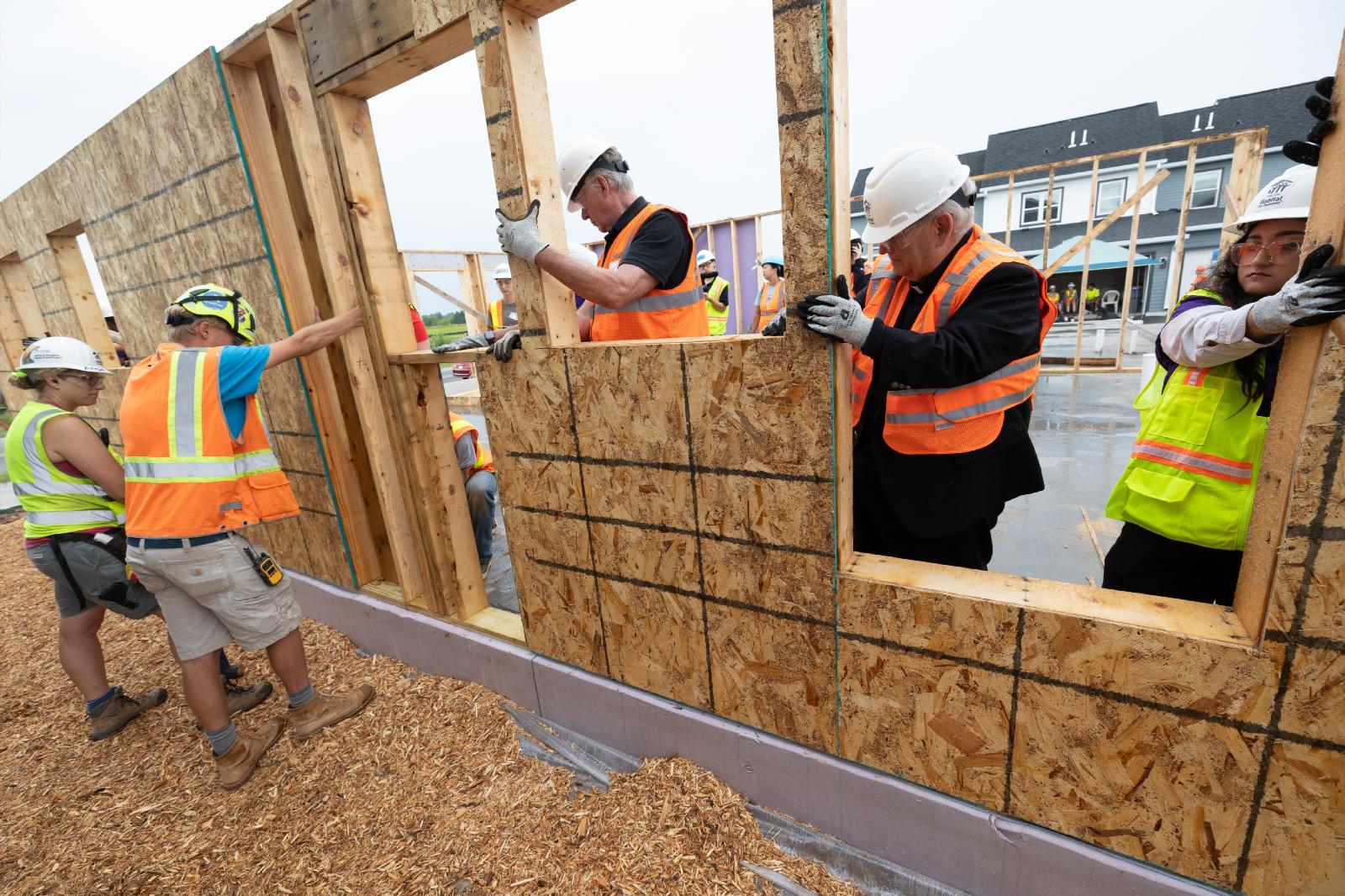
ST. PAUL, Minn. (OSV News) — Donning hard hats and work gloves July 8, Archbishop Bernard A. Hebda of St. Paul and Minneapolis and students from St. Catherine University in St. Paul helped raise a wall of the first duplex being built in the Twin Cities as part of a national Habitat for Humanity initiative called the Pope Leo Village.
Inspired by Pope Leo XIV‘s commitment to service and social justice, an anonymous donor to Habitat for Humanity began discussions about the initiative with the Georgia-based nonprofit in 2025, Habitat officials said.
With that donor’s assistance, Twin Cities Habitat for Humanity is the latest of 20 affiliates across the country to join as a partner in Pope Leo Villages, with the chapter building two duplexes and a single-family home. The homes will be tucked into a larger affordable housing and light industrial development called The Heights in St. Paul.
74 homes built, 74 more planned
The Twin Cities affiliate has built 74 single-family homes, twin homes, three-plex and four-plex townhomes at The Heights and plans to build 74 more. Twenty homes are now occupied. In addition to St. Catherine University, local partners in Pope Leo Village include Cretin-Derham Hall high school in St. Paul and Tres Iglesias, an association of three neighborhood churches including St. Frances Cabrini and Prospect Park United Methodist, both in Minneapolis, and St. Cecilia in St. Paul.
Nationally, Pope Leo Villages are being built in cities including Chicago (Pope Leo XIV’s hometown and the first Pope Leo Village site), Cleveland, Cincinnati, Detroit, Philadelphia and Portland.
“Today, we’re going to begin building some additional houses here at The Heights, but we’ll also be building a sense of belonging as Twin Cities Habitat joins the national Pope Leo Village campaign,” Chris Coleman, president and CEO of the Twin Cities affiliate, said at the kickoff gathering of faith leaders and university and other officials.
“Pope Leo Village,” he said, “is an interfaith, multicity affordable housing initiative inspired by the first U.S.-born pope, and his commitment to service and social justice.”
‘This is about faith in action’
“At its core, this is about faith in action,” Coleman continued. “Today, we celebrate its launch in the Twin Cities. We’re bringing people together — especially young people — to build homes and in the process to also build a stronger, more connected community.”
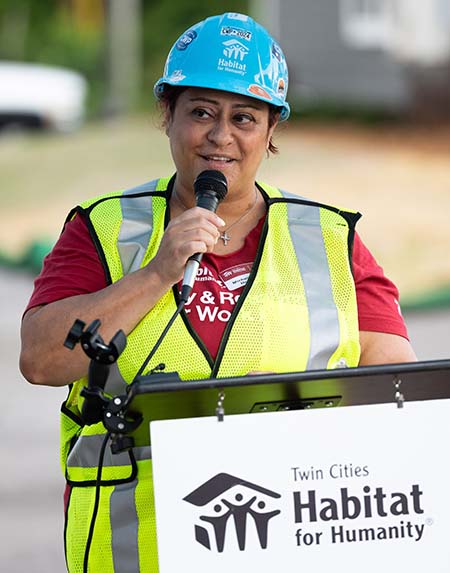
Archbishop Hebda said he was invited to the event to “offer a little bit of insight into this wonderful idea of a Pope Leo Village. And why it is that there would be somebody that would step forward with this initiative to fund this.”
“I think Pope Leo has been able to catch the attention not only of the Catholic Church, but of men and women of goodwill around the globe,” the archbishop said.
The pope listens and speaks from humility, and he has identified a loneliness, especially among many young people, Archbishop Hebda said.
“And when he looks at the controversies, the wars, the conflicts that are around the globe, he recognizes an inability of us to be able to work together, and that needs to be fixed,” the archbishop said.
Setting aside differences
“Pope Leo is asking people to work together, to put aside their differences, to be able to move beyond conflict, put our resources together in a way that we’re able to build and to help people reflect on the great gifts that we have received and how it is that we might use them for the promotion of the common good,” Archbishop Hebda said.
Seeing so many young people respond to the Pope Leo Village initiative is encouraging, the archbishop said.
“We’re able to concretely see that if we work together, we’re able to build something that’s far larger than ourselves and that helps humanity rather than creates that division that has been so destructive in our lives,” he added.
History of housing inequality, racial justice
Two students at St. Catherine University, Samantha Schroeder and Leslie Varela, told those gathered that they have been studying the history of housing inequality and racial justice in Minnesota in the classroom and community projects through St. Catherine’s Welcoming the Dear Neighbor initiative.
Schroeder, who will be a senior in the fall studying quantitative economics and public policy, said helping build the homes in Pope Leo Village will allow her and other St. Catherine students to demonstrate that “housing isn’t just something that we study; it is something that shapes people’s lives and communities.”
Varela said ensuring equal access to housing improves all communities, and Habitat for Humanity’s efforts “shows us what choosing to welcome means. People come together not just to build a house, but to build the foundation for a family to become part of a community. When families feel welcome and have the ability to build a future, they make entire neighborhoods stronger.”
As students, ‘we are just part of this work’
“As students, we are just part of this work,” Varela said. “There are thousands of people who are pushing it forward, and I’m hopeful in our generation to continue asking difficult questions, challenging injustice, and building communities where people don’t just buy a home, but they feel at home.”
Marcheta Evans, president of St. Catherine University, said she was grateful to Twin Cities Habitat for Humanity for its partnership with the university, and to all gathered at the event and helping with the project.
“I hope this effort inspires other colleges and universities, congregations, businesses, nonprofit organizations and civic leaders to ask, ‘How can we be a part of building stronger communities?'” Evans said. “Because the housing challenges before us are too important for one institution to solve alone. But together — together we can create lasting change.”
Joe Ruff is editor-in-chief of The Catholic Spirit, newspaper of the Archdiocese of St. Paul and Minneapolis. This story was originally published by The Catholic Spirit and distributed through a partnership with OSV News.
UPDATED July 16, 2026, at 4:44 p.m. ET
