


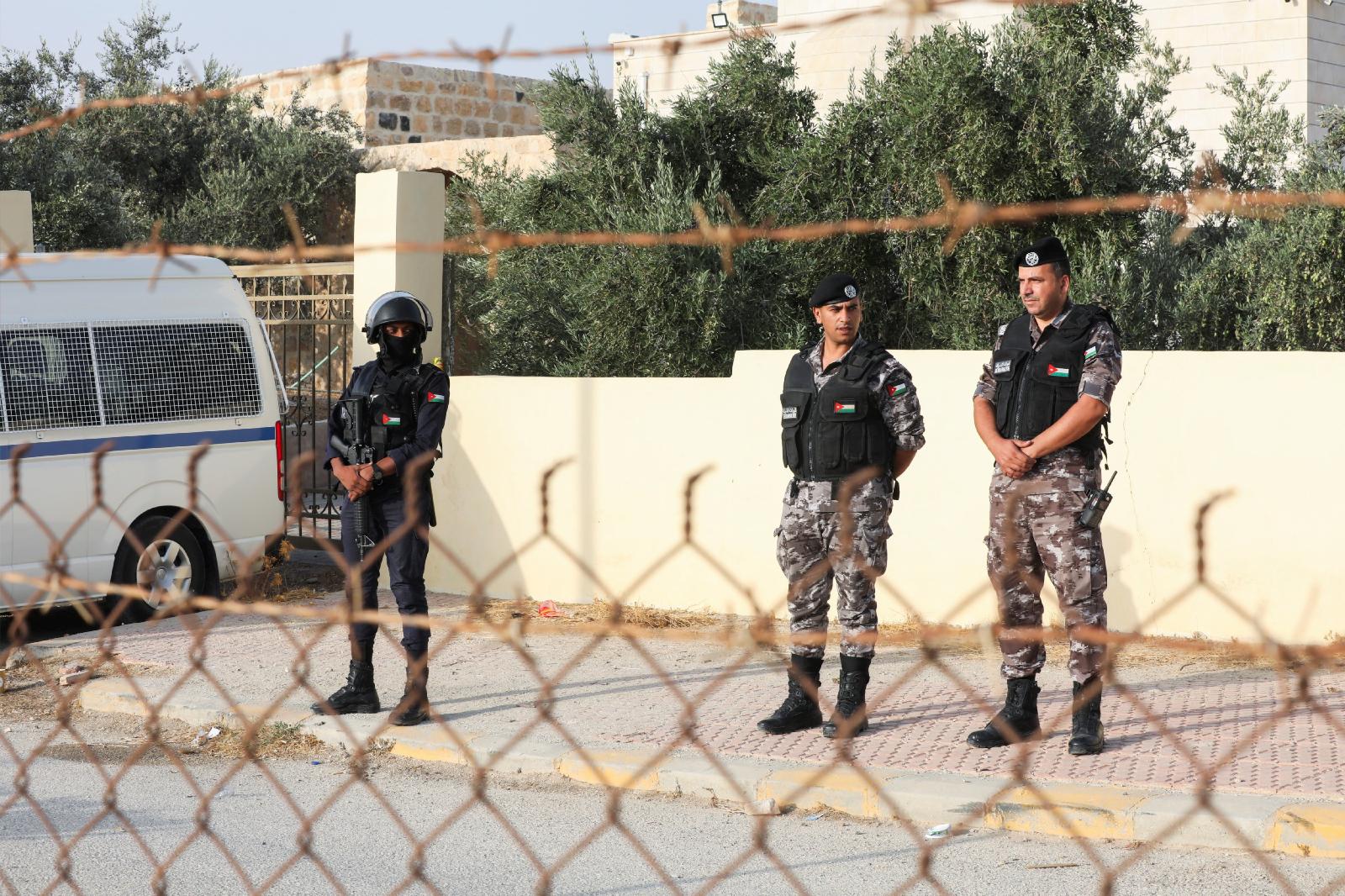
AMMAN, Jordan (OSV News) — Church bells rang out at noon across Jordan Oct 24 in remembrance of the victims of a massacre in the kingdom’s south that killed eight people and wounded 40 others during a funeral service that day.
Mourners had gathered at the St. George’s Orthodox Church in Hammoud, one of Jordan’s small Christian hamlets in the southern area of Karak, when three gunmen reportedly fired continuously for five minutes at them before fleeing the scene. One of those present said up to 200 mourners were in and around the church for the funeral service, adding that most of the victims were aged between 50 to 70 years old.
Another parishioner told CNN that she and others fled and hid behind the church’s altar for safety, fearing she would not make it out alive.
The Pontifical Mission Societies is also very active in Hammoud, and the Christian community in that area provides support and humanitarian care to local parishes.
An attack against Jordan
Jordanians of all persuasions are reeling the day after the traumatic event, and it has also caused consternation for Christians in neighboring countries.
Jordan’s King Abdullah II condemned the massacre, vowing the “harshest retaliation” against the attackers. The monarch rushed to the area to visit the wounded in local hospitals and to console those whose relatives were lost.
“Every Jordanian life is precious, and we will strike with an iron fist against those who dare to threaten our nation,” Abdullah said on the social media platform X. “Whoever imagines that the bullets of treachery can divide the ranks of Jordanians will fail in his endeavor before our steadfastness and unity.”
Jordan’s government has called the “unprecedented act” a “terrorist attack” against the entire nation.
“Any attack against a Jordanian, regardless of religion or belief, is an attack on Jordanian society as a whole,” said Mohammad Momani, the official government spokesman, who said the gunmen were driven by extremist ideology.
Momani stressed that Christians are deeply rooted in Jordan’s history and national identity, contributing to its past, present and future.
Jordanian Prime Minister Jaafar Hassan vowed to bring the perpetrators to justice and underscored the strictest legal action against anyone who incites discord or seeks to promote extremism within the community, according to The Jordan Times.
Church leaders’ sorrow
Jordan, which is part of the Latin Patriarchate of Jerusalem, received a message from its patriarchs and head of churches expressing “deep sorrow and utter dismay” for the “heinous and inhuman” terrorist attack firing “indiscriminately on innocent worshippers.”
“This terrorist attack against defenseless civilians is a grave offence against God and against humanity. To strike mourners at prayer, in a house of God, during the burial of their dead, violates every sacred and human value,” the condolence message said.
“It is an attack on the entire Christian community of the Hashemite Kingdom of Jordan and on the exemplary fabric of Jordanian society, in which Muslims and Christians have lived together in unity and fraternity for generations,” it added.
It also extended heartfelt condolences to the victims’ families and to His Beatitude Patriarch Theophilos III, the Greek Orthodox Patriarch of Jerusalem, the Orthodox Bishopric of Jordan and to the whole Patriarchate.
“We are encouraged by the unequivocal words of His Majesty King Abdullah II and by the Jordanian people’s firm rejection of this act. Such acts cannot and will not succeed in undermining the unity of the people of Jordan,” the patriarchate message said.
Archbishop Giovanni Pietro Dal Toso, apostolic nuncio to Jordan, also denounced the attack and visited the injured and their families in several hospitals on Oct. 24, accompanied by Bishop William Shomali of the Latin Patriarchate of Jerusalem, “to convey the closeness, solidarity, and condolences of the Holy Father,” Jordan’s official Petra news agency reported.
Vigil and prayers
Father Rif’at Bader, director of Amman’s Catholic Center for Studies and Media, invited Christians and Muslims to a candlelight vigil and prayer on Oct. 24 at his parish, the Sacred Heart of Jesus Church.
“Let us offer our prayers for our cherished homeland, for the repose of the souls of the martyrs, and for the swift recovery of the wounded and injured,” he urged.
Although Jordan suffered what it calls its own 9/11, in which Al-Qaida-linked suicide bombers attacked three hotels in Amman on Nov. 9, 2005, the kind of sectarian violence that has wracked Syria, Iraq and Lebanon is extremely rare. Some 60 people were killed, mainly Jordanian Muslim women and children.
Lebanon’s President Joseph Aoun, the Arab world’s only Christian head of state, called the church shooting a “heinous terrorist attack.” It “reaffirms once again that terrorism has no religion and no homeland, and its aim is to strike at coexistence and spread strife,” according the president’s statement.
Karak experienced a series of attacks in 2016 targeting police, including at the town’s historic “crusader castle,” popular with tourists. Ten people were killed, including seven officers, and dozens of others were wounded. Jordanian security forces killed the gunmen after a long standoff.
Dale Gavlak writes for OSV News from Amman, Jordan.
