


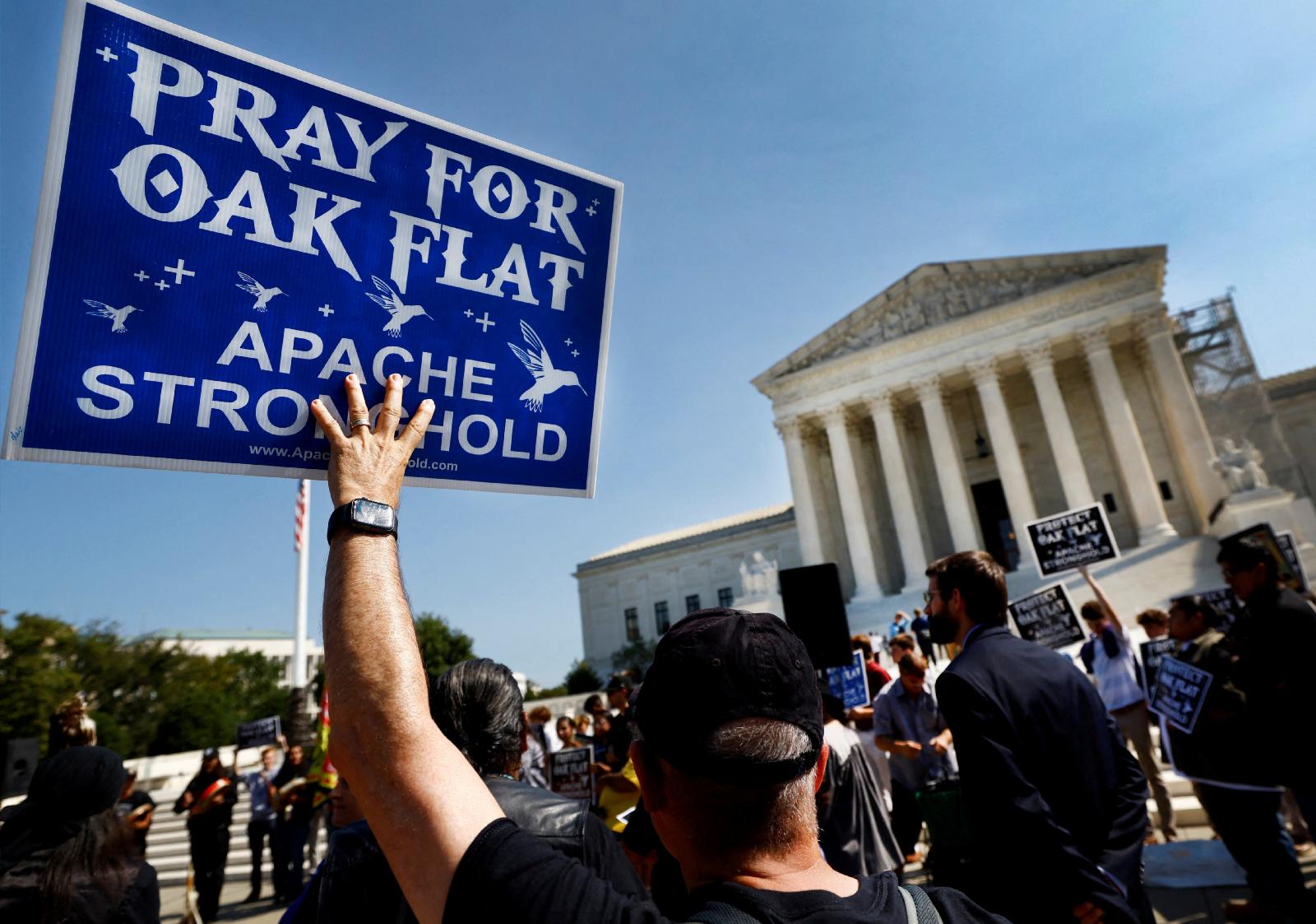
PHILADELPHIA (OSV News) — Although the U.S. Supreme Court declined to hear its case and the land has been transferred, an Indigenous coalition seeking to protect its sacred site at Oak Flat in Arizona from destruction by a copper mining giant continues its legal efforts, the group’s lawyer told OSV News.
Luke Goodrich, vice president and senior counsel at Becket and lead attorney for the coalition, which uses the name Apache Stronghold, told OSV News in an interview that there are still four active lawsuits challenging continued construction of the mine and challenging the land transfer and trying to get it rescinded.”
“Three of those cases are at the 9th Circuit right now,” he said. “And then the original Apache Stronghold case is back in District Court.”
Oak Flat is considered a sacred site by the region’s Indigenous peoples and is on the National Register of Historic Places. However, after the discovery of copper deposits on the land, Congress authorized in December 2014 the U.S. Forest Service to swap the land for other sites with Resolution Copper and lifted a mining ban on Oak Flat.
Series of lawsuits and appeals
Apache Stronghold filed a series of lawsuits and appeals to protect Oak Flat, eventually reaching the U.S. Supreme Court. A broad range of religious organizations — including the U.S. Conference of Catholic Bishops — had argued the high court should hear the coalition’s plea, because the case had serious implications for the scope of the Religious Freedom Restoration Act.
That law prohibits the government from placing a substantial burden on a person’s exercise of religion without compelling government interest. Even in those circumstances, it requires them to do so by the least restrictive means.
But the Supreme Court in May 2025 declined to take up the case. In a dissent, Justice Neil Gorsuch, joined by Justice Clarence Thomas, argued the court made “a grave mistake” in declining the case, arguing it met their standards for hearing the appeal.
In March 2026, the Trump administration said it planned to proceed with the copper mining project, arguing it would increase U.S. manufacturing, despite continued appeals from Native peoples. A transfer of the land to the mining company, Resolution Copper, took place soon after.
Resolution Copper points to ‘settled law’
In written comments provided to OSV News in April, a spokesperson for Resolution Copper said, “Settled law supports the Congressionally directed land exchange and advancement of this project.”
“Courts at every level have consistently ruled in favor of Resolution Copper — including on the very same claims that are recycled in this newest filing,” the statement said. “Three different presidential administrations have also supported this project. It is time for the meritless litigation to end.”
But Goodrich, speaking at Becket’s annual gala in Philadelphia, said that when the Supreme Court declined the case, it did not do so based on the merits, which the lower courts are still considering.
Asked about the wide variety of faith groups that offered their support to Apache Stronghold, Goodrich said that for Native Americans, the implications of the case could create “a very clear two-tier system of religious liberty.”
Preventing religious exercise creates ‘substantial burden’
“When the government prevents your religious exercise, that’s a substantial burden,” he said. “The government has to satisfy strict scrutiny for Native Americans when they bring these land use cases. It means they don’t get strict scrutiny unless they show a heightened coercion,” he said, adding that for Native Americans, it would mean “the government can destroy their sites and end their religious practices, often without any meaningful judicial review.”
For many other religious groups that support the Apaches, he said, “the concern would be that that watered-down standard for Native Americans starts to seep over other types of cases for other groups.”
History shows how the government has sometimes taken the religious sites of Native peoples, and “there are other religious groups that sometimes want to use federal land as well,” he noted.
For example, he said, Ebenezer Baptist Church in Atlanta, where the civil rights leader the Rev. Dr. Martin Luther King Jr., was baptized and ordained a minister, is now a national park.
The Apache Stronghold case was a topic at the inaugural meeting of the Department of Justice’s Religious Liberty Commission on June 16, 2025.
Asked what he hopes the commission includes in its final report about the case, Goodrich said he hopes that it will be “the double standard” created by the “wanton unnecessary destruction of sacred sites without meaningful scrutiny.”
Kate Scanlon is a national reporter for OSV News covering Washington. Follow her on X @kgscanlon.
