


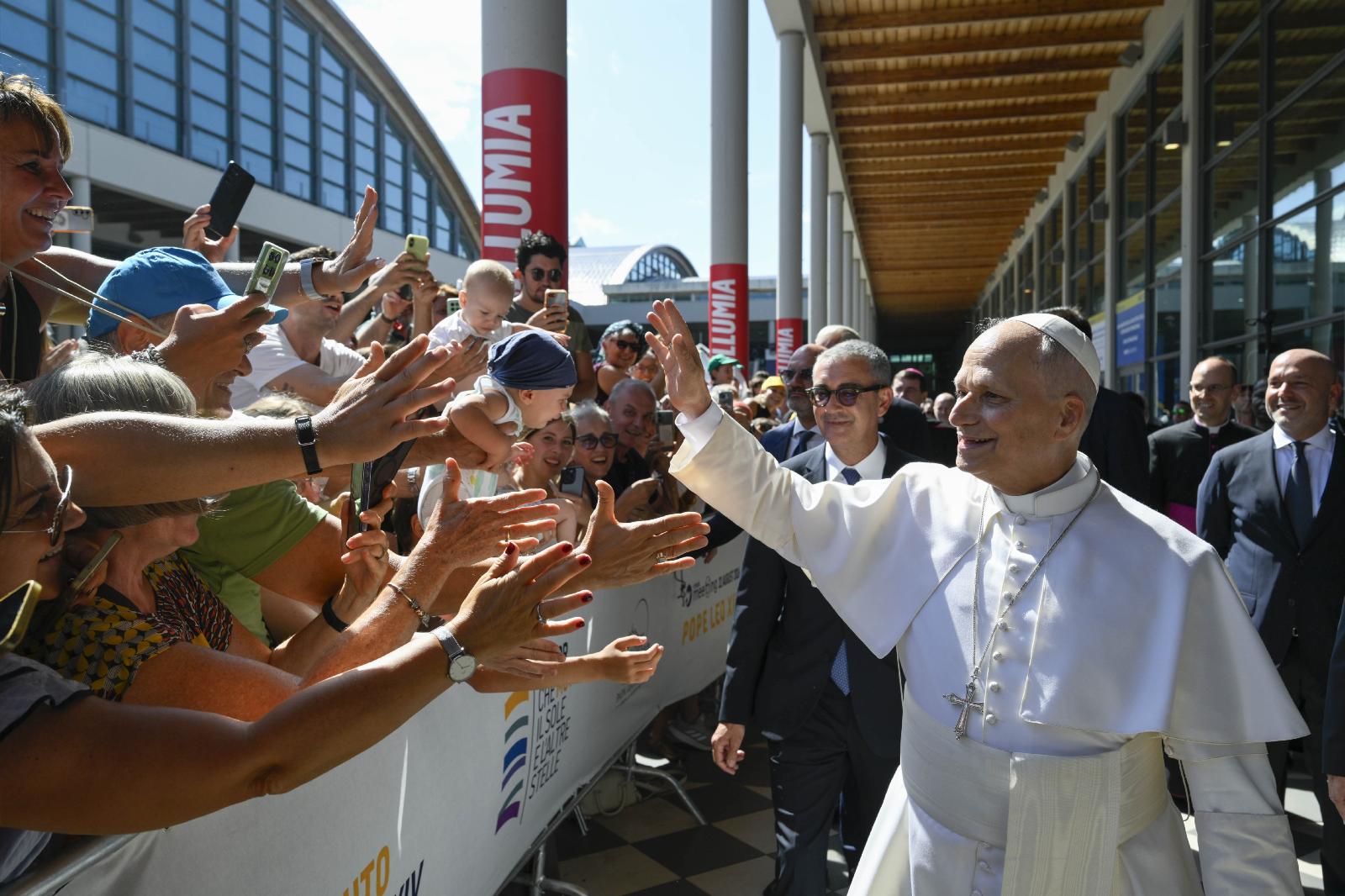
VATICAN CITY (CNS) — The Catholic vision and culture of love and mercy must overcome the false narratives that create enemies and convince people and nations to “re-arm” in a “culture of power,” Pope Leo XIV said.
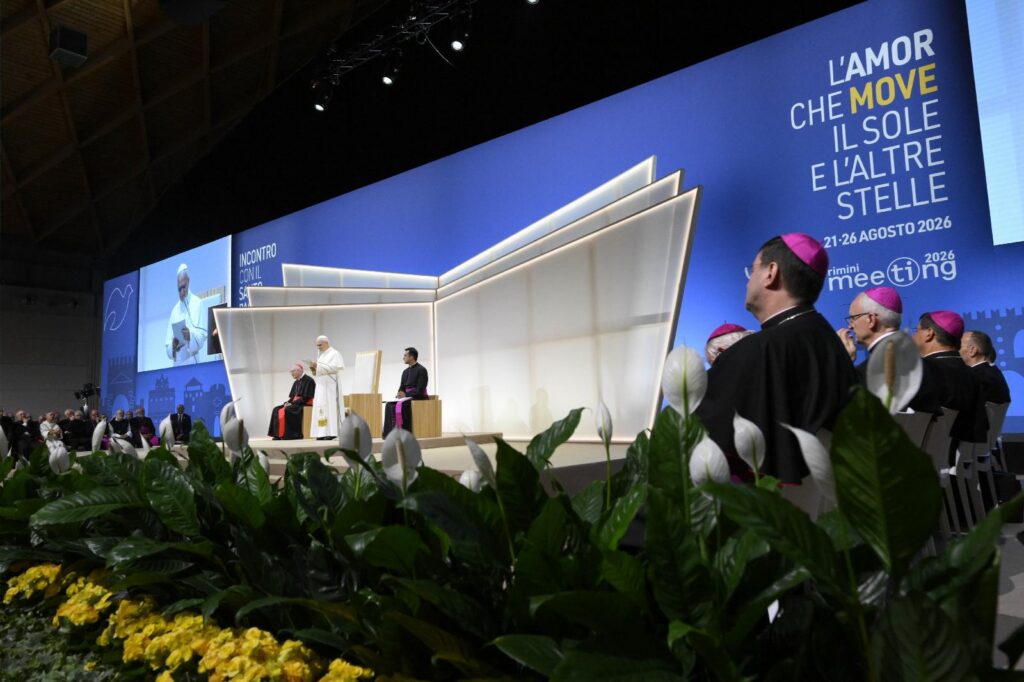
“Let us, then, together free our lives from suspicion, culture from arrogance, education from ideology, work from the idolatry of profit, and technology and finance from the business of death,” he told thousands of people attending the annual Meeting for Friendship Among Peoples Aug. 22 in the eastern seaside town of Rimini. The Vatican broadcast the events live on its channels.
“Let us expose unjust structures of power that lie at the root of poverty, inequality, war and environmental disasters. Let us disarm technological development whenever it becomes invasive and destructive,” he said, calling for convincing, credible and “courageous pioneers,” who take the first step “by first changing course in their own lives.”
The pope’s lengthy speech, which was repeatedly interrupted by applause, was the highlight of a daylong journey which brought him first to the micronation of the Republic of San Marino nestled on a mountain on the Italian peninsula, then to Rimini, where he celebrated Mass along the Adriatic Sea and attended the annual Rimini Meeting organized by the Catholic lay movement Communion and Liberation.
Only 2nd time a pope has attended meeting in person
While every pope has sent a written message to the international event every year since it was launched in 1980, it was the second time after St. John Paul II’s visit in 1982 that a pope attended in person.
Pope Leo picked up on the same appeal the Polish pope made 44 years ago: to tirelessly bring forth a civilization born of truth and love in a world seriously threatened by selfishness and indifference to others’ suffering.
Humanity “hungers and thirsts for justice,” Pope Leo said, and “peace is fostered and spread by people who love to encounter one another and are not afraid to engage with one another.”
“This is a time for responsibility” for Christians, he said, because “to follow Jesus Christ in the wake of the tragedies and new beginnings of the twentieth century indeed requires a clear awareness that evil is not overcome by evil.”
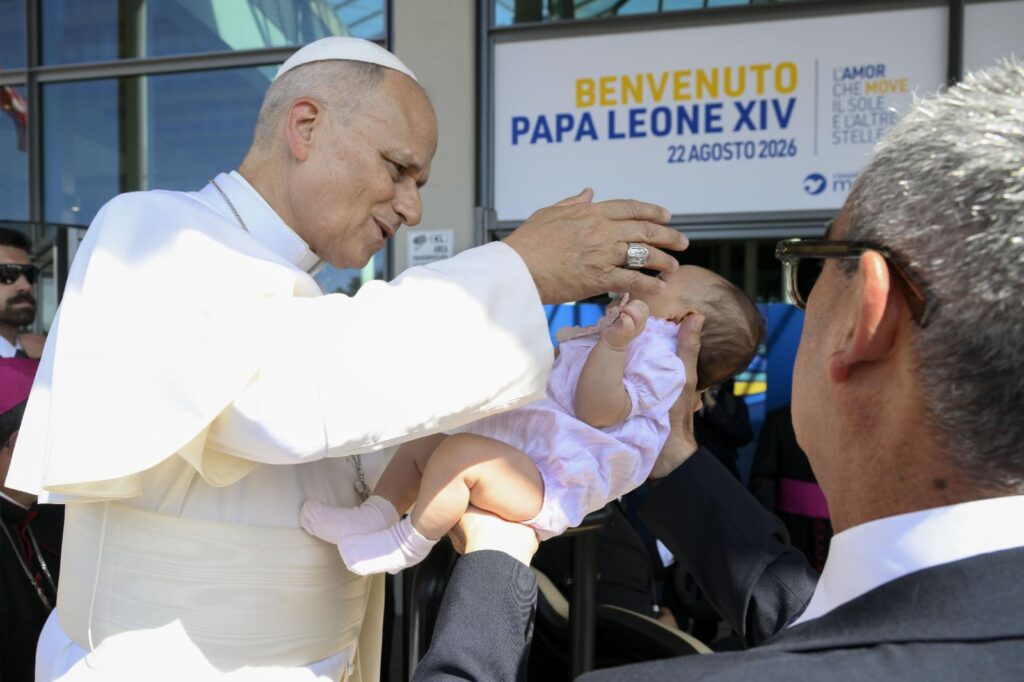
“Love is the law of life and the means of redemption,” the pope said. “Catholic culture must counter the false realism that re-arms minds, words and nations, with the realism of mercy which recognizes that there can be no enemies, and that everyone, even those who oppose us, is a brother or sister to be looked in the eye and encountered in truth.”
Christ’s redeeming love is stronger than sin
Christ’s redeeming love is stronger than sin, he said, and Christians need to continually purify their own “thoughts, interests, habits, associations, plans and investments — indeed, every aspect of our lives — from all that the culture of power has tainted.”
Authentic conversion requires seeking God’s glory over one’s own, he said. And it will be “courageous pioneers who, by first changing course in their own lives, can make the transformation required of everyone convincing and credible.”
Pope Leo spoke often to the many young people in attendance, putting the spotlight on their great enthusiasm, “which is a sign of the Spirit!”
The world needs communion, which starts with friendship, he told them in off-the-cuff remarks before his main speech. “The world needs you, your enthusiasm, your love, your faith.”
“Dear young people, today the world seems surprised by your commitment to Christ, by the attraction you feel toward him and his word, and by your sense of belonging to the Church,” he said in his main address.
Truth is encountered ‘only in freedom’
“This is not a matter of numbers, although it is moving to see thousands of your peers seeking Baptism in societies considered among the most secularized in the world. It is, rather, a matter of freedom because the truth can be encountered only in freedom,” he said to great applause.
The importance and true meaning of freedom was the focus of his meeting with the authorities, distinguished guests and residents of San Marino — the oldest republic in the world that traces its founding to St. Marinus; according to tradition, he fled Rome in 301 during the persecutions of the Roman Emperor Diocletian.
Celebrating 100 years of formal diplomatic relations with the Holy See, the republic’s motto is “Libertas,” or “Freedom.”
“There is no true civil liberty without personal liberty — that is, without respect for and the promotion of the dignity of the human person,” Pope Leo said in the wood-paneled chamber of the general council in the main Public Palace.
Individual freedom is “bestowed and guaranteed by God, whose voice resounds in the conscience of every human being,” he said, which is why promoting liberty requires defending human conscience.
Withs its source, roots in God, freedom is like growing plant
With its source and roots in God, freedom is like “a plant that grows and produces branches and leaves to offer everyone oxygen, shade, fragrance, fruit, and new seeds,” he said.
That root is damaged, he added, by an “idolatry” that presents political or economic projects as bearing the hallmark of freedom, when instead they are really “enslaved to idols and power.”
True freedom is realized “in giving, in communion, in encounter and in dialogue,” he said. In fact, “freedom and communion stand or fall together.”
While the ancient republic has a strong Catholic heritage and more than 91% of its population of almost 35,000 people identify as Christian, there is no official state religion and its constitution guarantees freedom of conscience and worship.
U.S. President Abraham Lincoln — who became an honorary citizen of San Marino — praised the tiny nation for showing that governments founded on the principles of a representative republic can be “secure and enduring.” Pope Leo was shown the president’s handwritten letter from 1861 in a display case.
Highlighting ‘unique value of a small state’
The pope told the governing authorities his visit was much like his visit to the small principality of Monaco — to “highlight the unique value of a small state, one ‘on a human scale,’ where it is possible to experience politics that is attuned to the needs of citizens and, therefore, a more effective democracy,” especially when it is also guided by Christian values.
“For this reason, the Republic of San Marino can serve as a ‘laboratory’ for good governance, where — without compromising the state’s secular nature — one can draw upon the principles of Catholic social teaching: the pursuit of the common good, the universal destination of goods, the harmony of subsidiarity and solidarity, and social justice,” Pope Leo said.
He encouraged officials, citizens and the Catholic Church to continue their “courageous dedication” and cooperation in promoting everyone’s human dignity and the common good.
The pope then visited the Basilica of San Marino, where he venerated the relics of St. Marinus and met with local Catholics.
The early founders and leaders of the nation, he said, “were able to translate the message of the Gospel into a new communal and political model, strongly characterized by the Christian principles of freedom, mutual respect, and communion — a model that remains alive to this day.”
Gospel is path to freedom, meaning for humanity
The Gospel is the path to freedom and meaning for humanity of every age, he said, and “the greatest gift we can offer to the brothers and sisters whom the Lord places on our path is to help them encounter Him.”
The Gospel inspires a society built on respect for one’s own freedom, that of others, and for God’s will, which “commands care for the weakest, forgiveness, communion and solidarity,” he said.
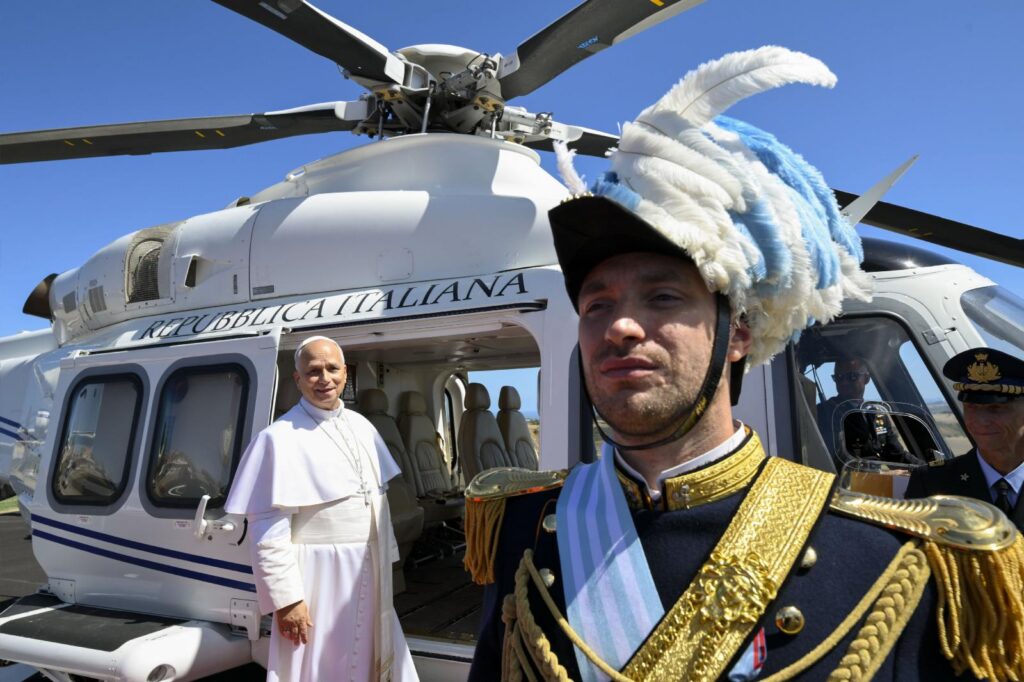
Pope Leo then went by helicopter to Rimini for the afternoon, where he spoke at the meeting and then visited people receiving care and support from the local Caritas.
The pope spent a long time blessing and talking to the elderly, infirm and marginalized in the city’s cathedral in a festive atmosphere, as an ecumenical choir and orchestra played jazz and big band hits, like “Don’t Sit Under the Apple Tree (with Anyone Else but Me)” by the Andrew Sisters and “Shake That Thing” by Papa Charlie Jackson.
The pope then celebrated an outdoor Mass at the city’s port as thousands gathered along the beach and blue sea. Hundreds of people, still sporting bathing suits, shorts, caps and straw hats from their afternoon outing, stood behind metal barricades and scores of others wore traditional striped sailor shirts. A giant ferris wheel lit up brightly as the sun set over the horizon.
Some forms of entertainment the world offers can lead to emptiness
In his homily, the pope said the world “offers many forms of entertainment, some of which, however, lead more to distraction and ruin” and emptiness.
This idea of “escapism,” he said, assumes that everyday life is “a prison from which to flee.”
The best way to find “refreshment,” he said, is “where we encounter God and truly encounter one another,” which is not “out there in the chaos, but within us, in the depths of our souls.”
“As a Christian community, we are therefore called in a special way to cultivate this experience and to pass it on,” he said, through a readiness to help and be welcoming, and a caring and contemplative atmosphere in Church.
“And this applies both to those seeking a well-deserved time of rest after a year of work and to those who, wounded in body and spirit, seek refuge, food, and assistance far from their homeland,” he added.
Albanian Cardinal Ernest Simoni, 97, was among the many priests, bishops and cardinals who concelebrated at the Mass, and the original painting of Our Lady of Mercy, patroness of the city, was displayed for veneration.
