


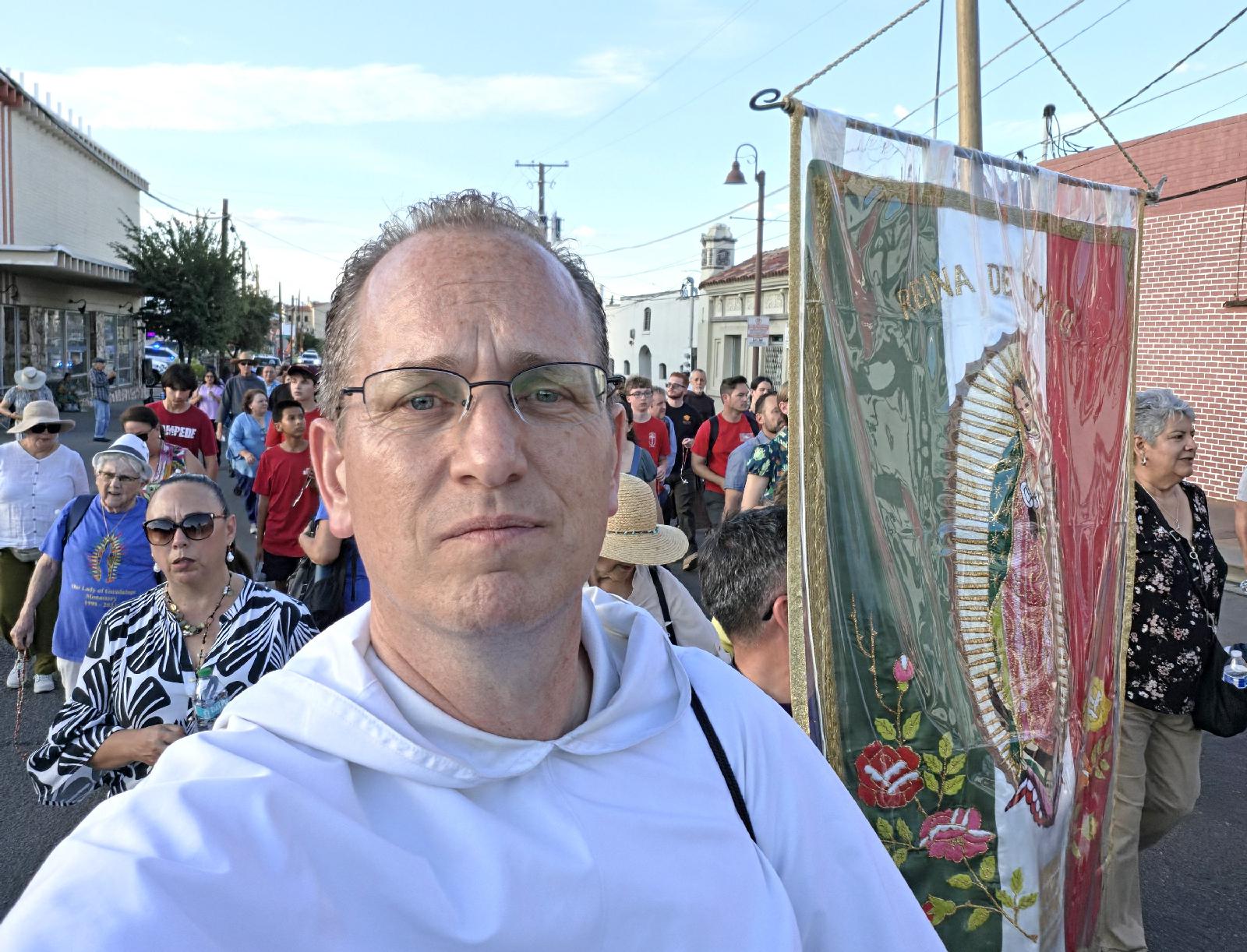
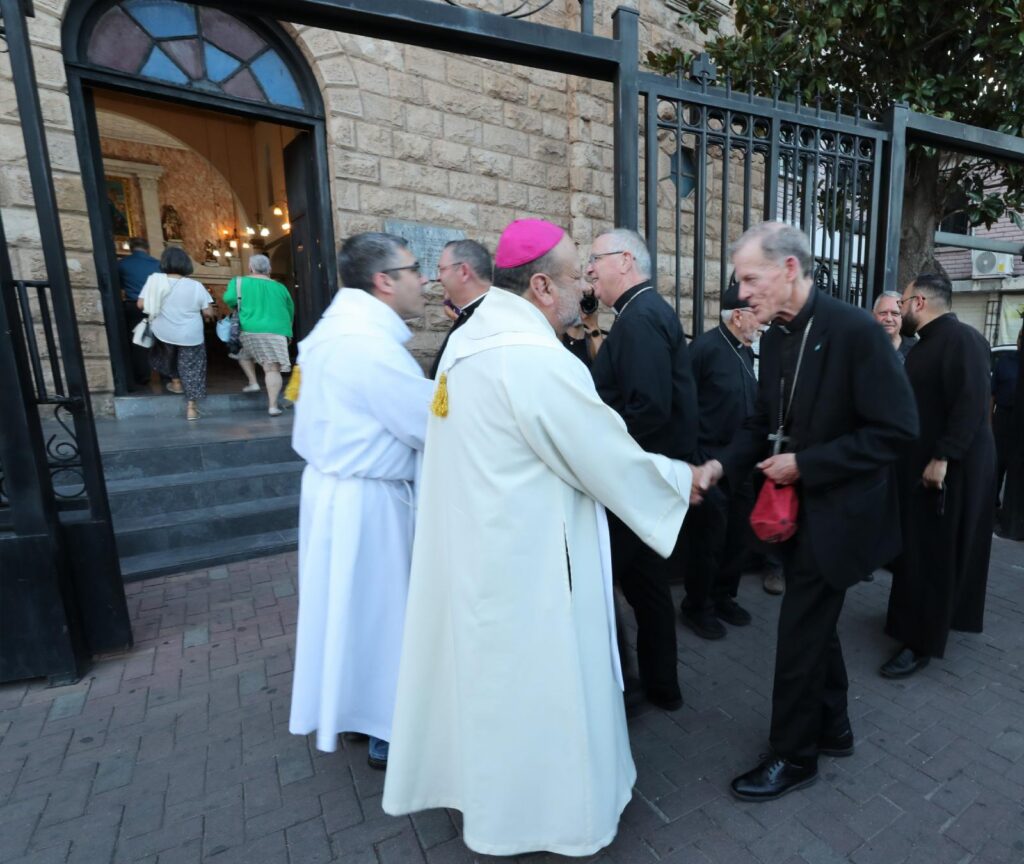
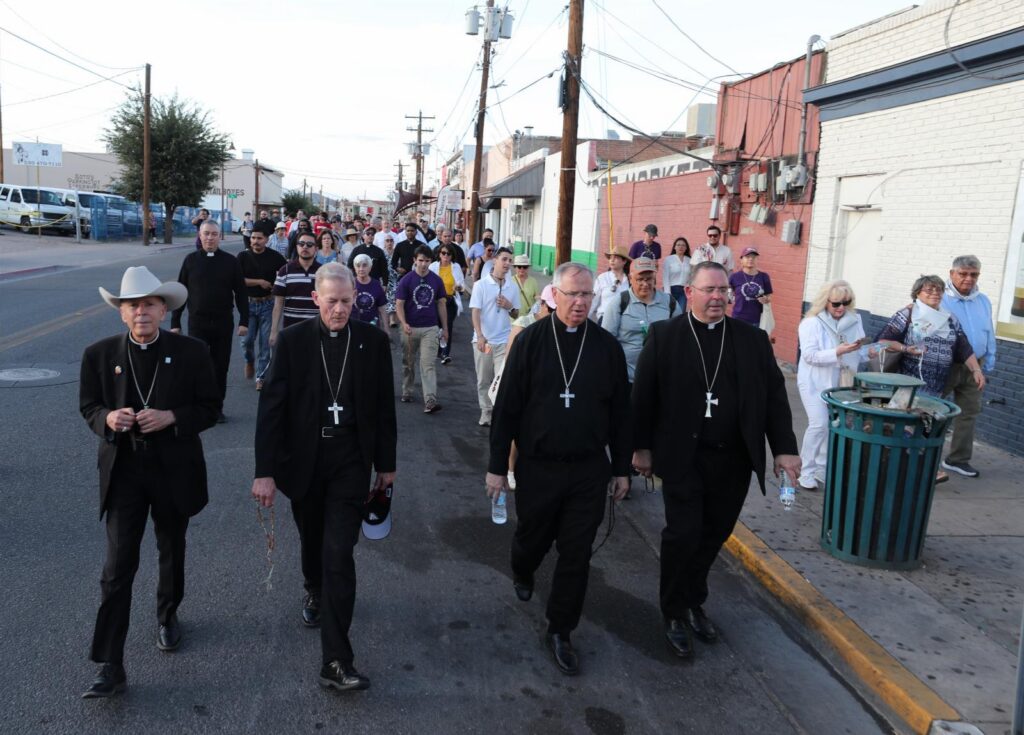
(OSV News) — Hours before a June 26 border Mass celebrated by Catholic bishops in Nogales, Arizona, OSV News spoke with Dominican Father Brendan Curran of the Province of St. Albert the Great, regional promoter of justice and peace for the Dominicans of Canada and the United States.
Father Curran shared his reflections on the broader psychological and spiritual significance of borders, while pointing to Jesus’ crossing “the border of death into new life.”
This interview has been edited for length and clarity.
OSV News: Why did you feel it was important to be at this border Mass?
Father Curran: We’re participating (as members of the Dominican order) for a variety of reasons.
One is that we’re standing with the bishops at an important moment, and an especially historic week (the nation’s 250th anniversary), which is unfortunately also a bad news week at the Supreme Court. How appropriate it is that we have to be here today, amid the quite disturbing news about the court’s decision regarding Temporary Protected Status (for Haitians and Syrians), which is a huge setback in terms of those communities and people (under TPS protection) who reside all over the United States.
So the primary reason for the (border Mass) gathering is of course the dignity of immigrants, and how, especially on this 250th anniversary of the United States, we can keep in front of us the value of the immigrant spirit, the immigrant passion, as well as immigrant peoples’ plight and their finding new roots in a place that collectively we have for generations called home.
OSV News: You’ve spent considerable time working to develop community presence and ownership in southwest Chicago through your role as community organizer with The Resurrection Project, a social impact organization. Talk about how communities use borders to define themselves in both positive and negative ways.
Father Curran: Border space is a sign of a relationship that is so basic to humanity across the world. People move in and out of a border zone in a regular pattern, going across the border for work, coming back across the border to where they call home.
There is a border economy, and there are border people that this event (the border Mass) lifts up. Many of us who are away from the border physically are not aware of this, if they haven’t lived close to or in such places.
I grew up on the South Side of Chicago. My father came here from Ireland in 1960. My mother’s roots are in Los Angeles. I say that because my parents crossed multiple borders to fall in love. They met in Chicago, and it’s so much the immigrant story; this is not unique.
In the very local reality of Chicago, neighborhoods become borders in unique ways, such that people visiting from other places (can sense that), because of how different and solid the border of a neighborhood seems. That’s not necessarily a common experience in some other cities of the United States, but certainly in Chicago, it is true and feels absolutely real.
The positive aspect of this is that communities have built up a sense of home in a place over generations. There’s a sense of welcome in such neighborhoods for people in the difficulty of the first years of arrival (as immigrants). There is a vibrance of culture and traditions you can find and experience. In Chicago, in a Catholic way, everyone still asks, “What parish are you from?”
And that is mostly a healthy experience of a border, because then people can identify you: “Oh, you’re from that area.” It helps to locate some of your life experience, to understand each other and our own self-identity.
But there is a negative part of that experience. I’m talking about the edges of communities who, because of the color of their skin or their accent, experience a sense that “you don’t belong here; your people are over in that neighborhood. Why are you trying to buy a house in this neighborhood? You can’t rent here; you can’t buy here.”
We have pockets of community where we continue to isolate people or intimidate people from crossing borders of neighborhoods. That’s not necessarily the best of our society; that’s an ugly part of borders.
OSV News: As Catholics, how do we recover a proper sense of borders, aligned with God’s intention?
Father Curran: This tension over borders is not new. Jesus, in the Gospels, experienced border frictions. The Jewish community from which he came from experienced border differences.
In speaking with the woman at the well (John 4:4-42), Jesus was crossing borders in their society. He went to the woman at the well and her community, who were considered “watered-down,” less-than-authentic Jews by some.
Jesus fled from his homeland so that his parents, wisely, could protect him from the evil policy that was slaughtering innocent children in order to get rid of him. They (the Holy Family) fled to Egypt, as we remember in Matthew’s Gospel (Matthew 2:13-15); they were crossing borders to survive. Jesus absolutely lived through the traumas of this day in his own (historical) context, as we read about every Sunday.
All through salvation history, borders were an issue, a challenge. And we are often afraid to deal with these big subjects of “who’s in” and “who’s out” — who’s within my border, who belongs and who doesn’t belong.
But we as the faithful believe in Jesus’ resurrection. Jesus crossed the border of death into new life. The empty tomb reflects the crossing of a border.
We are border-crossing border people through the sacrament of baptism; we cross the border into the promise of new life. We do this as Catholics. This is our DNA.
If we proclaim we are Catholic, how do we live that out with regard to the borders with our lives?
Jesus knew how to do this. What are we doing about it?
Gina Christian is a multimedia reporter for OSV News. Follow her on X @GinaJesseReina.
