


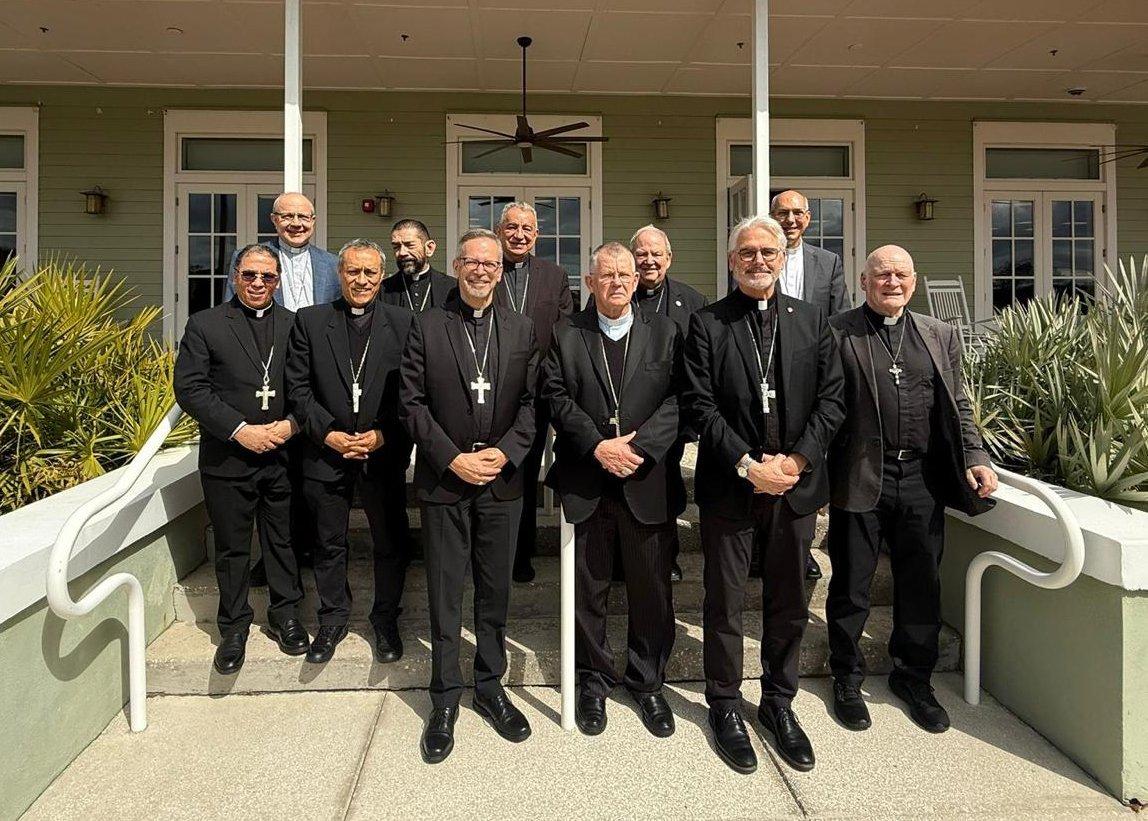
(OSV News) — At their biennial meeting, bishops from Latin America and the Caribbean, the United States and Canada renewed their commitment to work together as a Church united across the continent, “bearing clear and consistent witness to Jesus Christ, Crucified and Risen, the living hope for all peoples.”
The bishops noted that, despite different national contexts, “our peoples experience similar anxieties and that our episcopal ministries face common challenges that invite coordinated, compassionate, and profoundly evangelical responses,” according to a Feb. 19 joint statement signed by the Latin American and Caribbean Episcopal Council, known as CELAM, the Canadian Conference of Catholic Bishops and the U.S. Conference of Catholic Bishops.
Guiding Catholics with ‘wisdom and courage’
“Our prayer and our conversations have focused on how to better guide the People of God with wisdom and courage in a time marked by profound changes and challenges,” said the statement about the Feb. 15-17 meeting in Tampa, Florida.
The bishops of the continent are “very aware that we need to further deepen our bonds of communion and mutual support as a Church, as a Church on the continent of the Americas,” Bishop Daniel E. Flores of Brownsville, Texas, who is USCCB’s vice president and one of the 11 bishops attending the gathering, told OSV News.
Likewise, Archbishop José Domingo Ulloa Mendieta of Panama, second vice president of CELAM, told OSV News that all conferences share a reality, which is the reality of the migrant. “For us, the migrant from the pilgrim Church in the Americas is not a stranger, but a brother, and one of the purposes is to strengthen coordination from the Church of origin, through the Church of passage, to the final destination,” he said.
Addressing rights of Indigenous people
According to the bishops’ statement, the bishops also addressed issues such as the rights of Indigenous peoples, the poor and vulnerable, human trafficking, narco-culture, social polarization, and the vulnerability of the migrant community.
“No migrant is a stranger to the Church,” the document stated. “In every person who leaves their homeland seeking safety, opportunities, or dignity, we recognize a brother, a sister; we recognize the very face of Christ on the move.”
“Human mobility cannot be reduced to a merely political or economic issue; it is a profoundly human reality that challenges our Christian conscience and the ethical responsibility of nations.”
The bishops also urged civil authorities to “promote policies that safeguard the lives, rights, and dignity of migrants” and faithful in the Americas to welcome migrants and defend their dignity as visible signs of fraternity and response to the call of Jesus and his teaching.
Impact of immigration policies on migrant families
Bishop Flores told OSV News that during his years serving at the border, he has witnessed how the immigration policies of successive administrations impact migrant families.
“It also affects the conscience of nations, how to treat people with respect and how to formulate laws in a way that respects the sovereignty of countries, but also respects that human life, according to the teaching of the Church, is the fundamental point from which we begin to think about how to organize a society ethically and morally, with the good of the human being first,” said Bishop Flores.
Archbishop Ulloa, for his part, is well aware of the drama of migrants who for years crossed the treacherous Darien Gap, risking their lives, and he acknowledged the support of the Church in the U.S. and Canada, in welcoming and accompanying these migrants.
He talked about “the right of countries to regulate their borders” but criticized the criminalization of migrants.
‘There is international hypocrisy’
“There is international hypocrisy. We criminalize migrants, but we do not raise our voices in the countries where these migrants are forced to leave. ‘Either I die there, or I die on the way’ because of persecution, hunger and lack of education for their children,” said the archbishop. “I believe these are factors that our governments do not take into account, and I do believe that we must raise our voices against these countries that expel their own citizens.”
Archbishop Ulloa added that “there is another phenomenon occurring now, which is that of entire families — poor families, grandparents, uncles and aunts, and above all, children — are coming, and that is why, as a Church, we cannot be indifferent to the phenomenon of migration,” he said.
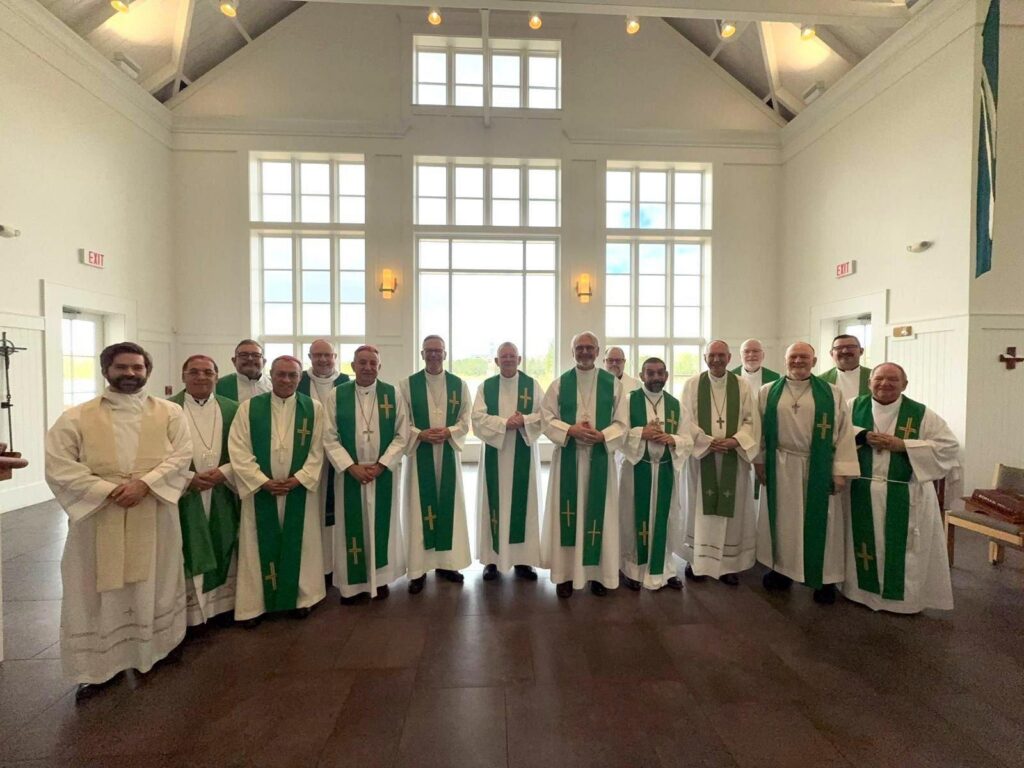
The archbishop stressed that transforming social realities requires educating and raising awareness among the faithful, promoting both internal conversion and action, including through the political participation of the laity. He pointed out that the voice of the Church “is not only the voice of the bishops but of all the baptized,” emphasizing the responsibility of each person to respond to injustice and discrimination.
‘Great works being done’
Archbishop Ulloa stressed that “there are great works being done throughout the continent, and the media also has a great influence there. We have to make visible all these good pastoral practices, the number of shelters supported by the Church, religious and laypeople who accompany migrants throughout this process.”
Bishop Flores also said that part of the intention of these meetings “is to deepen our mutual understanding, how we are trying to respond with the Gospel and with the Church’s efforts to form people in the Christian life to these realities that are very current, even though they have very particular manifestations in different regions of the Americas,” he added.
One of the main fruits of this meeting, he said, was to learn more about the pastoral realities of the different nations, in order to “intensify the bonds of cooperation and see how we can respond more as a Church in communion and defend especially the dignity of the human being,” in coordination with the other conferences and collaborators.
Refocus efforts this Lent
Archbishop Ulloa invited everyone to refocus their efforts and resume their paths during this Lent, recognizing that the Church’s mission is fulfilled more effectively when working in a spirit of collaboration and fraternity. “We are distinct, but not distant,” he concluded. “Diverse America, but one heart and one Church.”
For his part, Bishop Pierre Goudreault, president of the Canadian Conference of Catholic Bishops and bishop of Sainte-Anne-de-la-Pocatière, spoke with OSV News about the pastoral fruits of this meeting and cited among them the exercise of synodality because at this meeting, he said, “we really listened to each other.” He added that they learned “from each other and we let ourselves to be transformed by the different experiences that the bishops are living, are going through with their communities.”
Agreeing on concrete commitments
He noted that the bishops agreed on concrete commitments to collaboration and the joining statement to “the people of God on pilgrimage in the Americas,” as well as in a letter sent to Pope Leo XIV “to let him know that we are kind of making efforts among the bishops to build up some bridges between our countries, to continue to work together also for different pastoral issues.”
Bishop Goudreault also highlighted the creation of fraternal bridges. “We know that we’re coming from very different contexts”, he said. “We want to be one church in the Americas.”
Marietha Góngora V. is a correspondent for OSV News.
