


(OSV News) — For over three decades, the allegations of sexual, psychological and spiritual abuse against Slovenian Father Marko Rupnik were met with cover-ups and bureaucratic delays.
In a message to a safeguarding conference in October 2025, Pope Leo XIV highlighted the need for safeguarding and transparency within the Catholic Church.
“I renew my appeal that there can be no tolerance for any form of abuse in the Church,” the pope said.
However, in the time since the allegations against Father Rupnik were revealed to the public during Pope Francis’ pontificate, the case has tested the Catholic Church’s commitment to transparency and tackling the institutional problems that allowed the Slovenian artist to continue his artistic public ministry for years relatively unscathed.
Allegations and revelations
The revelations of the many allegations against Father Rupnik were made public in 2022. However, internal warnings and complaints about the Slovenian priest’s alleged psychological, spiritual and sexual abuses date as far back as the early 1990s.
Details of the abuses that occurred within the now-defunct Loyola Community — a women’s religious community co-founded in the early 1980s in Ljubljana, Slovenia, by Father Rupnik and Slovenian Sister Ivanka Hosta — were published by Left.it, an Italian blog.
Requesting testimonies, the blog published a letter sent to Pope Francis in 2021 by a member of the community who chronicled the alleged abuses by Father Rupnik. Several former members had also written to the pope that same year. However, according to Left.it, none received a response.
Noting that there were still a number of members who believed that steps taken to reform the Loyola Community were a form of persecution against Father Rupnik and Sister Ivanka, the anonymous member said she requested exclaustration, or separation from the religious community.
“In its early days, the community was also marked by abuse of conscience, as well as emotional and presumably sexual abuse by Fr. Marko Rupnik,” she wrote to Pope Francis. “As a friend of the foundress and several early sisters, he maintained a close and constant presence in the personal lives of all the sisters and the community as a whole.”
Another testimony was published anonymously in 2022 by Gloria Branciani, another former member of the Loyola Community who later revealed her name publicly.
Branciani described her experience of abuse at the hands of Father Rupnik as “a descent into hell,” noting the use of psychological and spiritual manipulations to appeal “to my uncertainties and frailties while using my relationship with God to push me to have sexual experiences with him.”
She also said that the Slovenian priest would request “more and more erotic games in his studio at the Collegio del Gesù in Rome while painting or after the celebration of the Eucharist or confession.”
According to the anonymous member’s letter to Pope Francis, Father Rupnik was separated from the community in 1993 due to “the extreme suffering of some sisters.” However, she noted, his behavior was “practically covered up and not reported, both by the individuals directly involved and by Sister Ivanka, who was aware of them.”
In a separate article, a source told Left.it that Father Rupnik and Sister Ivanka had a heated argument over his removal and that “several sisters left the community to form a nucleus of women who, living at the Aletti Center in Rome, collaborated with him.”
Among those women was Maria Campatelli, who has served as director of the Aletti Center since 2020. The center, a theological and artistic community founded by Father Rupnik in 1991, was inaugurated by St. John Paul II in 1993.
Jesuits receive complaints
In Rome, Father Rupnik’s mosaics gained prominence. Among the well-known works he completed between the late 1990s and early 2000s are the mosaics at the Vatican’s Redemptoris Mater Chapel in 1999, the Sanctuary of Our Lady of Lourdes in France in 2008, and the crypt of the Sanctuary of Padre Pio of Pietrelcina in San Giovanni Rotondo, Italy.
Other works include shrines in Fatima, Washington and Malta.
OSV News learned that in 2000, 22 members of the Loyola Community were forced by Sister Ivanka to write letters to Father Rupnik describing their abuse and to forgive him.
“The reason Ivanka gave us when she forced us to write about our experience with Rupnik was that on the occasion of the Jubilee (of the year 2000), we needed to seek reconciliation with him; I don’t know if she then had the letters delivered to Marko,” Fabrizia Raguso, a former Loyola Community member, told OSV News.
According to a chronology published by the Jesuits in 2022, allegations of sexual harassment, as well as an accusation that Father Rupnik gave absolution to an Italian novice with whom he had engaged in sexual activity, were received in October 2018 by the society and an investigation was opened.
By May 2019, the accusations were deemed credible, and the following month, Jesuit Father Juan Antonio Guerrero, who at the time was the Jesuit’s Delegate of Interprovincial Houses and Works of the Society of Jesus in Rome and Father Rupnik’s superior, imposed restrictive measures against the priest.
Investigation and brief excommunication
Although not included in the Jesuits’ chronology, The Associated Press reported that the Vatican sent Bishop Daniele Libanori, a Jesuit who at the time served as an auxiliary bishop in Rome, to Slovenia to investigate allegations by members of the Loyola Community.
A dossier was sent to the then-Congregation for the Doctrine of the Faith, and the Vatican doctrinal office requested that the Jesuits complete an administrative criminal process. By January 2020, the Jesuits’ investigation determined that Father Rupnik had given the absolution to the novice.
Nevertheless, despite the results of the investigation, Father Rupnik was asked to deliver the first sermon at the annual Lenten retreat for Pope Francis and the Roman Curia in March 2020. It is unclear who extended the invitation to the Slovenian priest.
By May 2020, the Vatican doctrinal office formally confirmed that the absolution had happened and that Father Rupnik had incurred an automatic excommunication. However, that same month, the excommunication was lifted after Father Rupnik “admitted the facts and asked for forgiveness,” the Jesuits said.
“Administrative restrictions were imposed on Fr. Rupnik (for a period of three years), and at the same time he ceased to be director of the Aletti Center,” the Jesuits’ chronology stated.
Loyola Community accusations
Following his 2019 investigation, Bishop Libanori encouraged the women of the Loyola Community to file their complaints against Father Rupnik to the Vatican, AP reported.
After receiving the complaints, the Vatican doctrinal office contacted the Jesuit general curia in June 2021, and Jesuit Father Arturo Sosa, the society’s superior general, asked Jesuit Father Johan Verschueren, who succeeded Father Guerrero as the delegate for the Interprovincial Houses, to begin an investigation.
The investigation, which concluded in January 2022, deemed the accusations by members of the Loyola Community credible, and the findings were sent to the doctrinal office along with a recommendation to begin criminal proceedings against Father Rupnik.
That same month, Father Rupnik had a private audience with Pope Francis at the Vatican.
Further restrictions on the priest were subsequently imposed by Father Verschueren. However, by October 2022, citing the statute of limitations, the Vatican doctrinal office, now known as the Dicastery for the Doctrine of the Faith, declined to carry out the proceedings.
Public revelations
In December 2022, several Italian blogs and news outlets reported on the accusations of sexual, psychological and spiritual abuse by the priest.
The revelation drew outrage. Survivors and victims’ advocates highlighted the lack of transparency and failures to act, particularly when it came to the abuse of women in the Church.
In a meeting with journalists a week after the revelations were made public, Father Sosa said Father Rupnik’s case was “a good example of how much we still have to learn, especially about people’s suffering.”
However, he also noted that such cases were “the exclusive responsibility of the Dicastery for the Doctrine of the Faith.”
In February 2023, the Jesuits announced that the order had received new testimonies and complaints against the Slovenian priest of abuse that allegedly took place “during various periods from the mid-1980s until 2018, spanning more than thirty years.”
The credibility of the reports, which came from individuals involved with the Loyola Community and the Aletti Center, was “very high,” the Jesuits said in a statement.
The investigative team charged with receiving complaints against Jesuit members, the statement read, “proposed meeting with Father Rupnik regarding these matters, but without success.”
It also stated that after reading the report of the complaints, Father Verschueren imposed further restrictions on the priest, including “forbidding him, under obedience, from undertaking any public artistic activity, particularly in connection with religious institutions.”
Dismissal from Jesuits
Several months later, in June 2023, the Jesuits announced Father Rupnik’s dismissal from the society “because of his stubborn refusal to observe the vow of obedience.”
Despite the restrictions imposed upon him, including restrictions on travel and artistic work, the priest was spotted working on restoration projects for local churches in Bosnia and Herzegovina as well as in Croatia.
According to the Jesuits, following the investigative team’s report, the priest had been ordered to transfer to a different community and accept a new assignment. “Faced with Marko Rupnik’s repeated refusal to obey this directive, we were unfortunately left with only one option: dismissal from the Society of Jesus,” the Jesuits said.
Less than two months after his dismissal, Father Rupnik was received into the Diocese of Koper in his native Slovenia.
Two days after that revelation, on Oct. 28, 2023, the Vatican announced that Pope Francis ordered the DDF to review the case and lifted the statute of limitations.
According to the Vatican press office, the Vatican’s Pontifical Commission for the Protection of Minors “brought to the pope’s attention that there were serious problems in the handling of the Fr. Marko Rupnik case and a lack of outreach to victims.”
“The pope is firmly convinced that if there is one thing the Church must learn from the Synod, it is to listen attentively and compassionately to those who are suffering, especially those who feel marginalized from the Church,” the press office said.
Calls for mosaics’ removal
Branciani and another former Loyola Community member, Mirjam Kovac, revealed their identities at a press conference in Rome in February 2024 and appealed to Pope Francis to investigate the handling of the accusations, which they said were not taken seriously by officials.
In the aftermath, more survivors not only detailed their alleged abuse, but also called for the removal of the priest’s artwork from churches and public spaces around the world, saying that it was a painful reminder of the abuse they suffered.
One of Father Rupnik’s alleged victims, Sister Samuelle, said she was abused while they were installing a mosaic.
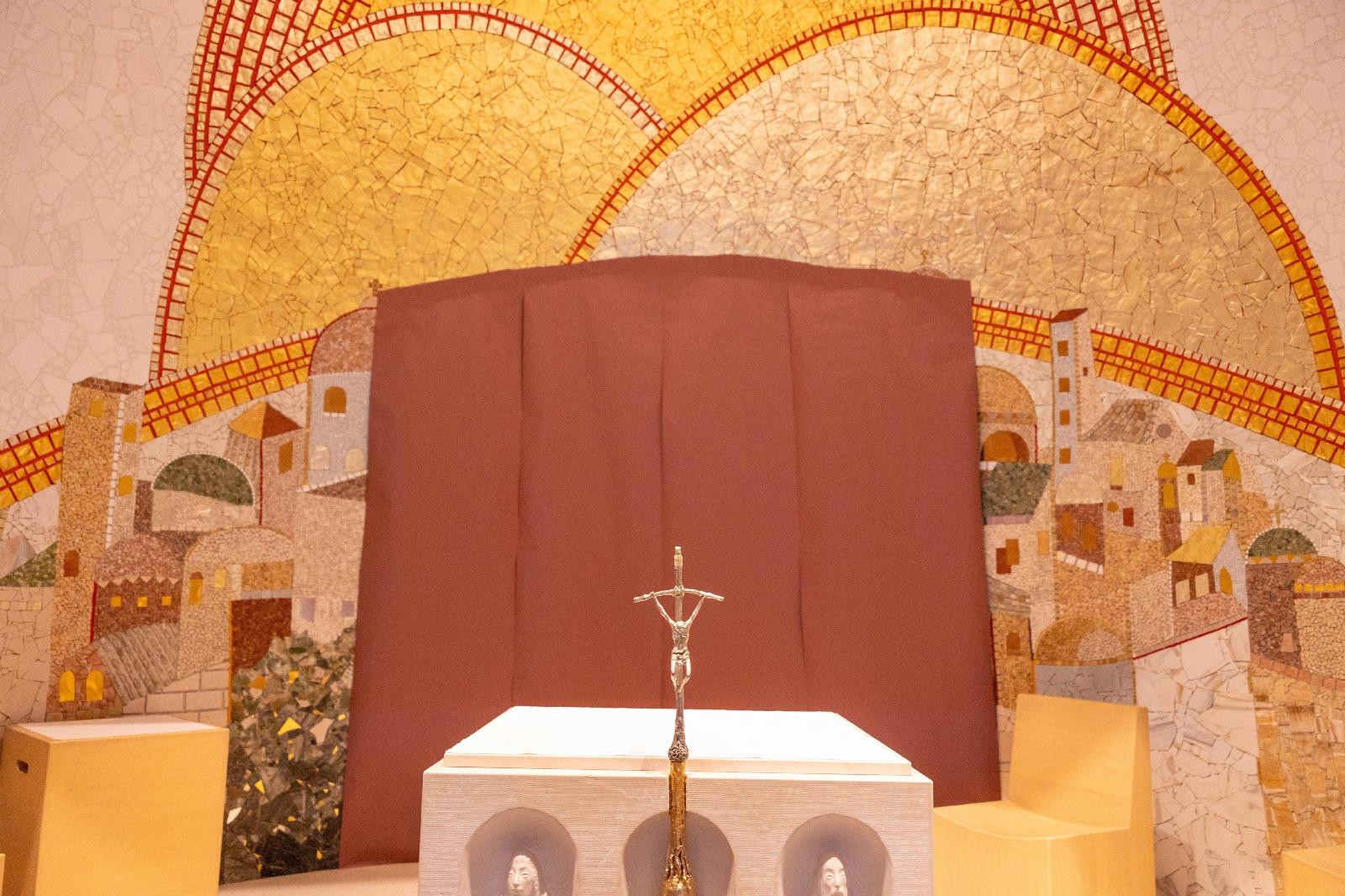
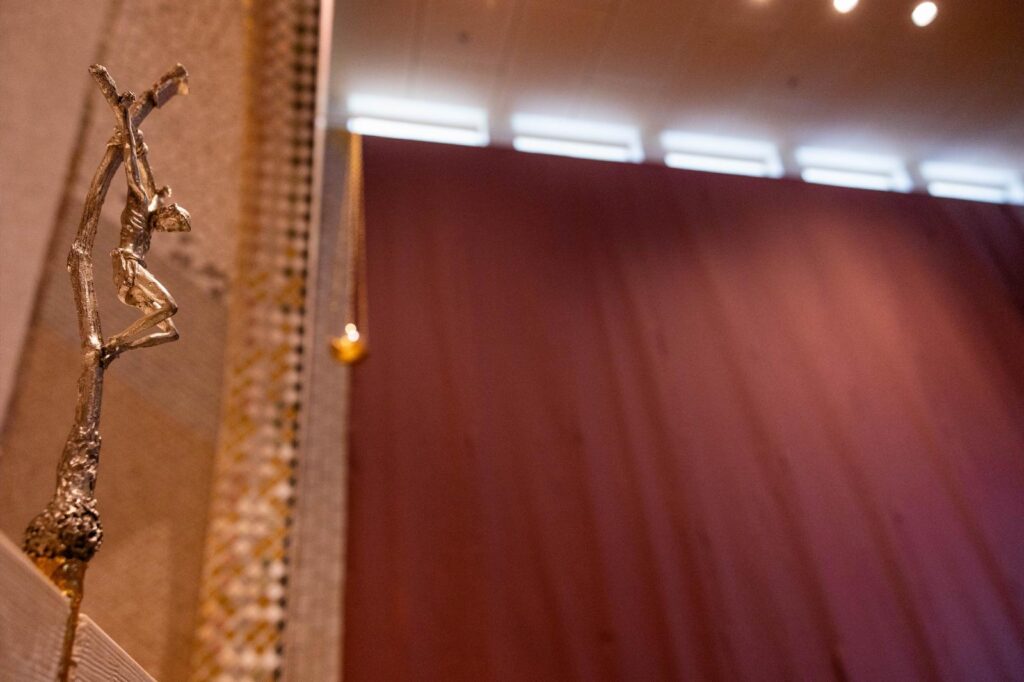
In the wake of the allegations, several shrines that featured his artwork, including the St. John Paul II National Shrine in Washington and the Holy Family Chapel at the Knights of Columbus’ headquarters in New Haven, Connecticut, as well as the basilica in Lourdes, opted to cover the mosaics out of respect for his alleged victims.
Others, including the Shrine of Our Lady of Fatima, said they were not considering removing his mosaics.
Vatican’s use of priest’s artwork
The Vatican also faced backlash as the Vatican News website and social media continued to feature Father Rupnik’s artwork in some of its articles, despite the alleged victims’ requests.
Attention on the perceived inconsistency grew when Paolo Ruffini, now the outgoing prefect of the Vatican’s Dicastery for Communication, defended the use, saying that removing Father Rupnik’s art from public space was “not a Christian response.”
Addressing communications professionals attending the Catholic Media Conference in Atlanta in June 2024, Ruffini argued that removing the artwork before a decision was made in the canonical proceedings was “not good.”
“Do you think that if I put away a photo of an art from … our website, I will be more close to the victims? Do you think so?” he pressed an OSV News journalist at the end of his answer. When an answer was given in the affirmative, Ruffini responded: “I think you’re wrong.”
Several days after Ruffini’s comments, Boston Cardinal Seán P. O’Malley, then-president of the Pontifical Commission for the Protection of Minors, called on the dicasteries of the Roman Curia to exercise “pastoral prudence” in displaying Father Rupnik’s artwork.
Such prudence, the cardinal said, would “prevent displaying artwork in a way that could imply either exoneration or a subtle defense” of a person alleged to have committed abuse, “or indicate indifference to the pain and suffering of so many victims of abuse.”
“Pope Francis has urged us to be sensitive to and walk in solidarity with those harmed by all forms of abuse. I ask you to bear this in mind when choosing images to accompany the publication of messages, articles, and reflections through the various communication channels available to us,” the cardinal said.
In spite of the recommendation, two days later, Ruffini’s office posted a photo of an icon created by Father Rupnik depicting St. Irenaeus of Lyon for its June 28 “saint of the day” feature on Vatican News.
Canonical trial preparations
The conclave that followed Pope Francis on April 21, 2025, delayed the canonical proceedings against Father Rupnik.
However, less than a month after Pope Leo’s election, Vatican News quietly removed Father Rupnik’s artwork from its website.
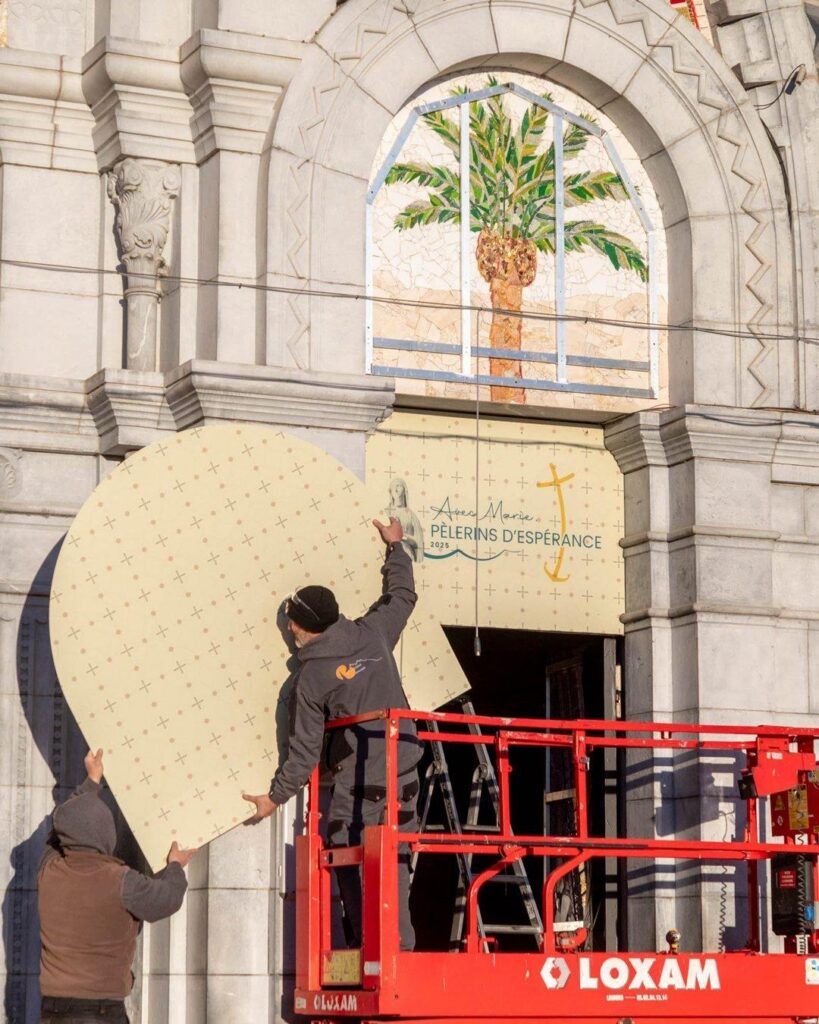
Ahead of Pope Leo’s apostolic trip to France Sept. 25-28, Bishop Jean-Marc Micas of Tarbes and Lourdes told the Paris Match weekly magazine that Pope Leo told him during their June 2025 audience that the pope “had given instructions to Holy See communications to no longer illustrate publications with Rupnik’s mosaics,” commenting that Pope Leo “is very determined on this issue.”
In July 2025, Cardinal Victor Manuel Fernández, prefect of the Dicastery for the Doctrine of the Faith, provided a significant update. Speaking to a group of journalists in Rome, the prefect revealed that a panel of judges had been established to oversee the canonical trial.
The panel, the cardinal said, “is made up of judges who are all independent and external to our dicastery.”
Three months later, the Dicastery for the Doctrine of the Faith released a statement saying that five judges were formally nominated to the tribunal.
“The panel of judges is composed of women and clerics who are not members of the Dicastery for the Doctrine of the Faith and who hold no office within any of the dicasteries of the Roman Curia,” the dicastery said in a statement published by the Vatican press office.
“This has been done in order to better ensure, as in every judicial proceeding, the autonomy and independence of the aforesaid tribunal,” it said. The communique did not reveal a formal date for the trial.
The naming of the judges was the last official update of the case until 2026.
A lack of information
On July 20, the Italian website Messainlatino.it, citing “persistent and highly authoritative sources,” reported that a verdict had been reached and that Father Rupnik was acquitted.
The rumor prompted Laura Sgrò, a civil and canon lawyer representing five of Father Rupnik’s alleged victims, to issue a letter to Cardinal Fernandez criticizing the DDF for the lack of information about the case, noting that neither she nor her clients were informed if the trial had even begun.
The lack of information, she wrote, was a “further violence against my clients, whose wounds are still raw and not even minimally healed.”
“They have never received any news, not even from me, about this trial, about which everything is whispered and certainly nothing is known,” she added.
The rumored acquittal prompted a statement from the Vatican press office, calling the reports “completely unfounded” and confirming that the canonical trial is still under review.
“During the proceedings, as with any judicial process, no information regarding the ongoing investigation may be shared in any way out of respect for the process itself and to avoid causing harm to all those involved in the matter, as has occurred in recent days,” said Vatican’s Press Office Director Matteo Bruni.
“Should the panel determine that it requires further information, it will take the necessary steps on its own initiative to obtain it,” he said.
While the statement provided the first official confirmation that the trial had begun, its outcome remains uncertain due to the secrecy of the proceedings.
Junno Arocho Esteves is an international correspondent for OSV News. Follow him on X @jae_journalist.
Updated Sept. 1, 2026, at 8:16 a.m. ET
