


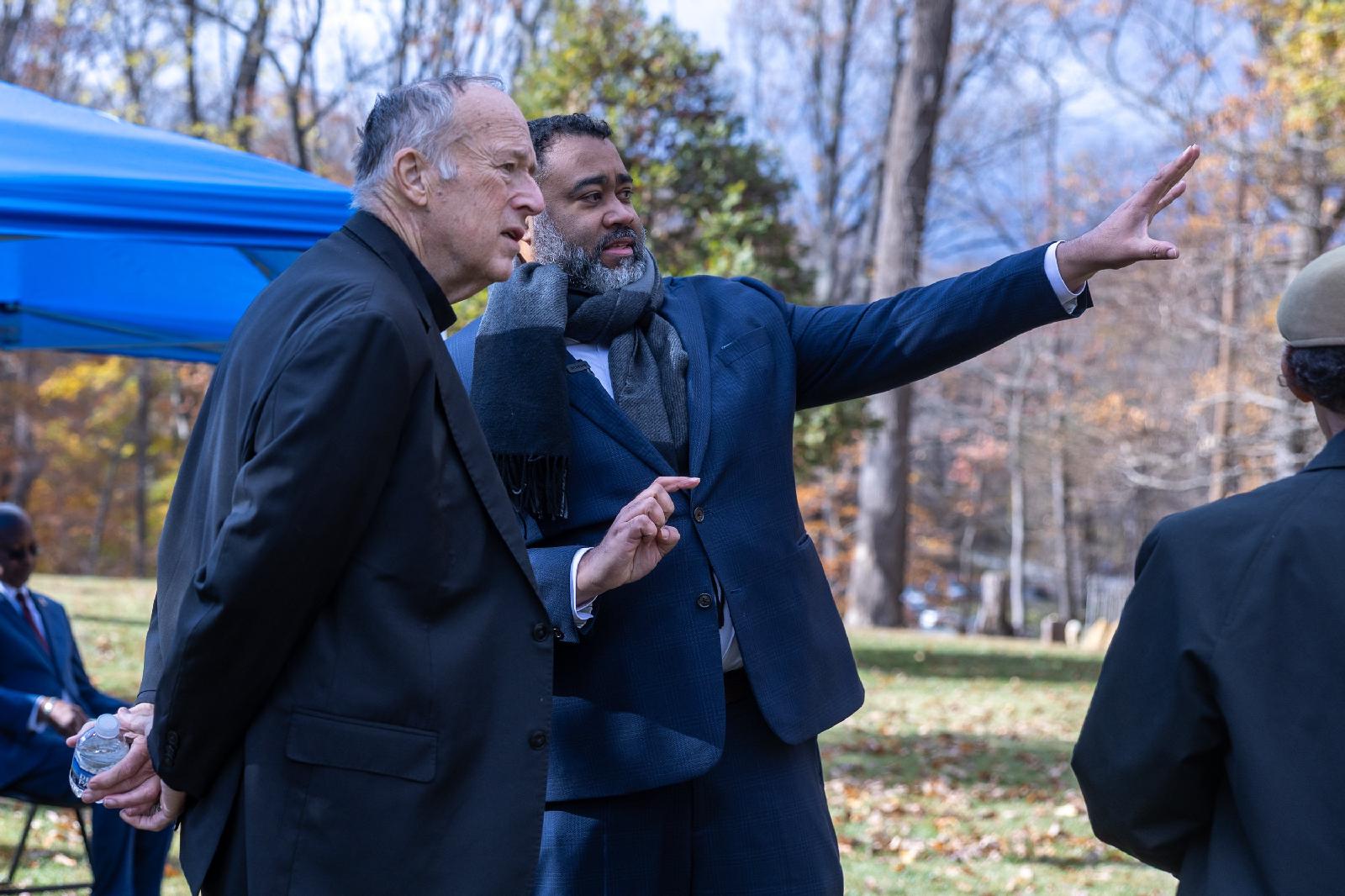
BOWIE, Md. (OSV News) — On June 19, 1838, the Maryland Society of Jesus signed an article of agreement to sell 272 enslaved men, women and children to two sugar plantation owners in Louisiana, a sale that helped ensure the financial survival of the Jesuits’ Georgetown College, now Georgetown University.
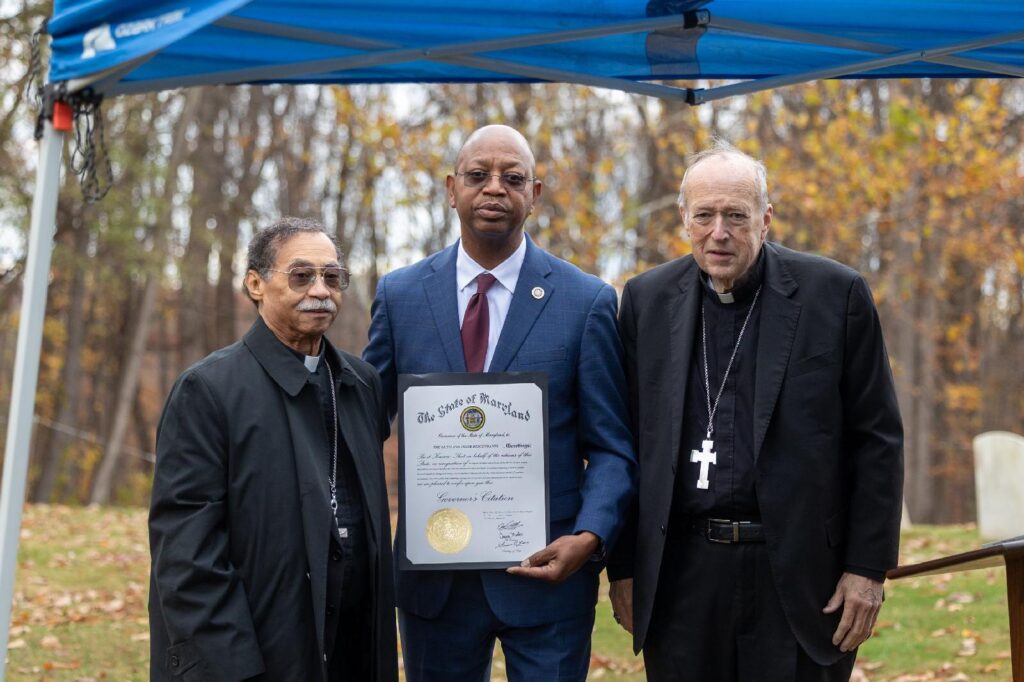
On Nov. 15, 2026, another document offered respect to those enslaved people that they had been denied in life and in death, as a citation from Maryland Gov. Wes Moore was proclaimed acknowledging “the dignity, strength and resiliency” of the GU272 and honoring them and their descendants.
Poignantly, the ceremony took place at Sacred Heart Cemetery in Bowie in an area that was once part of the Jesuits’ White Marsh Plantation, one of their seven missions in Maryland, where from colonial times through the first decades of the new United States of America until Emancipation, enslaved men, women and children lived, worked and died.
In recent years, archaeological surveys on that cemetery’s hillside have uncovered what are believed to be the unmarked graves of hundreds of enslaved people who once toiled at the White Marsh Plantation.
Governor’s citation notes infamous sale by Jesuits
At the ceremony, Maryland Delegate N. Scott Phillips, chairman of the state’s Legislative Black Caucus, read the governor’s citation, which noted the infamous sale by the Jesuits and said, “On this day, Maryland honors the GU272 and their descendants, whose lives, faith, labor, suffering, courage, and perseverance form an enduring part of the American story.”
The 1838 sale to help “extinguish the debt of Georgetown College,” generated $115,000, which would be equivalent to about $3.3 million today, Phillips said in his remarks.
“But the true cost of that transaction cannot be measured in dollars. It must be measured on the impact of those who were sold, those families that were separated,” he said. “Eighty-nine of those individuals came from right here, from these grounds. This is Maryland history, it’s Catholic history, it’s American history.”
History must be remembered and taught and never repeated, he emphasized. “I want to acknowledge that nothing that we do today will change the past, but it is an essential step toward healing, and it must always be accompanied by meaningful action,” said Phillips, who represents a district in Baltimore County
Introducing the delegate was retired Auxiliary Bishop Roy Campbell Jr. of Washington, who leads an initiative of the Archdiocese of Washington to honor those who were enslaved. The bishop noted that the enslaved died without recognition, but on that day, they were being honored.
Maryland State Sen. Ron Watson, whose Prince George’s County district includes Bowie, also offered remarks.
Gathering takes place ‘on sacred ground’
“Today we gather on sacred ground,” he said, “ground that holds not only the remains of those who came before us, but also the memories, sacrifices, prayers and untold stories of generations whose lives helped shape the Maryland that we know today.”
The 272 enslaved men, women and children in that 1838 sale were separated from their communities, their homes and their loved ones, he said. “But while history records that they were sold, we must never forget that their humanity was never for sale. They were not simply a number.
“They were mothers and fathers, sons and daughters, brothers and sisters. They had names, dreams, faith and aspirations for their children, the same as we do today. And although their freedom was denied, their dignity could never rightfully be taken away.”
Watson said that this year as the United States marks its 250th anniversary, while celebrating its triumphs, it must acknowledge its injustices, including how the promise that all people were created equal was denied to millions of Americans for generations.
He said the gathering that day should “be more than a commemoration. Let it be a commitment, a commitment to remember those whose voices were silenced, a commitment to honor the descendants who have worked to preserve their ancestors’ stories, and a commitment to ensure that the lessons of our past help shape a more just and compassionate future.”
Cardinal McElroy offers a prayer and a reflection
Cardinal Robert W. McElroy of Washington offered a prayer and a reflection at the gathering, after earlier that morning celebrating a special Mass at Sacred Heart Church for those who were enslaved at White Marsh, and blessing a plaque at the church to honor them.
The cardinal said that the ground where they stood had been made sacred by the lives of the enslaved who once endured “that soul-crushing institution” there.
He praised the legacy of the enslaved people who remained resilient while living through the barbarism of slavery.
Their spirit continues in their descendants, who “are the truest sign of what was there that they maintained, and they refused to give up, even amidst the darkness,” Cardinal McElroy said. “And so I welcome you all today as the true testimony of that community which lives on, and in this place, as we mark it today, this sacred ground, we remember always the lives, the hearts, the souls, the beauty which those who were enslaved managed to carve out despite the darkness which was visited upon them.”
Several descendants of the enslaved then reflected on their family stories.
Descendant of matriarchs, patriarchs of enslaved community
Kevin Porter, president and founder of the White Marsh Historical Society, recited the names of four of the first matriarchs and patriarchs of the enslaved community at White Marsh, generations before the 1838 sale.
“Nelly was a cook. Isaac was a blacksmith. Tom was a carpenter. Mary Queen was a domestic servant,” he said, adding, “They were my ancestors.”
Porter’s search for the names and stories of his enslaved ancestors led him to the Sacred Heart Cemetery, on part of the grounds of what had been the White Marsh Plantation, and spurred the archaeological work that uncovered what are believed to be the hundreds of unmarked graves on that hillside.
“Many of my ancestors are buried on this land. Most of their graves are marked with simple fieldstones. Only a handful bear their names,” he said.
“We still have work to do here at White Marsh,” he added. “My life’s mission now is to recover more names, tell their stories, and protect the grounds of their final resting place.”
‘A physical manifestation of my ancestors’
“I would like to stand here as a physical manifestation of my ancestors, and I call out their names. We’re on hallowed ground,” said Robin Proudie, the founder and executive director of Descendants of the St. Louis University Enslaved, whose ancestors were trafficked by the Jesuits from White Marsh to St. Louis to support the order’s mission there.
The work in uncovering the enslaved ancestors’ names and stories has also helped descendants restore connections with their present-day family members in other parts of the country.
“The restoration has begun,” said Proudie, who discovered that Kevin Porter is one of her cousins, and she has since visited the Sacred Heart Cemetery to see the abandoned graves on the hillside and honor her ancestors who lived and died at White Marsh.
Proudie said she uses money from her veteran’s pension to support her research on enslaved ancestors, and she encouraged Catholic Church officials to assist descendants in that effort. “We’re out here doing the work. … I would ask you to reach out and ask what we need. … We are all his (God’s) children, and he loves us all,” she said.
After the ceremony, several of the participants quietly walked the cemetery grounds and hillside, walking where the enslaved people of the White Marsh Plantation once lived, worked and were laid to rest.
Mark Zimmermann is editor of the Catholic Standard, the news outlet of the Archdiocese of Washington. This story was originally published by the Catholic Standard and distributed through a partnership with OSV News.
