


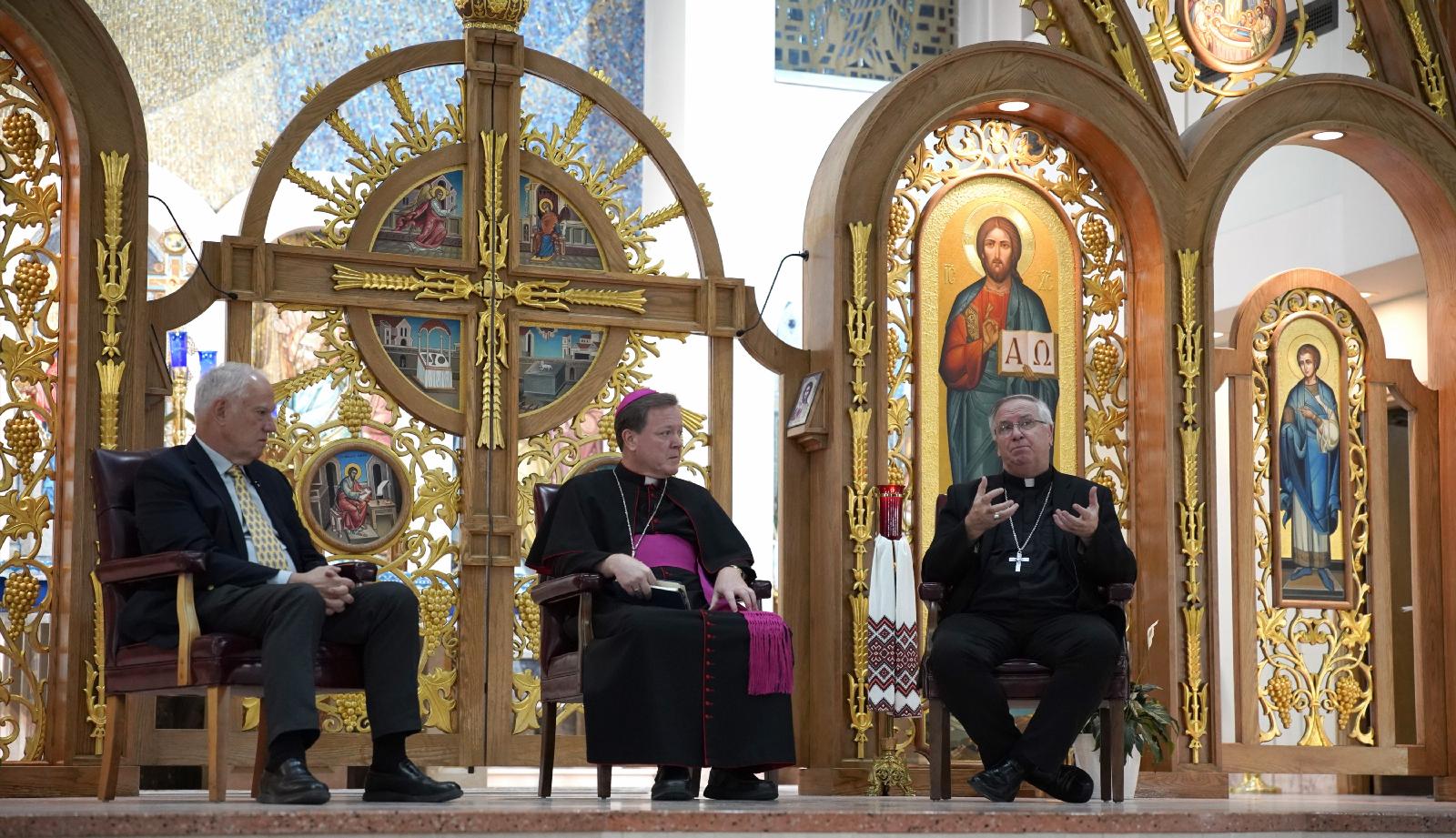
PHILADELPHIA (OSV News) — Through prayer, presence and collaboration with mental health professionals, the Catholic Church can seek to discover “deeper, newer ways to continue to bring God’s healing love and mercy to those who suffer, particularly with mental illness,” said Auxiliary Bishop Keith J. Chylinski of Philadelphia.
Bishop Chylinski, who holds a Master’s degree in clinical psychology, moderated a Nov. 19 roundtable on “Placing Mental Health in the Lord’s Hands,” hosted by Metropolitan Archbishop Borys A. Gudziak of the Ukrainian Catholic Archeparchy of Philadelphia.
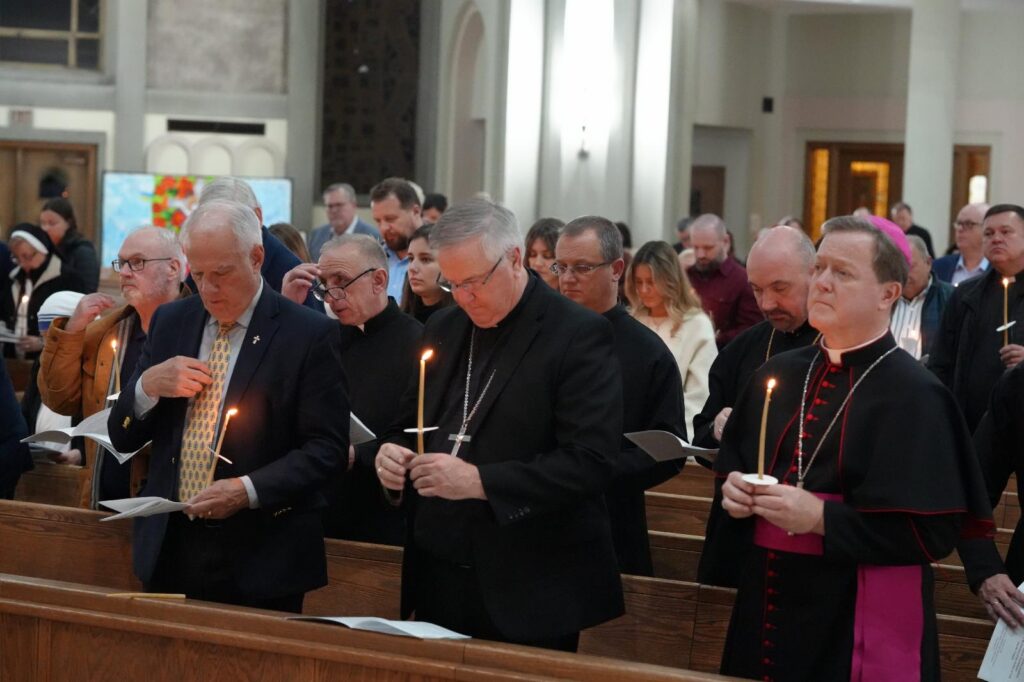
The gathering took place at the Ukrainian Catholic Cathedral of the Immaculate Conception following a vespers service and a presentation on the newly established Ukrainian Catholic Charities USA, the nation’s first Eastern Catholic charities organization. Prayer for healing and individual anointings of participants with sacred oil followed the discussion.
Described as “An Evening of Prayer and Reflection on Mental Health Ministry,” the roundtable featured panelists Bishop John P. Dolan of Phoenix and Deacon Edward Shoener of the Diocese of Scranton, Pennsylvania, president of the International Association of Catholic Mental Health Ministers.
A widespread mental health problem that hits home
According to the National Alliance on Mental Illness, more than one in five U.S. adults experience mental illness each year, with more than one in 20 each year reporting serious mental illness issues.
In addition, chronic stress has become “part of the baseline” for many U.S. adults, according to an October report by the American Psychological Association. In April, Gallup estimated 51 million Americans currently suffer from depression.
In their respective mental health ministries, both Bishop Dolan and Deacon Shoener have drawn on devastating personal experiences they have publicly disclosed over the years.
Bishop Dolan has lost four family members — his brother, two sisters, and his brother-in-law — to suicide.
In 2016, Deacon Shoener’s 29-year-old daughter Katie took her own life, following a long battle with bi-polar disorder. The deacon revealed her illness and cause of death in an obituary that gained international attention for its candor about mental health awareness.
During the roundtable, Bishop Dolan said that his mental health ministry provides him with his own “level of healing.”
Mental illness is not ‘a failure of faith’
He stressed the importance of neither cloaking mental health issues nor deeming them “a failure of faith.”
Bishop Dolan described the devout faith of his deceased siblings, especially his sisters, who regularly prayed with fervor and devotion.
Such faith coexists with the real “struggle” inherent in mental health issues, he said.
“That’s why we continue to seek all the assistance we can,” while “finding benchmarks of hope,” said Bishop Dolan, whose diocese has a dedicated Office of Mental Health Ministry, as well as a partnership with the University of Mary to form counselors grounded in Catholic teaching on human dignity.
Deacon Shoener said he attributed his ministry “to the work of the Holy Spirit.”
In addition, he expressed his hope that “one day, when someone is facing a mental health challenge or illness, they will think (about consulting) the Catholic Church” because of its understanding, awareness and compassion.
Faith, psychiatry and psychology “go together,” he said.
Bishop Chylinski reflected that “as human beings, we’re a mysterious union of both flesh and spirit in one person.”
Just as medical science is seen as “a gift from God,” so too are resources for treating persons with mental health issues, he said.
“It’s ‘both-and,'” rather than a mutually exclusive choice, said Bishop Chylinski.
Telling the story, overcoming stigma
Bishop Dolan encouraged dioceses and eparchies to launch mental health ministries, providing links to clinical resources as well as places and occasions for accompaniment.
Deacon Shoener also highlighted the problem of “self-stigmatization,” which he described as “a large part of our problem.” He urged those experiencing mental health issues to seek care just as they would for physical ailments.
“There’s no shame in going to your doctor,” he said.
“When we’re able to tell our story,” others are emboldened to open up about their own anxieties, said Bishop Dolan, adding, “When we communicate, we begin the process of healing.”
That goes for clergy as well, said the roundtable panelists.
Suicide among clergy “does happen in the U.S. and around the world,” said Deacon Shoener, who underscored the need to “be aware that clergy too have mental health issues” and need assistance.
“We are flesh and blood like everyone else,” concurred Bishop Chylinski. “It’s so important for us to acknowledge that.”
‘We can do our part’
Speaking to OSV News after the roundtable, Bishop Chylinski — who had previously served as rector of the Archdiocese of Philadelphia’s St. Charles Borromeo Seminary, now located in Ambler, Pennsylvania — said today’s seminarians and future priests “see the value of good mental health ministry, particularly when counselors are very well-formed in Christian anthropology.”
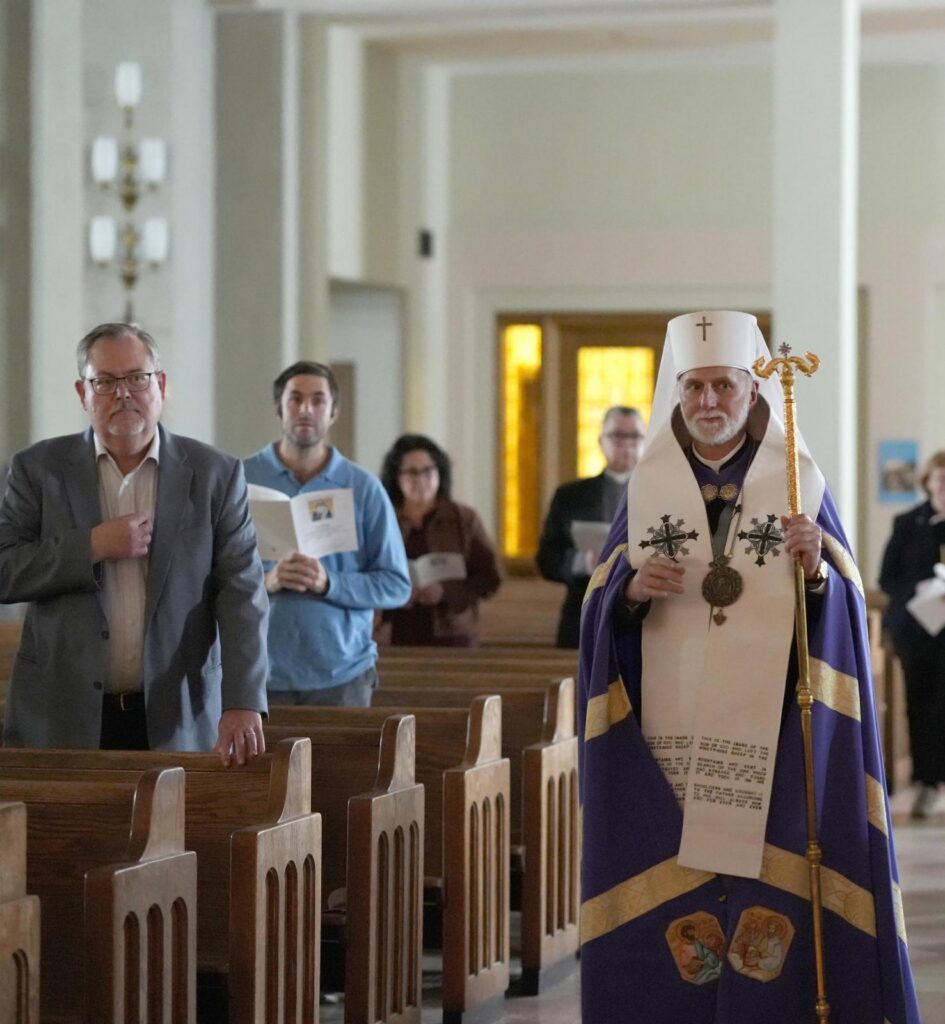
Archbishop Gudziak told OSV News that among “a number of impetuses” for his longstanding efforts to raise mental health awareness in the Church was his friendship with the late psychologist and spiritual author Father Henri Nouwen.
“That opened up for me the sometimes necessary cooperation between the fields of spiritual accompaniment and psychological therapy,” explained Archbishop Gudziak, who along with Bishop Robert E. Barron of Winona-Rochester, Minnesota, was the inaugural co-chair of the U.S. Conference of Catholic Bishops’ National Catholic Mental Health Campaign.
“Aside from the organic causes, one of the greatest causes of mental health (issues) is the belief that we’re alone, and we’re not loved by God and by others,” said Bishop Chylinski in his roundtable remarks. “We are loved. We were loved into existence.”
Nurturing an awareness of that love in others, while supporting them in their mental health journey, is a lifelong task, said Bishop Dolan.
“I don’t think we will ever eradicate or prevent suicide … just as Catholic Charities will never eradicate hunger,” he said during the roundtable. “But we can do our part; accompaniment is a very big part. We will still do our very best.”
If you are experiencing mental health distress, call 911 for emergency assistance, or contact the 988 Suicide and Crisis Lifeline by dialing or texting 988.
Gina Christian is a multimedia reporter for OSV News. Follow her on X @GinaJesseChristian.
