


Lately, instead of greeting the day with “thank you, Lord, that I get to have another one!” I rise with a cranky growl, mentally grousing at God and giving the saints a bit of Irish lip, too.
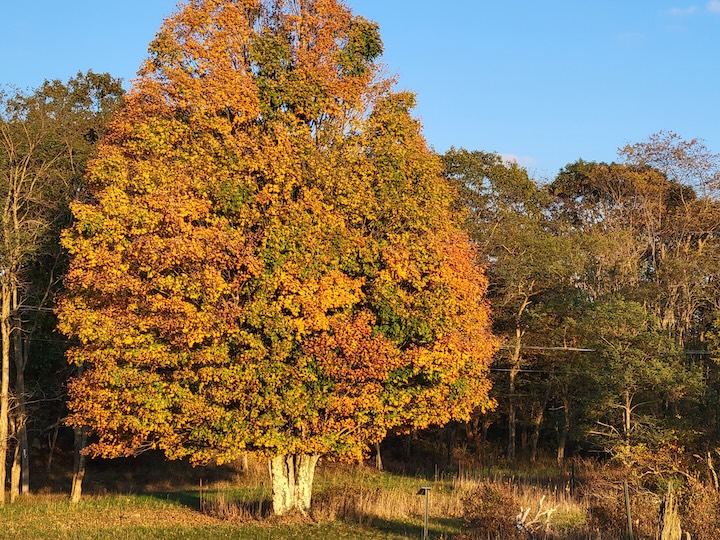
Autumn, my favorite season, is partly to blame. I tell myself that I’m cranky because what delights me in October — sharp air, warm sweaters and breathtaking foliage — will disappear so swiftly into dreary November.
But the truth is I also like November, which author Rumer Godden called a month of “howling winds and holy souls.” I look forward to the apocalyptic Mass readings that close the liturgical year with such a bang. It warms me that we begin the month with an obligation to prayerfully remember our spiritual ancestors while the world just spins on in its worldly way.
I love exiting that Mass to a world of falling leaves; they crunch under our feet and ride delightfully on the breezes, bringing to mind both Winnie the Pooh, who celebrated a “rather blustery day,” and St. Hildegard of Bingen, who described herself as “a feather on the breath of God.”
Anxiety and trust
Those are two terrific analogies for what we should aspire to, as Christians: to see (like the Pooh-bear) something wonderful in the brown time, when trees are going bare, their exposed branches resembling arms raised in supplication against the fading light; to blow (like the saint) swiftly to wherever God wishes us to be, and to settle there — lightly — trusting (as St. Teresa of Avila wrote) “that you are exactly where you are meant to be.”
Trust is hard, sometimes. We look at the state of the world, or at difficult circumstances in our lives, or the lives of those we love, and it feels easy to give in to discontent — to kvetch at God (which is a kind of prayer) and to cast a wary eye at the saints with a flippant, “and what have you done for me, lately?”
We feel sorry for our stressed-out selves, ignored, impotent and abandoned, and linger at these lines from Psalm 102: “I have become like a lonely pelican in the wilderness, like an owl in desolate places. I lie awake and I moan like some lonely bird on a roof.”
Hildegard lived and died long before Teresa and yet both of those monastic Doctors of the Church breathed the same spiritual sentiment against stress and irritability; rather than banging on about circumstances we rarely can do much to change (although it cannot be said too often that prayer is real action), we do best when we settle in — trusting that our lives are moving in God’s direction, in God’s time — and enjoying the blustery or serene seasons as they come, because they are all meant for us, for everyone, for all creation.
Psalm 102 ends brilliantly: “Long ago you founded the earth and the heavens are the work of your hands. They will perish but you will remain. They will all wear out like a garment. You will change them like clothes that are changed. But you neither change, nor have an end.”
That’s an instructive reminder of the futility of our daily anxieties and that (again from St. Teresa), “all things are passing” as the world (and you and I) and all creation do constantly renew: Once Autumn has reached absolute fullness and becomes incapable of being more of itself, the season wanes.
Cooperation with God
Then, inexorable winter comes, eventually reaching its own culmination, too — becoming wholly and fully winter, until it can be winter, no more, and splendid spring must follow. There is such hope in fitting ourselves to that reality as God arrays himself in the grandeur of all of it, wears it, and wears it out, like garments needing changing.
And that is us, as well. If we are to be Christ to each other, a presence of God that is love, mercy and justice, then our whole lives are, like autumn, then winter, then spring, a quest to become wholly and fully ourselves, until we cannot be more of what we are, and must evolve, so that God may array himself in us, and then wear us, until — if we are true saints — we are worn out.
If we can remember and trust in that (and remember, too, that prayer is powerful, genuine action in co-operation with God), we should be able to get through things without too much grousing, after all.
Elizabeth Scalia is editor-at-large for OSV. Follow her on X @theanchoress.
